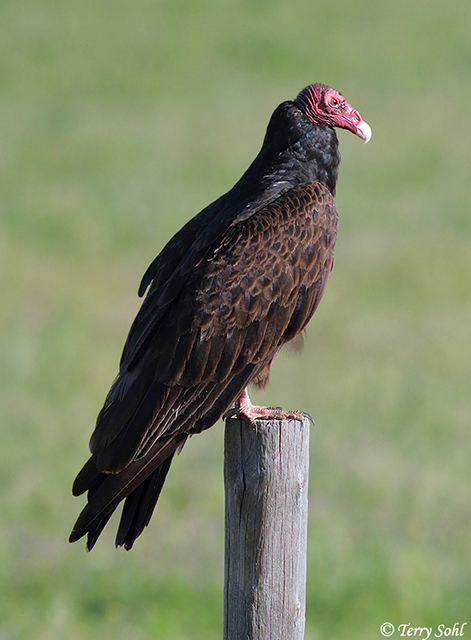
The Turkey Vulture is a carrion feeder most often seen in flight, soaring on thermals as it searches for food, rarely needing to flap its wings. They often congregate and forage around highways where roadkills are frequent, and can often been seen flapping away from a roadkill carcass upon a car's approach, only to return when the car has passed the delicious meal. They use a very strong sense of smell to locate carrion.
Habitat
Turkey Vultures can be found in a very wide variety of open and semi-open habitats. They avoid dense unbroken forest, and prefer nesting and roosting sites within a few miles of foraging sites.
Diet
The diet of a Turkey Vulture consists almost exclusively on carrion, feeding primarily on mammals, but they're not picky, and will forage on any dead creature they come across. They're not equipped for hunting, and unlike their cousins the Black Vulture, they never attack live prey.
Behavior
Turkey Vultures are most often seen soaring over open or semi-open country in search of carrion. Carrion may be found by either sight or smell. They are sometimes seen on a perch with their wings spread, which is thought to be either for thermoregulatory control, or to dry the wings.
Nesting
May through July. The nest of a Turkey Vulture is usually just a site on a rocky ledge, a cliff, a hollow in a tree, or sometimes in or on a man-made object like a building or tower. No formal nest is built on the site, other than sometimes a few bits of debris. The female usually lays 2 eggs, and both parents help to incubate them. When the eggs hatch, both parents help to feed the young by regurgitation. The young fledge after about 10 weeks.
Song
Generally silent, as Turkey Vultures don't have the physiology to make vocalizations like most birds. On carcasses a hissing sound is sometimes heard.
Migration
Permanent resident in much of the southeastern U.S., but northern populations migrate as far as South America in the fall.
Interactive eBird map
Click here to access an interactive eBird map of Turkey Vulture sightings
Similar Species
If seen well, Turkey Vultures have a unique appearance, but in flight or from a distance, Turkey Vultures could potentially be confused with the following species:
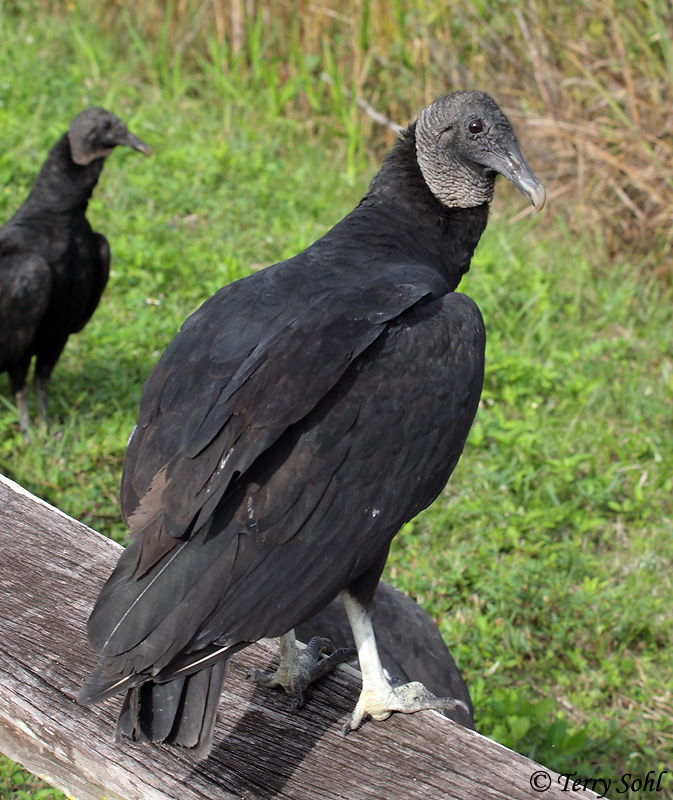
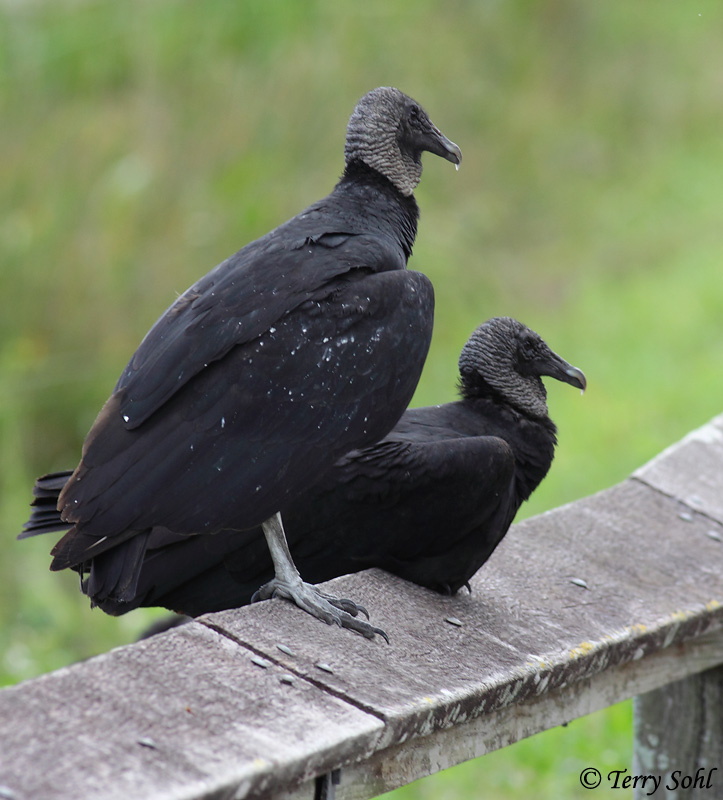
- Black Vulture - The nearest relative in the United States, Black Vultures are primarily found in the southeastern United States, and have yet to be seen in South Dakota. In their range, Black Vultures can be differentiated from Turkey Vultures by the head color, as Black Vultures have a black head, and Turkey Vultures have a reddish head. In flight, the two species can also be easily distinguished, as Black Vultures have black wings with white primary flight feathers at the wing tips, while Turkey Vultures have black inner wing linings all all white primary flight feathers.
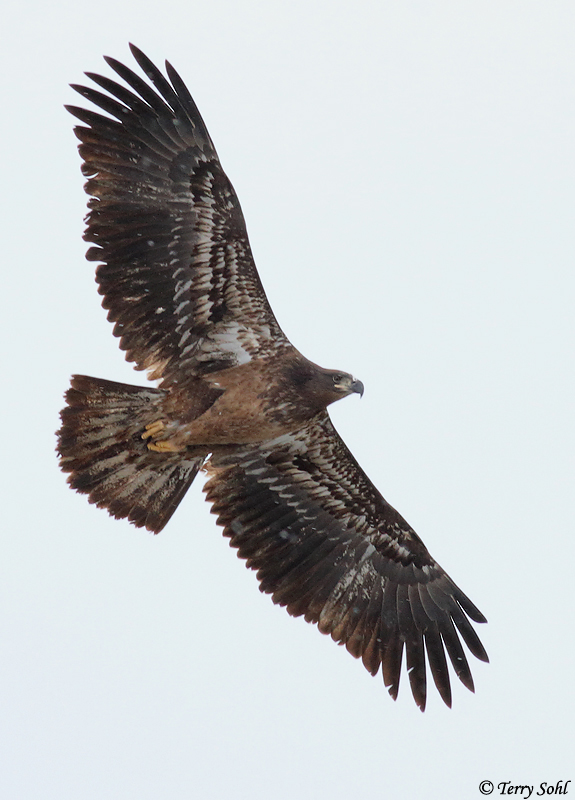
- Bald Eagle - Mature Bald Eagles are unlikely to be confused with a Turkey Vulture, as the white head and tail are diagnostic and quite different than a Turkey Vulture's plumage. Immature Bald Eagles are mostly dark, however, and could be confused with a Turkey Vulture, particularly in flight. However, immature Bald Eagles are dark underneath with white speckling throughout the plumage, while Turkey Vultures are uniformly black with strongly contrasting completely white primary flight feathers.
- Zone-tailed Hawk - Zone-tailed Hawks are a raptor of the southwestern US, where they are known for mimicking flight patterns of Turkey Vultures. However, a check of a "vulture" in flight might reveal a Zone-tailed Hawk, similar in appearance in flight, but with white banding across the tail, and primary flight feathers that are lighter than the dark wing linings, but have a barred pattern (compared to clean white flight feathers of a Turkey Vulture).
 |
 |
 |
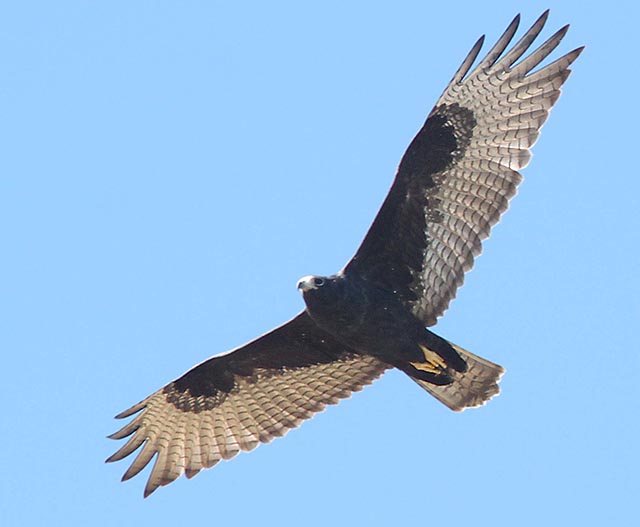 |
| Black Vulture | Black Vulture | Bald Eagle (immature) | Zone-tailed Hawk |
Feeders
Will attend feeders for deer carcass and assorted roadkill (Just kidding!!)
Status
Systematic surveys in have shown modest increases in numbers over the last few decades. They are found across a very broad geographic area, and are common in parts of that range. Overall populations are not threatened, and the IUCN lists the Turkey Vulture as a species of "Least Concern".
Photo Information
May 19th, 2016 - Lincoln County, South Dakota - Terry L. Sohl
