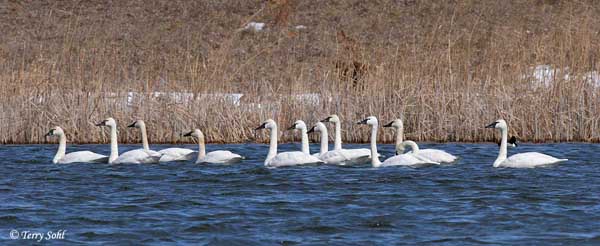
Well named, the Tundra Swan is a large white swan that breeds on Arctic tundra wetlands across northern North America. It migrates long distances between its Arctic nesting grounds and wintering areas along the Atlantic Coast, Pacific Coast, and interior regions of the United States. Tundra Swans feed primarily on aquatic vegetation, roots, tubers, grains, and other plant material gathered in wetlands and agricultural fields. They are highly social and often migrate in family groups or large flocks, producing distinctive musical calls while in flight. The North American race is often called the "Whistling Swan", while the Eurasian race is often called "Bewick's Swan". This is the most widespread and common of the swans normally found in North America.
Habitat
Its summer breeding grounds are the lakes and ponds of the North American tundra. During migration and the winter months, is most often found on shallow lakes, ponds, and estuaries, often in the vicinity of agricultural fields.Diet
Primarily feeds on the seeds, roots, and stems of aquatic plants. Will also eat large amounts of waste grain in harvested fields, as well as the occasional small invertebrate.Behavior
Forages both on land and in the water. In the water, forages by swimming on the surface and either grabbing food items from the surface, or by dipping its head and neck below the water for good. As with some other waterfowl species, they have learned to take advantage of waste grain left behind in agricultural fields, and will rely heavily on such food sources during migration and in winter.Breeding
Non-breeder in South Dakota. The Tundra Swan nests on Arctic tundra near ponds, lakes, marshes, and coastal wetlands. The pair builds a large mound-like nest of grasses, sedges, mosses, and other vegetation on slightly elevated ground, often close to water. Typical clutches contain 3–6 eggs, and both adults vigorously defend the nesting territory while the female performs most of the incubation.Song
The Tundra Swan gives clear, musical, high-pitched honking calls often described as mellow hoo-hoo notes. These vocalizations are generally higher and more melodious than those of the Trumpeter Swan and are frequently heard from migrating flocks flying overhead.
