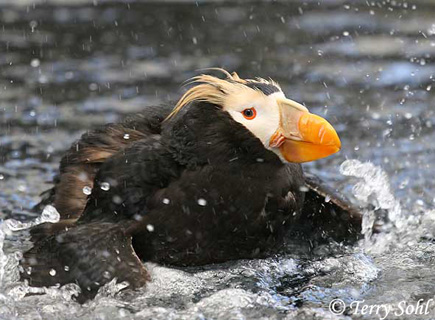
Tufted Puffins are easy to differentiate from their close cousins, the Horned Puffin, despite the overlapping range. Obvious, loose tufts of yellow feathers are a distinguishing feature, particularly in the summer months. They have a much wider breeding range than Horned Puffins, with nesting colonies found as far south as the coastline of northern California. Both species scatter widely across the northern Pacific during the winter months.
Habitat
Breeds on offshore islands in the north Pacific, usually on the tops of cliffs or on grassy slopes. Some birds during breeding season can also be found far from shore in the open Pacific. After the breeding season, birds disperse widely and are typically found on the open ocean.Diet
Fish makes up a majority of the diet, with capelin and sand lance particularly preferred. They will also feed on crustaceans and mollusks.Behavior
Food is acquired by swimming underwater and capturing fish and other prey with their beaks. Both adults will forage for fish for their young, sometimes foraging far from the nesting colony and not returning for a day or two. Nesting burrows are often re-used by mating pairs for multiple years.Nesting: Tufted Puffins often use islands with grassy areas and loose soil for nesting, and will dig nesting burrows up to 8 feet deep. Other nesting areas sometimes include rock crevices or under a bush in heavy vegetation.
Song
Tufted Puffins are generally a quiet species. Birds at sea are silent, while birds at nesting colonies are generally restricted to occasional low groans.Migration: After the breeding season, most birds
disperse far out to sea. Birds in the northern part of the range,
particularly those in the Bering Sea, likely move south during the coldest
months.
Interactive eBird Map
Click here to access an interactive eBird map of Tufted Puffin sightings
Similar Species: Horned Puffin , Atlantic Puffin Conservation Status: Breeding populations in the southern part of the range, particularly in northern California, have declined sharply, likely in response to the introduction of predators such as rats to the islands used for breeding. However, Pacific-wide populations are strong, with an estimate of over 1 million breeding birds in Alaska. The IUCN considers the Tufted Puffin to be a species of "Least Concern". Further Information: 1) WhatBird - Tufted Puffin
2) Alaska SeaLife Center - Tufted Puffin
3) Audubon Guide - Tufted Puffin
