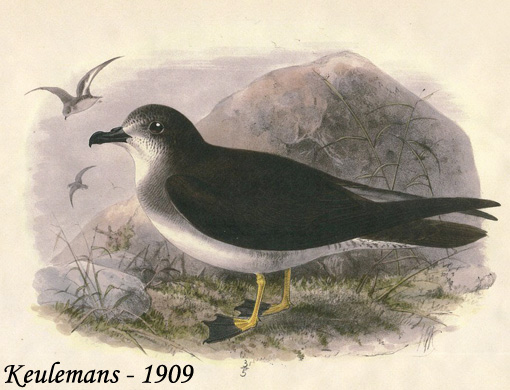
ID Keys: Short stubby bill. Two color morphs, dark is all dak,
light is dark above, lighter below.
The
Herald Petrel has a confusing taxonomy, with different sources offering
different opinions on status as a species. The Pterodroma
arminjoniana described here is restricted to a few breeding islands in
the South Atlantic, but has been a rare but relatively regular vagrant to
the north Atlantic off the coast of the Carolinas. This population is
also known as the Herald Petrel, but the Trindade Petrel is named for an island group where it
breeds. What some consider the true "Herald Petrel" is Peterodroma
heraldica, a bird of the Pacific Ocean. A darker-looking version of the
Pacific "Herald Petrel" is Peterodroma atrata. The three
individual populations have all carried the moniker "Herald Petrel", and
taxonomy is still in dispute. The Herald Petrel was originally named
by the naturalist who first identified it, who named it after the HMS
Herald, the ship he was traveling on at the time.
Habitat
Breeds on the Trindade and Martin Vaz
islands off the coast of Brazil. Pelagic outside of breeding, often
found far out to sea, but also sometimes found relatively near coastlines.
Diet
Feeds on squid, crustaceans, and small fish.
Behavior
Forages by flying over the water's
surface, dropping down to skim prey items from the surface or just below the
surface, then resuming flight and consuming the prey while flying.
Nesting
The Trindade Petrel doesn't build a nest,
but lays a single egg in a rock crevice or cavity. Both parents help
to incubate the eggs, and both tend to the young and feed it upon hatching.
Song
Generally silent while away from breeding
colonies. Makes whinnying sounds on the breeding grounds.
Migration
Breed on a handful of islands in the
south Atlantic ocean, off the coast of South America. After breeding,
wanders widely across the Atlantic, with evidence that they may regularly
wander to some parts of the North Atlantic.
Very similar to Murphy's Petrel, but that species is found in the Pacific
basin. Also possibly confused with the
Black-capped Petrel, or Fea's
Petrel.
Conservation Status
The nesting range of the
Trindade Petrel is very small, and introduced predators have negatively
impacted breeding populations. The global population is low, with a
total population likelyi below 20,000.
The
IUCN lists the Trindade Petrel as a "Vulnerable" species.
Image Information
Image
from Godman's 'Monograph of the Petrels', 1909. Plate by artist John
Gerrard Keulemans, 1842--1912. Copyright expired in the U.S., public
domain image.