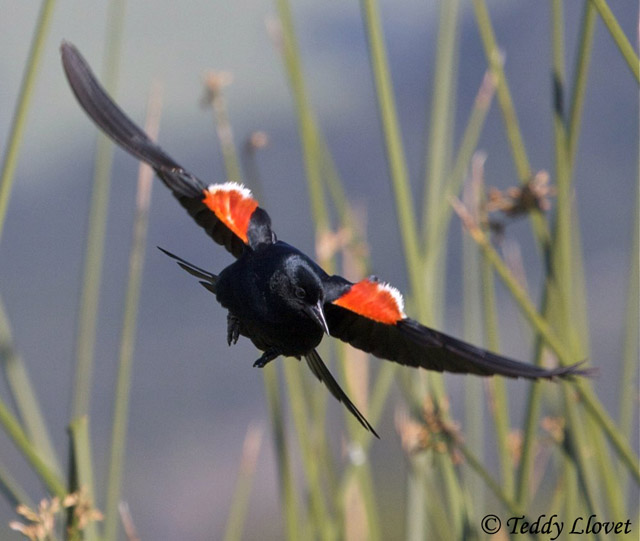
ID Keys: Males black overall, dark red lesser coverts with white
median coverts. Females similar to Red-winged Blackbird females, but with less warm tones.
The
Tricolored Blackbird is a close relative of the
Red-winged Blackbird, with
primary identification difference being a whitish stripe on the median
coverts of the Tricolored Blackbird compared to a yellowish stripe on a
Red-winged Blackbird. Tricolored Blackbirds have a very limited
geographic range, with most birds found nesting in the central California
Valley. Populations have sharply declined in recent decades as wetland
habitat in their breeding range has been lost. In addition, breeding
birds in agricultural areas often exhibit complete breeding failure when
agricultural fields are harvested. Other potential reasons for the
decline of the species include pesticide use and killing of birds as
agricultural pests.
Habitat
Found in large freshwater marshes during
the summer breeding season. At other seasons, can be found in a
variety of open habitats where foraging opportunities exist, such as farm
fields, pastures, wetlands, and grasslands.
Diet
Feeds heavily on insects and spiders during
the summer months. Also feeds heavily on seeds and waste grain,
especially during the winter months.
Behavior
Most foraging is done while walking on
the ground. Gregarious, usually found foraging with other Tricolored
Blackbirds, or other blackbird species.
Nesting
The nest is a cup of wetland vegetation
and grasses, built in vegetation at the wetland edge (often using cattails).
The female lays between 3 and 5 eggs, and she alone incubates them.
Upon hatching, both parents help to feed the young, who leave the nest
within 2 weeks.
Song
Song of a Tricolored Blackbird is a harsh
descending gurgling series of notes.
Migration
Considered a permanent resident
throughout much of its range. However, some birds at the far northern
edge of their range will move southward a short distance for the winter.
Populations may also move short distances in response to local foraging
opportunities.