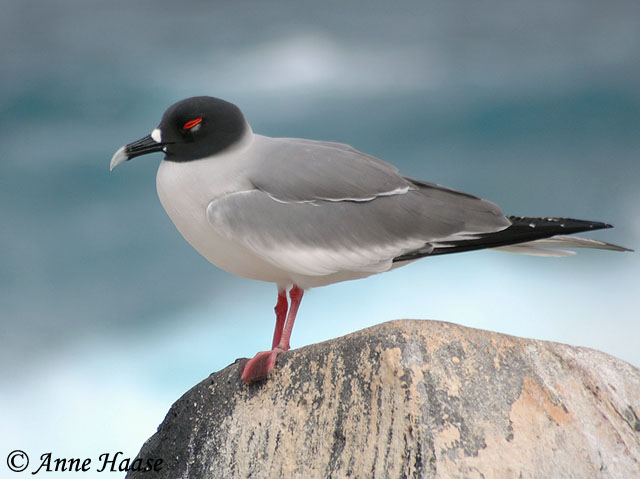
ID Keys: Breeding Plumage: Dark head, long black bill with gray tip,
red orbital ring, gray upperparts, white underparts. In
non-breeding plumage, the head is white, and the orbital ring is
black.
The
Swallow-tailed Gull is a beautiful, medium-sized gull of the Galapagos
Islands. Nearly all birds breed in the Galapagos, with just a few
breeding records off the coast of Columbia. They are only known in
North America from a single bird, found on coastal California in 1985.
Even non-breeding birds spend their time around the Galapagos, with smaller
numbers found along the west coast of South America. Given their
normal breeding and non-breeding ranges, it is not a species that you would
reasonably expect to find in North America again. They are one of the
most nocturnal of all gull species, and have large eyes adapted to feeding
at night.
Habitat
Found on rocky slopes and cliffs of the
Galapagos Islands when breeding. Non-breeding birds are pelagic, and
may be found well off the coast of South America.
Diet
Feeds on squid and small fish that are near
the ocean's surface at night.
Behavior
Foraging is done by flying above the
water's surface and dipping down to capture food items, or swimming on the
water's surface and grabbing squid and fish that come into range.
Nesting
The Swallow-tailed Gull has unusual
nesting habits. Some birds will be found breeding at all seasons in
the Galapagos. It is thought that Swallow-tailed Gulls have 9-month
nesting cycles, with pairs returning to nest every 9 months. The nest
itself is a collection of pebbles, coral, and other items with a depression
in the center, placed on a rocky ledge. Unlike most gull species, the
female lays only a single egg, and both parents help to incubate it.
Upon hatching, both parents help to feed the young, with the non-brooding
parents in the colony leaving at dusk to hunt for fish and squid at night.
The young birds first attempt to fly after about 2 months, but typically
stay around the breeding colony for another month until fully fledged.
Non-breeding adult birds and juvenile birds disperse, living a pelagic
lifestyle until it is time to return to the breeding grounds.
Song
The most commonly heard call is a gurgling
alarm call, often picked up and repeated by many individuals once one bird
begins calling.
Migration
Breeding birds are found around the
Galapagos Islands at all seasons, but individual pairs are continuously
rotating in and out of breeding areas. Non-breeding birds are pelagic,
with most found well off the coast of western South America.