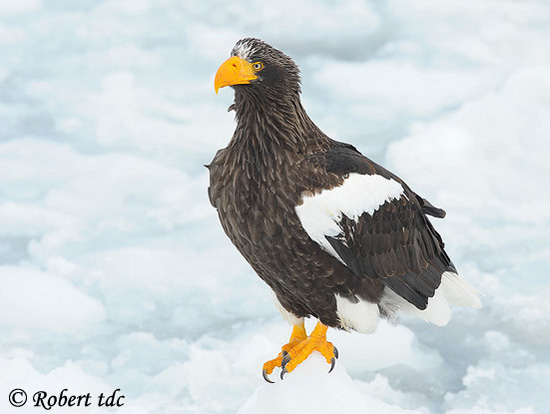
ID Keys: Massive size, dark overall, powerful and large orange bill,
white shoulders and tail
The
Steller's Sea-Eagle is a massive and powerful raptor of northeastern Asia,
this species has wandered a few times to North America, with strays found
along the Alaskan coast on occasion. They are one of the largest
raptors in the world, reaching weights of close to 20 pounds with wingspans
of over 8 feet. Like the Bald Eagle of North America, Steller's
Sea-Eagles, often congregate on river systems in the fall to take advantage
of massive numbers of dead salmon that have spawned.
Habitat
During breeding season in northeastern
Asia, Steller's Sea-Eagles either will nest along coastlines, or along
rivers with adjacent mature forest land. During migration and in
winter, they are often found on coastlines, rivers and water bodies around
Japan, and even on the open sea-ice. Some birds also move to
mountainous regions in the winter, where they evidently feed heavily on deer
that die during harsh winters.
Diet
Steller's Sea-Eagles feed heavily on fish,
and also will take many water birds, including birds as large as cranes,
geese, and swans. They will also opportunistically feed on a variety
of mammals, squid, crabs, carrion, and even young seals.
Behavior
Steller's Sea-Eagles forage by observing
from a perch, or flying, diving to grab a fish or other prey item in their
powerful talons. They will also steal fish and other prey from other
bird species, or feed heavily on dead fish, dead dear, or other carrion when
the opportunity arises.
Nesting
Steller's Sea-Eagles build massive stick
nests, either on a cliff or in a large tree. Both parents help to raise the
young.
Migration
Some birds are non-migratory,
especially those that nest along coastlines. However, other
birds do migrate, with some birds moving to Japan or Korea, and others
making altitudinal migrations.
The IUCN lists the Steller's
Sea-Eagle as "Vulnerable". Populations have been moderately declining
due to habitat loss. They are also susceptible to lead poisoning, as
they will readily feed on deer and other carrion that have been shot by
hunters. Total global populations are likely well below 10,000.