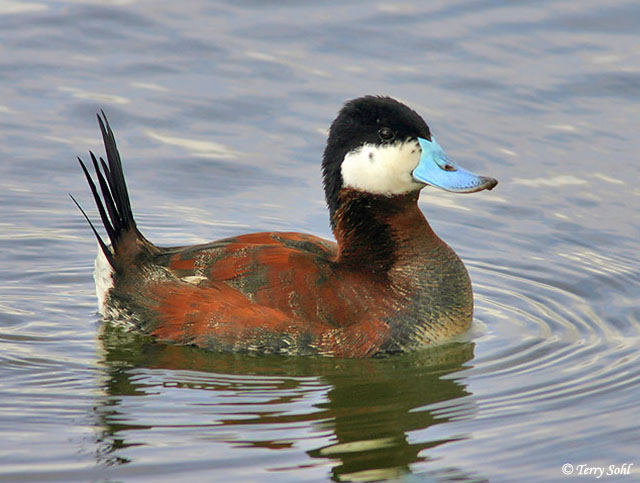
A unique small duck, readily identifiable by the male's bluish bill (in breeding plumage), white face, and long, stiff, upright black tail (See photo at the right). Ruddy Ducks are often reluctant to fly, and when disturbed, often will sink below the surface and swim away underwater like a grebe rather than fly away. They are nearly incapable of walking on land, with legs and feet set very far back on the body. Ruddy Ducks are generally relatively tame, making the species susceptible to hunting pressures. From a birding perspective however, they're generally more approachable than many waterfowl.
Habitat
The Ruddy Duck inhabits shallow marshes, prairie potholes, ponds, and lakes with extensive cattails, bulrushes, and other emergent vegetation. During migration and winter it also uses larger lakes, reservoirs, estuaries, and coastal bays where open water provides suitable feeding and resting areas.
Diet
The Ruddy Duck feeds mainly on aquatic insects, insect larvae, crustaceans, snails, and other small aquatic invertebrates captured while diving. It also eats seeds, roots, and other parts of aquatic plants, especially during migration and winter.
Behavior
Forages by diving and swimming underwater. It uses its bill to pluck mud from the lake bottom, straining the mud to obtain food items contained within.
Nesting
June and early July in South Dakota. The female builds a bowl-shaped nest of dead cattails, reeds, and other vegetation, placed and anchored in dense wetland vegetation. The nest is usually placed a few inches above the water's surface, and often has surrounding vegetation pulled down over the nest bowl, forming a canopy. The female lays between 4 and 15 eggs, and she alone incubates them. The young hatch after about 24 days. The young leave then nest within a day of hatching and are self-sufficient, feeding themselves and even being capable of diving underwater for safety soon after hatching. However, the female continues to protect them while young.
Song
Generally silent, with one very noted exception. Ruddy Duck females will sometimes give quiet vocalizations and hisses around the nest, particularly when feeling threatened. However, it's the unique courtship ritual of the male that is most often heard. The males will court and defend territory by raising their tail vertically, placing their bill against their chest, and rapidly slapping the bill on their vibrating chest, typically resulting in frothy bubbling around the male's chest. The display ends with a squawking "belch".
1Click here to hear audio of a male Ruddy Duck courtship display
Migration
The Ruddy Duck breeds across the prairie wetlands of central and western North America, then migrates south in fall to winter on large inland lakes, reservoirs, coastal bays, estuaries, and marine waters. Wintering birds occur throughout the southern United States, Mexico, Central America, and parts of the Caribbean, often gathering in large flocks on open water.
Interactive eBird map
Click here to access an interactive eBird map of Ruddy Duck sightings
Similar Species
Male Ruddy Ducks are unlikely to be confused with any other species if seen well. However, if not seen well, or for females and males in non-breeding plumage, there's a greater chance of being confused with other species:
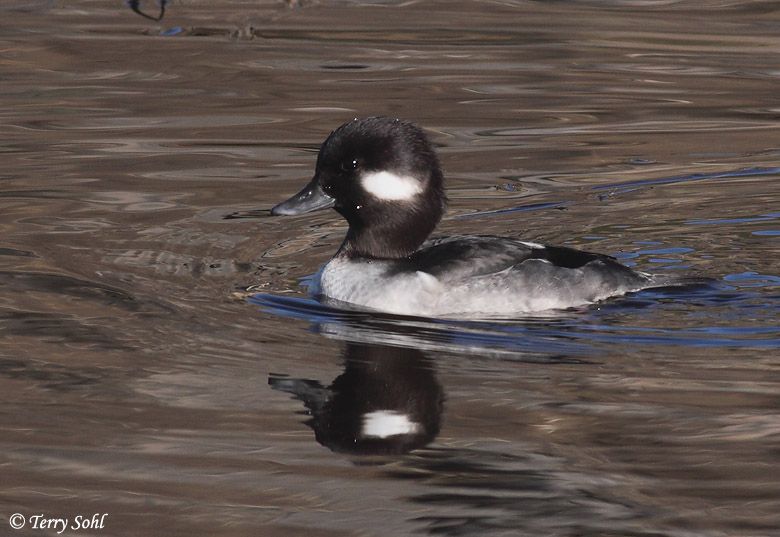
- Bufflehead - It's the female bufflehead that is potentially easiest to confuse with a Ruddy Duck, if not seen well. Female Buffleheads have a white patch on the cheek and dark bill that could be confused with a male Ruddy Duck in non-breeding plumage. However, the head pattern on a non-breeding male Ruddy Duck is more contrasty, with a darker cap above a lighter face and neck. Also, the white facial patch on a non-breeding male Ruddy Duck is much larger than that of a female Bufflehead.
- Female Scoter Species - Female Black, Surf, and White-winged Scoters could potentially be confused with female Ruddy Ducks or possibly non-breeding male Ruddy Ducks. Part of the reason for potential confusion is the bill shape, very different than many other ducks, but somewhat similar between Scoters and Ruddy Ducks. However, all Scoter species are noticeably larger than a Ruddy Duck, and none carry their tail in a vertical fashion as Ruddy Ducks often do.
 |
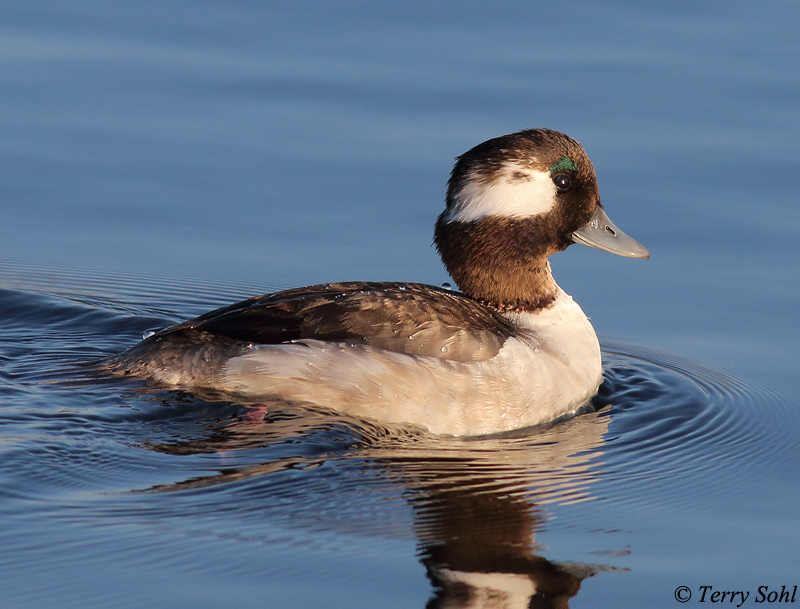 |
| Bufflehead (female) | Bufflehead (female) |
Conservation Status
There's little doubt Ruddy Ducks are much less common than in 19th century. Hunting and habitat loss led to decreases in both numbers and range. However, their numbers are generally now stable, they're found across a very broad geographic area, and they are common in parts of their range. The IUCN considers the Ruddy Duck to be a species of Least Concern.
Photo Information
March 25th, 2007 - Minnehaha County, South Dakota - Terry Sohl
Audio File Credits
1Bruce Lagerquist. Recorded in Lake County, Oregon on May 30th, 2019. Original recording and information from xeno-canto.
