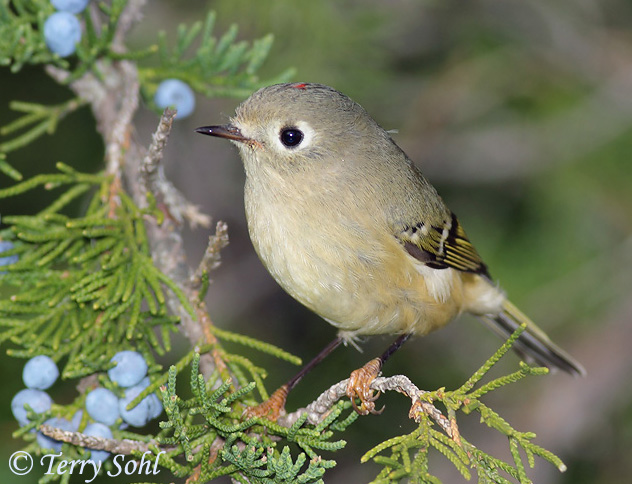
Ruby-crowned Kinglets are tiny, extremely active migrants throughout most of the state, as well as a summer resident in the Black Hills. They are very often seen foraging in mixed flocks containing kinglets, nuthatches, and warblers. The male's ruby-crown is only raised in excitement, and is generally quite difficult to spot.
Habitat
Uses coniferous forest for breeding. Can be found in a wide variety of forest and shrub habitats during migration and in winter.
Diet
Primarily insects. Will eat berries and seeds (primarily in winter), and will feed on tree sap.
Behavior
Extremely active foragers, constantly moving and flicking it's wings and tail as it clambers through foliage in search of food. They will also hover and glean insects from foliage.
Nesting
June and July. The nest of a Ruby-crowned Kinglet is a deep cup of mosses, twigs, lichens, evergreen needles, bark strips, and other material, lined with softer feathers and plant down. The nest is usually in a spruce tree or sometimes another evergreen, from relatively clsoe to the ground to very high in the canopy. The female usually lays between 6 and 8 eggs, and she alone incubates the eggs, with the male feeding her during the incubation period. When the eggs hatch, both parents help to feed the young. The young fledge after about 17 days.
Song / Calls
The song of a Ruby-crowned Kinglet is a complex, multi-part song that begins with a series of lower-pitched, musical whistled notes, transitioning into a short, faster series of trilled notes, and ending with emphatic, higher-pitched, two toned call notes that alternate between two pitches. Ruby-crowned Kinglets also have a chattering, scolding call.
- Click here to hear the chattering alarm calls of a Ruby-crowned Kinglet1
- Click here to hear the song of a Ruby-crowned Kinglet2
Migration
Summers throughout much of Canada, the western U.S., the Great Lakes region, and the northeastern U.S. Winters throughout much of the southern, western, and eastern U.S., and points south. In South Dakota, they are migrants throughout most of the state, and can be quite common in both the spring and fall seasons. However, they are also permanent residents in higher-elevation areas of the Black Hills.
Interactive eBird Map
Click here to access an interactive eBird map of Ruby-crowned Kinglet sightings
Similar Species
The following are two species that may be confused with a Ruby-crowned Kinglet, one of which is commonly found in South Dakota, and one of which that isn't an identification chellenge here, but is extremely close in appearance and a very difficult identification challenge where the two species cross paths:
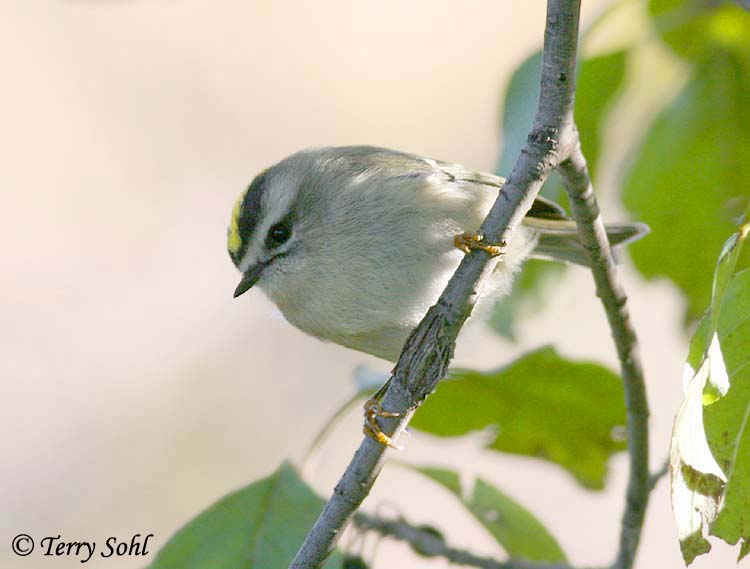
- Golden-crowned Kinglet - Golden-crowned Kinglets are seen in migration and winter throughout most of South Dakota, while some are permanent residents in the Black Hills. They sometime cross paths with Ruby-crowned Kinglets, and with a similar body plumage, could potentially be an identification challenge. As their namesakes suggest, crown color is an obvious way to tell them apart, with Golden-crowned Kinglets having a golden central crown stripe, while Ruby-crowned Kinglets having a ruby-colored patch of feathers on the crown. Note the crown on a Golden-crowned Kinglet is quite visible at all times, while the ruby-colored feathering on a Ruby-crowned Kinglet is often concealed. Facial pattern is another distinguishing feather as Golden-crowned Kinglets have diffuse dark and light facial striping, while Ruby-crowned Kinglets have an obvious light eye-ring.
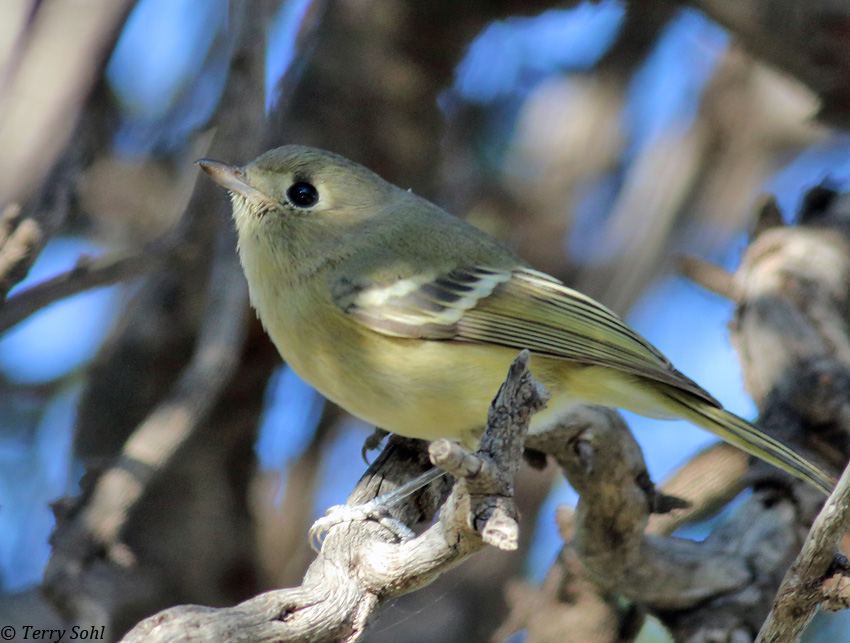
- Hutton's Vireo - Hutton's Vireos are not an identification challenge in South Dakota, but in their range in the southwestern US, Mexico, and along the US West Coast, they present a stiff identification challenge for a birder. A vireo species with an incredible resemblance to a Ruby-crowned Kinglet, down to the coloring and light eye ring, they do lack the namesake crown of the Kinglet. However, given those colored feathers are often concealed on a Ruby-crowned Kinglet, lack of visible crown is not a reliable identification feature. Bill structure is one diagnostic feature, as Hutton's Vireo have a thicker, more stout "vireo-like" bill than the smaller bill of a Ruby-crowned Kinglet. Color of the feet is another identification clue, as Hutton's vireos have dark legs and feet that match in color, while Ruby-crowned Kinglets have dull orangish feet that contrast with black legs. Finally, wing pattern of a bird at rest can be used to differentiate the two species. Hutton's Vireos have two obvious light wingbars, while Ruby-crowned Kinglets show a thin, often hidden top wingbar, and a more bold lighter wingbar below which is a darker patch.
 |
 |
 |
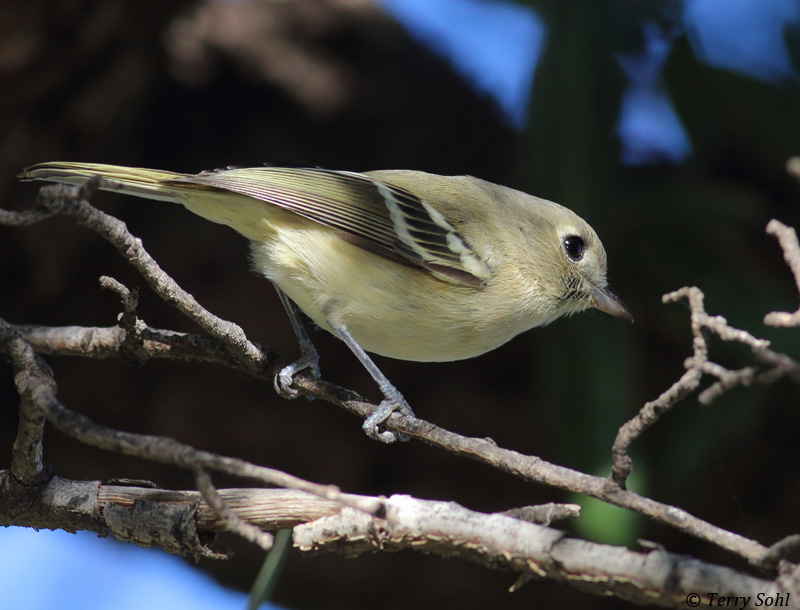 |
| Golden-crowned Kinglet | Golden-crowned Kinglet | Hutton's Vireo | Hutton's Vireo |
Feeders
Ruby-crowned Kinglets are irregular visitors to feeders, occasionally coming for peanut butter, already hulled sunflower seeds, small bits of peanuts and other nuts, and suet.
Conservation Status
Systematic surveys such as the Breeding Bird Survey (BBS) and Christmas Bird Count (CBC) show some modest increases in populations of Ruby-crowned Kinglets over recent decades. They are found over a very wide geographic area, they are common in many areas, and overall numbers are strong. The IUCN lists the Ruby-crowned Kinglet as a species of "Least Concern".
Photo Information
October 5th, 2008 - Minnehaha County, South Dakota - Terry Sohl
Audio File Credits
- 1Jarrod Swackhamer. Recorded in Cochise County, Arizona on January 26th, 2020. Original recording and information available from xeno-canto.
- 2Martin St-Michel. Recorded in Quebec on May 21st, 2016. Original recording and information available from xeno-canto.
