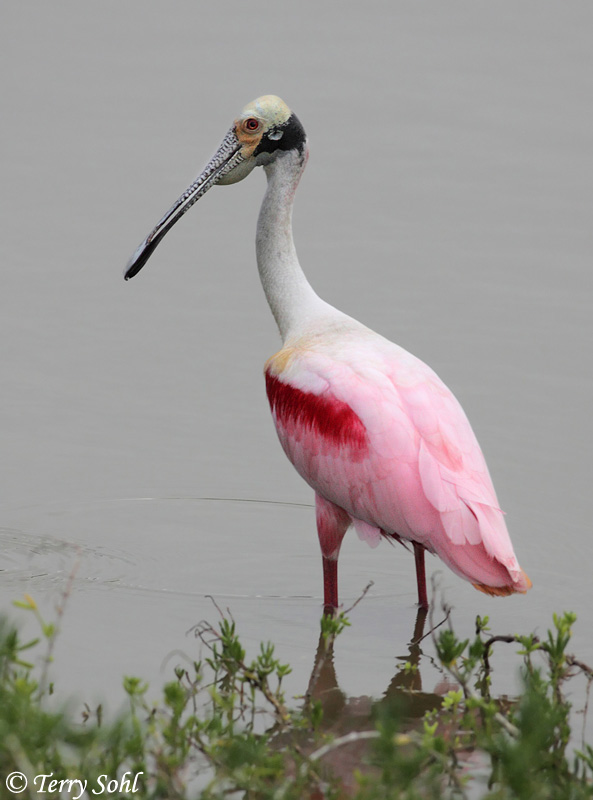
ID Keys: Pink body with white neck, distinctive spoon-shaped bill.
Roseate
Spoonbills are very distinctive birds from the southeastern United States, a
species that was once much more common before the feather trade devastated
the species in the 1800s. While numbers are recovering in the U.S.,
the species has a wide geographic distribution, with higher populations
found throughout Latin America. When seen from a moderate distance,
the beautiful pink plumage and general outline provide the impression of a
stunningly beautiful bird, an impression that is dampened somewhat upon a
closer view by the somewhat less attractive head and face.
Habitat
Roseate Spoonbills can be found foraging in both freshwater and saltwater, typically relatively close to the ocean int he U.S. During the summer breeding season in the U.S., nesting colonies are found in mangrove swamps in Florida, and in other forested wetlands elsewhere along the Gulf Coast.
Diet
Feeds on a variety of aquatic animals, including small fish, crayfish, shrimp, crabs, large aquatic insects, leeches, slugs, frogs, and salamanders They will also consume the tubers and new shoots of some aquatic plants.
Behavior
Uses it's unique spoon-shaped bill to forage by wading in shallow water, and swinging its bill from side to side until prey is detected.
Nesting
The nest of a Roseate Spoonbill is a large platform of sticks and branches, depressed in the middle and lined with leaves and other smaller pieces of vegetation. Both parents incubate the eggs, and both parents help to raise the young.
Song
The Roseate Spoonbill is generally quiet but gives low grunts, harsh croaks, and guttural sounds, especially at nesting colonies or when disturbed. Young birds often make persistent begging calls, while adults may snap their bills or hiss during aggressive encounters.
Migration
Considered a permanent resident throughout most of their range, but many U.S. birds are migratory, moving to Mexico or the Caribbean for the winter. Young first-year birds may disperse widely after fledging, and make up the majority of Roseate Spoonbill vagrants that have been seen in far-flung, inland locations (see map below).
Distinctive if seen well. From a distance, the American Flamingo can look similar, with pink plumage that is similar in hue, but the two species are very distinct if seen well. The Roseate Spoonbill differs from the American Flamingo by its broad spoon-shaped bill, shorter neck, and pink-and-white plumage with red shoulder patches. American Flamingos are taller and more uniformly pink, with extremely long legs, a sharply bent bill, and a more upright posture typical of flamingos.
Conservation Status
Listed as a species of "Least Concern" by the IUCN. Still much less common in the U.S. portion of its range than it was historically, as the species was heavily affected by those "harvesting" the birds for their feathers in the 1800s. Populations globally are stable, however.
Image Information
December 10th, 2012 - Everglades National Park - Photo by Terry Sohl