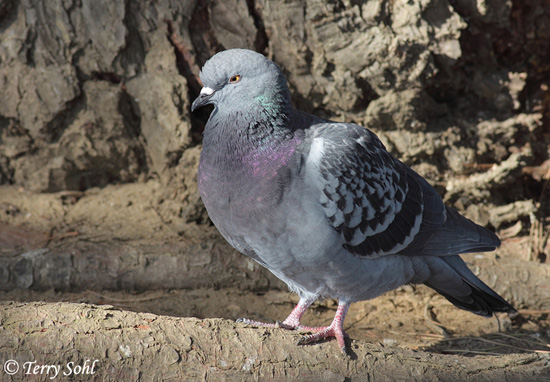
ID Keys: Two dark wing bars, iridescent feathering on head and neck
Along with the House
Sparrow, probably the most familiar of introduced bird species in the United
States. First introduced into the United States in the 1600's, the
domesticated form of the Rock Dove is often called the "homing
pigeon", due to its strong abilities in returning to a home location upon a
distant release. Perhaps less detrimental to native birds than many
introduced species, the presence of Rock Doves in urban settings is largely
responsible for supporting urban populations of Peregrine Falcons and Merlins.
Habitat
Primarily found around cities and other human-occupied locations and structures. Can also be found in wild settings such as around cliffs and bluffs.
Diet
Primarily feeds on seeds. In cities, will attend feeders for most seeds, but will also take a wide variety of human foods. In rural settings, feeds on waste grain and many types of seeds.
Behavior
Forages by walking along the ground, picking food items off the surface. Gregarious, often feeding in flocks.
Nesting
May through August
Song
Familiar repetitive cooing.
Migration
Non-migratory throughout its range.
Interactive eBird Map
Click here to access an interactive eBird map of Rock Dove sightings
Similar Species
Band-Tailed Pigeon
Feeders
Will attend for most seeds, as well as a very wide variety of human food including bread, other baked goods, and popcorn.
Conservation Status
Numbers steady throughout its range, abundant in cities throughout the United States, despite eradication efforts in some areas.
Photo Information
December 9th, 2011 - San Francisco, California - Terry Sohl