
The Ring-billed Gull is probably the most common gull found in the state. Adapted well to living with humans, it can often be found sitting in parking lots or scavenging at landfills, as well as in more natural habitats in around aquatic areas. The yellow legs and overall size help to distinguish the species from other similarly plumaged gulls found in the state, as does the characteristic black ring around the bill seen in mature birds (such as in the photo to the right).
Habitat
Usually found near lakes, marshes, and large rivers, although they will feed in a wide variety of habitats, including dryland habitats.
Diet
Omnivorous. Wide variety depending on circumstances. Includes fish, insects, small mammals, garbage, and grain. Can be seen in freshly plowed fields foraging for earthworms and grubs.
Behavior
Very sociable birds, with large groupings often seen in all seasons. Individual behavior often depends upon local foraging conditions and prey.
Nesting
Mid-May through June. Ring-billed Gulls are colonial nesters, sometimes mixing nesting colonies with other Gull species. The nest itself is a shallow saucer of grasses, wetland vegetation, twigs, moss, and other material, placed on the ground near the water's edge. The female usually lays 2 to 4 eggs, and both parents help to incubate them. When the eggs hatch, both parents help feed the young. The young learn to fly after about 5 weeks, and leave the parents soon after.
Song
Ring-billed Gulls have multiple vocalizations, and are generally more vocal in and around nesting colonies. This includes a high-pitched repeated kiyak or a a sharp ky-ow call.
- Click here to hear to hear the cries of two Ring-billed Gulls fighting over a food item1
- Click here to hear more calls from a Ring-billed Gull2
- Click here to hear the varied calls of a group of Ring-billed Gulls around a nesting colony3
Migration
Breeds in a scattered locations across Canada and the northern half of the United States. In winter, found primarily south of Canada and along the coastlines, with populations possibly occurring wherever open water exists.
Interactive eBird Map
Click here to access an interactive eBird map of Ring-billed Gull sightings
Similar Species
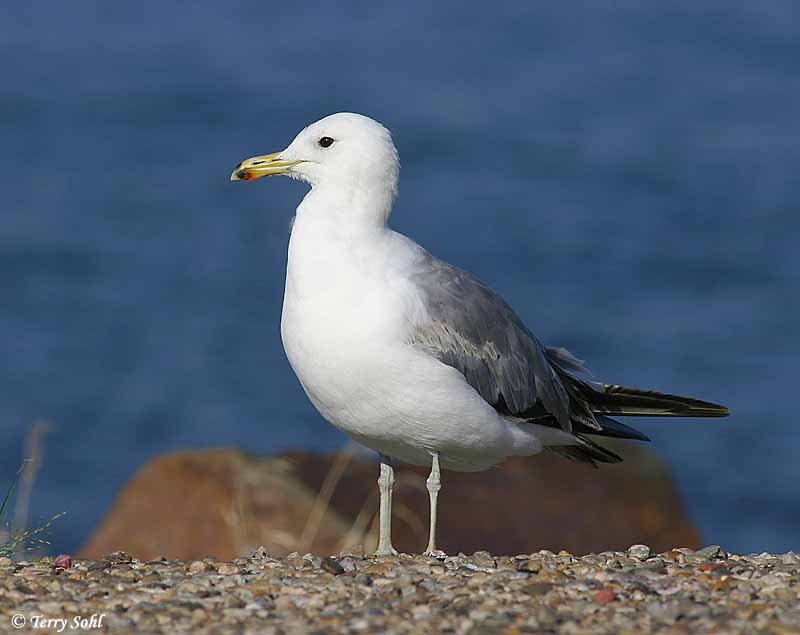
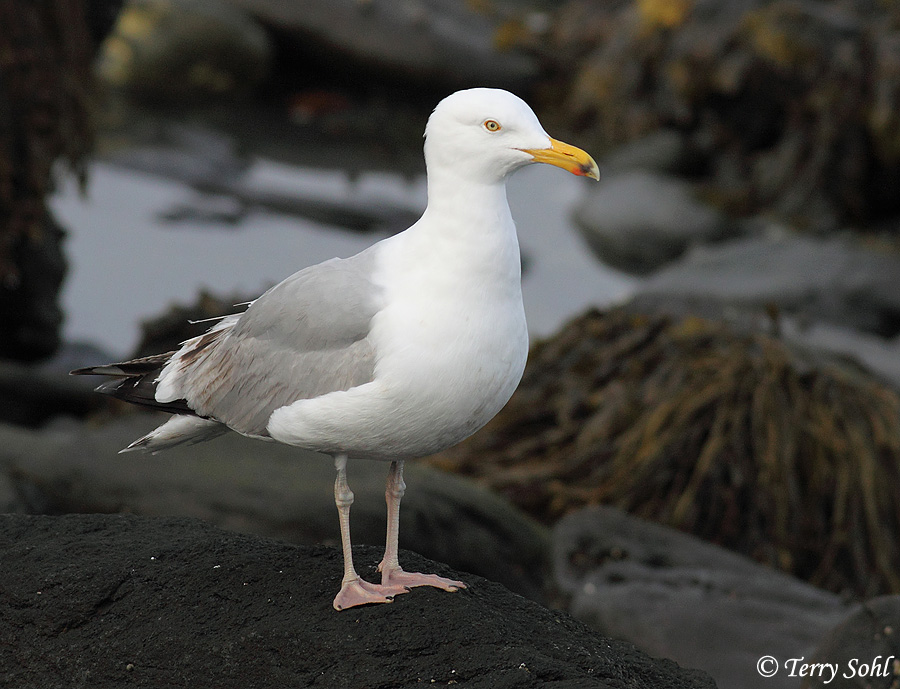
Can be confused with a number of other Larus gull species. In South Dakota, they're most likely to be confused with the California Gull or Herring Gull. Click here for a page with tips on how to differentiate a number of different species of gulls. General identification tips for (adult plumage) Ring-billed Gulls are as follows:
- Bill: Yellow bill with distinctive black ring that seemingly wraps around the entire bill. Note other Larus gull species that may be similar in overall appearance may have markings on their bill (red or black spots), but those spots are only found on the lower mandible, unlike the Ring-billed Gull which has black on the upper mandible as well.
- Legs/Feet: Yellow on an adult bird. Note first year birds generally have pinkish legs.
- Upperparts/Mantle - Light grey mantle, lighter in color than the California Gull, but mantle color alone isn't a great indicator unless multiple species are seen in close proximity for comparison.
- Eye: Pale eye.
- Size: Smallest of the three similar Larus species found in South Dakota. In order of size from smallest to largest, it's Ring-billed, California, then Herring Gull.
 |
 |
 |
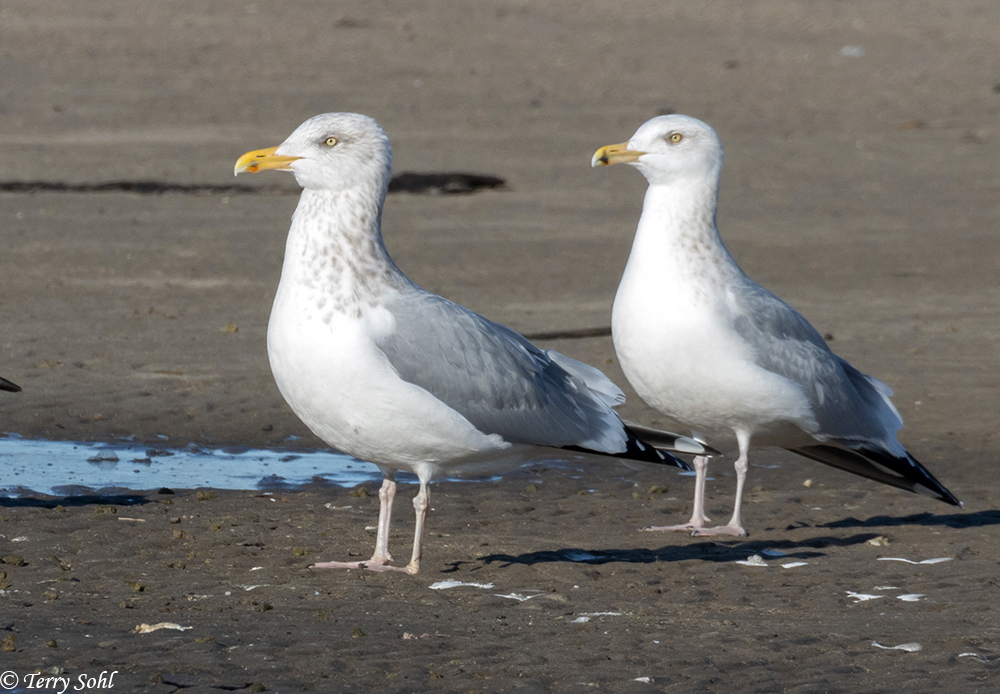 |
| California Gull | California Gull | Herring Gull | Herring Gull |
Status
Ring-billed Gull populations have been increasing in number, thanks to their adaptability, and to live in altered environments or even in environments dominated by a human presence. They are common in many areas, and are found over a very wide geographic area. The IUCN lists the Ring-billed Gull as a species of "Least Concern".
Photo Information
July 18th, 2004 - Below Oahe Dam near Pierre, South Dakota - Terry Sohl
Audio File Credits
- 1Krzysztof Deoniziak. Recorded on August 9th, 2014 on Long Island in New York. Original recording and information available from xeno-canto.
- 2Todd Wilson. Recorded on May 31st, 2010 in Lakeshore State Park in Milwaukee, Wisconsin. Original recording and information available from xeno-canto.
- 3Paul Marvin. Recorded on January 14th, 2014 in Sand Point Park near Titusville, Brevard County, Florida. Original recording and information available from xeno-canto.
