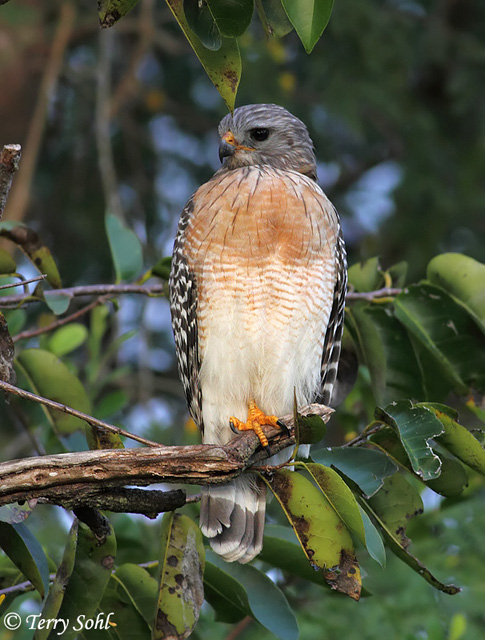
ID Keys: Narrow black and white bands on wings and tail in flight,
rust-colored underparts, spotted upperparts.
The Red-shouldered Hawk, a
hawk of forests and woodlands, is just a casual visitor to South
Dakota. Several different color phases exist, but all mature birds have
the characteristics listed in the ID Keys above. Given the forest habitat
in which they are found, the noisy call of the Red-shouldered Hawk is often
heard before the bird is seen.
Habitat
During nesting season, they are found in deciduous and mixed forests, usually in areas with large trees and open understories. They can be found in more open habitats during the winter.
Diet
Diet varies with location and season, and may include small mammals, frogs, snakes, lizards, large insects, crayfish, and sometimes fish or birds.
Behavior
Hunts from a perch, swooping out to catch prey that comes within range. Males perform flight displays in courtship, flying upward and calling, then diving back down towards the female. Courting pairs can also often be seen soaring together in circles and calling to each other.
Nesting
Non-breeder in South Dakota. In their normal nesting range, the nest is a platform of sticks, lined with softer vegetative materials such as leaves or moss, placed relatively high in a tree. The female usually lays 3 or 4 eggs, and the female does most of the incubating. When the eggs hatch, at first the male brings food while the female stays with the young. After about 2 weeks, both parents help to feed the young. The young leave the nest after about 6 weeks, but typically stay with the parents for several weeks after fledging.
Song
The Red-shouldered Hawk is known for its loud, ringing kee-aah, kee-aah call that is often repeated in a descending series. It also gives sharp alarm screams and shorter contact whistles near the nest or when soaring with a mate.
Migration
Primarily a permanent resident, but birds at the northern end of its range move small distances south in the fall.