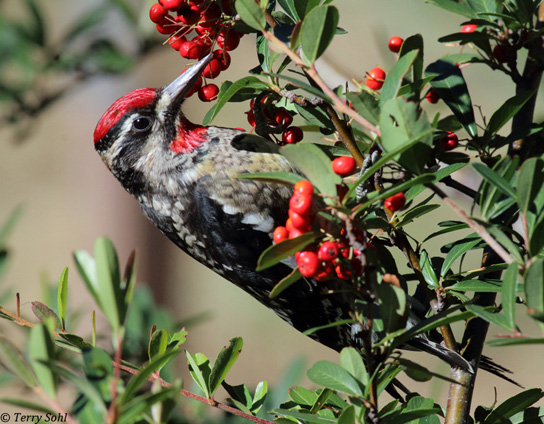
The Red-naped Sapsucker was considered a race of the Yellow-Bellied Sapsucker until late in the 20th century. The Red-naped Sapsucker has a distinctly different range, found only in the western United States, and in South Dakota, only regularly in the Black Hills. Both species are very similar in appearance.
As with other sapsucker species, Red-naped Sapsuckers feed on tree sap as a primary part of the diet. Often the easiest way to find them is to find areas where the tell-tale sap "wells" are present like a honeycomb on the surface of select tree species. Despite the name, they don't "suck" the sap up from a well, but instead flick their tongue against the wells, where the brush-like hairs hold onto the sap.
Habitat
Red-naped Sapsuckers are often found in and around aspen groves, but they will use a variety of mixed forest types. They are usually found around forest edges or forest clearings, rather than dense interior forest.
Diet
Like other sapsucker species, Red-naped Sapsuckers drill sap "wells" and feeds frequently on tree sap. They will also feed on insects, fruit, and berries.
Behavior
Drills sap wells into select trees and returns often to retrieve both leaked sap and insects trapped in the sap. Also climbs along tree trunks and branches to capture insects, and will occasionally fly out from a perch to catch a flying insect in mid-air.
Nesting
June and July. The nest of a Red-naped sapsucker is a cavity, constructed in either a living or a dead tree. When constructed in a live tree, it most often is in a disease that's afflicted by a fungal infection that makes the heartwood easier to excavate. The male constructs the nesting cavity, taking several days to build the nest site, and leaving wood chips at the bottom for a nesting spot. The female usually lays between 4 and 6 eggs, and both parents help to incubate them. The young hatch after 12-14 days, and fledge from the nest about 3 to 4 weeks after hatching.
Song
The most commonly heard vocalization is a series of whining short calls with a mewing quality. They may also use a harsher chattering call.
1Click here to hear the drumming of a Red-naped Sapsucker
2Click here to hear the mewing call of a Red-naped Sapsucker
3Click here to hear the begging calls of juvenile Red-naped Sapsuckers
Migration
Summers in and around the Northern to Mid-Rockies. Winters in Mexico and Southern Rockies.
Interactive eBird Map
Click here to access an interactive eBird Map of Red-naped Sapsucker sightings
Similar Species
There are several Sapsucker species in the United States that could be confused with Red-naped Sapsuckers:
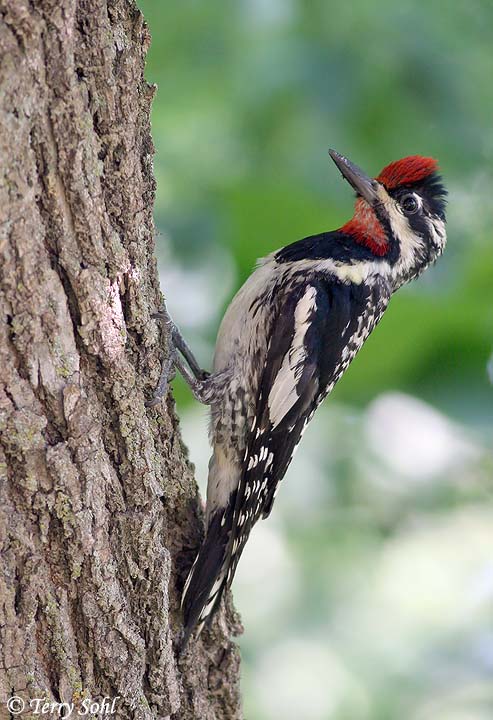
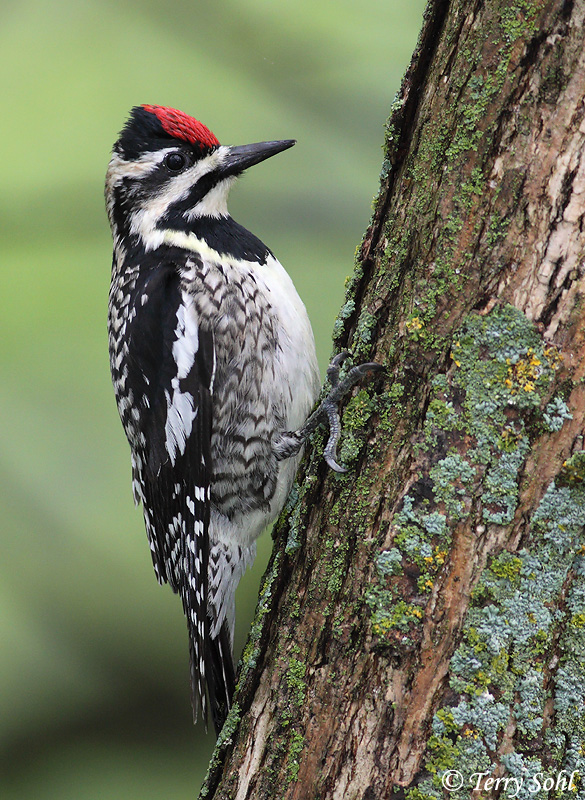
- Yellow-bellied Sapsucker - The closest in physical appearance to the Red-naped Sapsucker, Yellow-bellied Sapsuckers are birds of the eastern US. Range alone can often be used to identify a sighting. However, it's possible a migrant Yellow-bellied Sapsucker could come into the Red-naped Sapsucker's range in the Black Hills (as well as other narrow bands in the United States and Canada). In terms of appearance, Yellow-bellied sapsuckers lack the red nape patch of a male Red-naped Sapsucker. They also have a black border that completely encircles the red throat patch, while the black is more limited on a Red-naped Sapsucker.
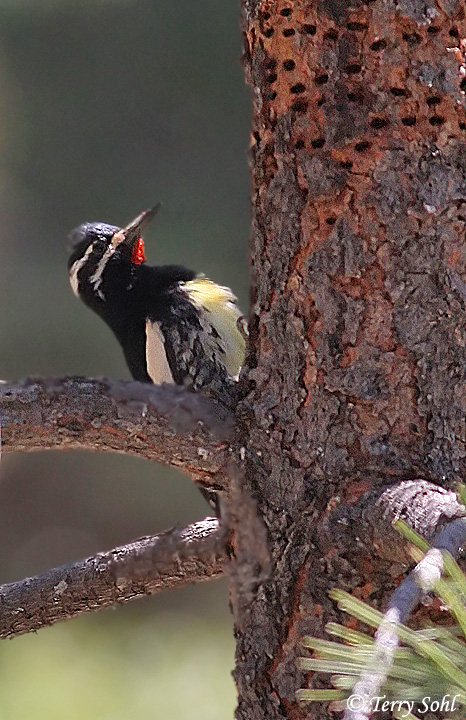
- Williamson's Sapsucker - Williamson's Sapsucker have a disjunct and scattered range in the western United States, but much of that range overlaps with the Red-naped Sapsucker. Female Williamson's Sapsuckers are substantially different in plumage than the males, with a mostly brownish color overall with a black-barred back. They also have a mostly tan-colored head, which differentiates them from the strong facial pattern on a Red-naped Sapsucker. Male Williamson's Sapsuckers have plumage patterns reminiscent of a Red-naped Sapsucker, with black and white facial patterns that are particularly similar. However, the red on an male Williamson's Sapsucker is limited to the throat, while Red-naped Sapsuckers have a broad red crown and a small red nape patch.
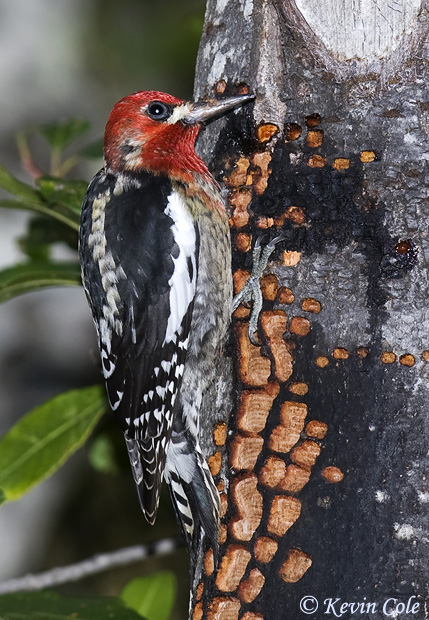
- Red-breasted Sapsucker - Red-breasted Sapsuckers are also a bird of western North America, but they are generally found further west, near the West Coast. They are not likely to be found in South Dakota, but could potentially overlap with Red-naped Sapsuckers in a narrow range in western North America. Red-breasted Sapsuckers have a head and upper breast that's nearly completely red, in comparison with the red, black, and white pattern on the head of a Red-naped Sapsucker.
 |
 |
 |
 |
| Yellow-bellied Sapsucker | Yellow-bellied Sapsucker | Williamson's Sapsucker | Red-breasted Sapsucker |
Feeders
Red-naped Sapsuckers will come to feeder complexes for various fruits and berries, will use hummingbird feeders for nectar, and may occasionally come for suet.
Conservation Status
There are some indications that populations of Red-naped Sapsuckers have been in decline in recent decades, most likely due to habitat loss. However, they are still found across a broad geographic area, are common in parts of that range, and have a very strong population overall. The IUCN considers the Red-naped Sapsucker to be a species of "Least Concern".
Photo Information
November 12th, 2015 - Santa Rita Lodge in Madera Canyon, south of Tucson, Arizona - Terry Sohl
Audio File Credits
1Peter Ward and Ken Hall. Recorded in Chelan County Washington on June 3rd, 2005. Original recording and information available from xeno-canto.
2Ryan P. O'Donnell. Recorded in Cache County, Utah on October 9th, 2011. Original recording and information available from xeno-canto.
3Bruce Lagerquist. Recorded in Okanogan County, Washington on July 3rd, 2016. Original recording and information available from xeno-canto.
