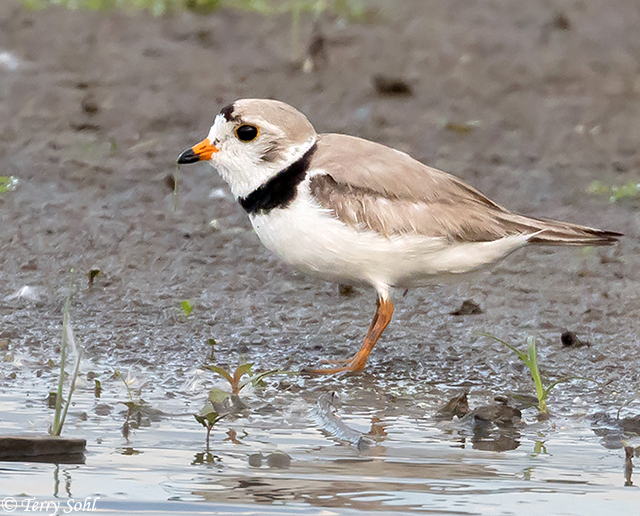
The Piping Plover was once a fairly common sight along Atlantic coast beaches, Great Lakes beaches, and interior river sandbars, but is now threatened or endangered throughout its entire range. In South Dakota, nesting activity is primarily on Missouri River sandbars, where successful nesting is threatened by controlled water levels in the state's reservoirs. Populations in the state are now primarily limited to areas below Gavin's Point Dam, the lowest dam on the Missouri River, as the free flowing Missouri still has extensive sandbars in the region. They also can be found in other scattered locations in the state where suitable sandy habitat exists, but distribution is quite limited. Note that populations in and around the Great Lakes are in even worse shape, with human disturbance extirpating the species from much of that region. Human disturbance on Atlantic coastline beaches has also greatly reduced Piping Plovers from historical population levels.
Habitat
Needs open sandy areas near water for nesting. In the interior of the country, this is often on sandbars of major rivers, as well as the sandy beaches of the Great Lakes. Sandy beaches along the shoreline are used along the Atlantic Coast.
Diet
Aquatic and terrestrial insects, small crustaceans and mollusks, and marine worms
Nesting
May through July. The nest is a simple scrape in the sand, sometimes lined with bits of rock or shell. The female lays 4 eggs, and both parents help to incubate them. After the eggs hatch, both parents help tend to the young, but the young leave the nest after just a few hours, and must find their own food.
Song
Piping Plovers have multiple call notes, including a short, quickly repeated call often given by the male during the breeding season, as well as other call notes given when a bird is alarmed, or in and around the nest.
1Click here to hear some typical call notes of a Piping Plover
Migration
Summers along major rivers in the Great Plains of the U.S. and southern Canada, as well as Great Lakes and Atlantic Seaboard beaches. Winters along the Atlantic and Gulf coasts.
Interactive eBird Map
Click here to access an interactive eBird map of Piping Plover sightings
Similar Species
Piping Plovers could potentially be confused with multiple plover species that are found in South Dakota in certain seasons
- Semipalmated Plover - The Semipalmated Plover is another small plover species with a single dark neck band. However, Semipalmated Plovers are migrants through South Dakota, breeding near the Arctic Circle. Seasonality thus rules out Semipalmated Plovers during the summer breeding season. In terms of appearance, both are similar in size, but in breeding plumage, the dark band around the neck is more extensive on the Semipalmated Plover, and there's substantially more black on the face, including through the eye. Non-breeding Semipalmated Plovers are perhaps more confusing, as some of the black on the face is less apparent, but in all seasons, Semipalmated Plovers in general appear darker than the paler Piping Plover.
- Snowy Plover - Snowy Plovers are typically found around inland alkaline and salt lakes of the western US, but in recent decades, there have been a handful of breeding records within South Dakota. Given both species use of open sandy areas, they could potentially both be present and be confused with each other. Snowy Plovers are even smaller and more pale than Piping Plovers. The black around the neck of a Snowy Plover is much less complete and extensive. The bill of a Snowy Plover is noticeably thinner and completely black, compared to the stubbier, orange and black bill of a Piping Plover.
- Killdeer - The most common plover in South Dakota, size alone differentiates it from Piping plover, as they are substantially larger. Killdeer also have two obvious, extensive black neck bands, and a longer and consistently dark bill.
South Dakota "Hotspot"
Piping Plovers rely on sandy areas for nesting, and in South Dakota, that historically was the shifting sandbars of the Missouri River and its larger tributaries. With dams inundating much of that habitat from southern South Dakota at Yankton (Gavin's Point Dam) and northward to the North Dakota border, the best remaining habitat of extensive sandbars lies downstream from Gavin's Point dam, in the far southeastern part of the state along the Nebraska border. North Alabama Bend park southwest of Vermilion is a great area to look, as that bend of the river tends to have vast expanses of sandbars suitable for breeding. It's also a great place to look for Least Terns.
Conservation Status
Piping Plovers are threatened or endangered throughout their entire range. Once a fairly common breeder on Great Lakes beaches, they are now nearly extirpated from the region. Regulation of water on rivers affects inland birds attempting to nest on sand bars. In South Dakota and North Dakota, the series of dams on the Missouri River inundated vast areas of former riparian and sandbar habitat, removing much of the suitable habitat in the state. Atlantic coastline beach nesters are severely impacted by human activity. On a global basis, the IUCN lists the Piping Plover as a "Near Threatened" species.
Image Information
July 3rd, 2020 - North Alabama Bend park near Vermilion, South Dakota - Terry Sohl
Audio File Credits
1Patrick Turgeon. Recorded in Saskatchewan on July 17th, 2016. Original recording and information from xeno-canto.
