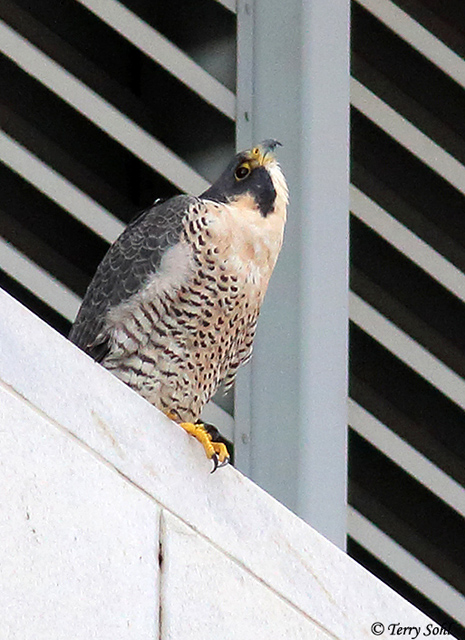
ID Keys: "Hooded" effect, dark upperparts, white underparts with
dark barring
The Peregrine Falcon is a medium sized falcon with a big reputation.
They are generally considered as one of the fastest birds in the world,
reaching speeds of nearly 200 miles per hour when diving after prey. They
can be found throughout much of the world, on every continent except
Antarctica, but are usually uncommon. Exposure to DDT and similar pesticides
resulted in a severe decline in North America by 1970. They are one of
the first and most successful benefactors of the Endangered Species Act and
conservation efforts that began in the 1970s. Banning of DDT led to
the elimination of a serious threat to both adult birds and their eggs,
while captive breeding and reintroduction efforts also fueled the species'
recovery. They are one of the few animals that has been removed from
the U.S. Endangered Species Act, with removal in 1999.
Habitat
Can be found in a very wide variety of habitats, where ever suitable nest sites are available. This may be coastlines or mountainous areas where cliff-side nesting ledges are available, Is more common near water, especially along coastlines, semi-open areas with available tree snags for nesting, or increasingly, urban centers where tall buildings are used for nesting.
Diet
Primarily feeds on birds. Often feeds on ducks, geese, and shorebirds near water. Those adapted to city life (including those reintroduced to specially built nesting platforms on tall buildings) often feed nearly exclusively on Pigeons . They will also occasionally eat small mammals or large insects.
Behavior
Spectacular hunter, often flying very high, and then diving at extreme speed to strike prey in mid-air. They will also sometimes hunt from a perch, or while flying low over the ground. Paired birds may mate for life, with circling and diving of paired birds common courtship behavior.
Nesting
May through July. Peregrine Falcons put very little effort into building a formal nest. They will sometimes use a nest built by another species, such as a large hawk or even an eagle or osprey. They also will use the remaining snag of a broken off tree, using the top as a nesting platform. Cliff ledges are frequently used as well, with a shallow scrape built on any sand, gravel, or soil that may exist on the ledge. Buildings are increasingly used as nesting platforms in areas with tall buildings, and plenty of potential prey such as Rock Doves or European Starlings . The female lays between two and five eggs, and she alone incubates them. The eggs are incubated for about 4 weeks before hatching. After hatching, the female stays with the young for a few weeks while the male brings food. Later the female also leaves the nest to hunt for prey. The young take their first flight 6 to 8 weeks after hatching.
As of the time of constructing this page, only two confirmed nesting records from South Dakota, one from 1925 in Harding County, and one from 1945 in Pennington County. Pairs of Peregrine Falcons have occasionally been spotted in downtown Sioux Falls in recent years, but no confirmed nesting has occurred.
Song
Usually silent, but will make a loud kyaah-kyaah when disturbed near its nest.
Migration
Permanent resident throughout much of the western United States and the western Canada coast. Birds summering throughout Canada, Alaska, and the Great Lakes region migrate south in the fall, with some going all the way to South America.
Prairie Falcon , Gyrfalcon. The Peregrine Falcon is a powerfully built falcon with a dark hood, bold black mustache, bluish-gray back, and heavily barred underparts, giving it a sharply contrasting black-and-white appearance. Prairie Falcon is paler sandy-brown overall with a lighter face, darker “armpit” patches under the wings, and a more washed, desert-toned look suited to open western plains and cliffs. Gyrfalcon is much larger and bulkier than either, with broader wings, a heavier chest, and plumage ranging from dark gray to nearly white, but always lacking the Peregrine’s crisp dark hood and the Prairie Falcon’s warm buff coloration.
South Dakota "HotSpot"
Peregrine Falcons aren't easy to find in South Dakota, although spring migration is your best bet. During that time, they tend to follow the migration, be it waterfowl earlier in the spring or shorebirds later in the spring. Most of my sightings have been in and around water, with a Peregrine Falcon keeping an eye on those migrants, or buzzing through trying to make a kill. Finding such a migrant is luck of the draw, however, and you certainly can't plan on going out to a certain wetland or lake and finding a migrating Peregrine. The most consistent location to find a Peregrine Falcon is downtown Sioux Falls. The buildings downtown are the tallest in the region, but really nothing 10 stories or above, so birds using the tops of these buildings as perches are accessible and viewable for a birder. On occasion, a pair of Peregrine Falcons have been seen downtown at the same time, but no known nesting has been attempted in recent years.
Conservation Status
Reproduction failure due to pesticide exposure caused a rapid and severe decline in the 1960s and 1970s. Pesticide exposure led to both mortality in adults, as well as eggshell thinning that often resulted in unviable eggs and young. A ban on pesticides such as DDT has led to a dramatic rebound of Peregrine Falcon populations in North America. The IUCN estimates a massive 2,600% increase in Peregrine Falcon populations over the last 40 years, given the very low numbers left in North America by the mid-1970s. They were one of the few species that have been removed from the Endangered Species List in the United States, with removal in 1999. They are still rather uncommon throughout most of its former range, but reintroduction programs and natural reproduction are resulting in continually increasing numbers. The IUCN now considers the Peregrine Falcon to be a species of "Least Concern" .
Photo Information
May 8th, 2018 - U.S. Bank building in downtown Sioux Falls - Terry Sohl