Return to Main Page

Passenger Pigeon

Ectopistes migratorius

Length: 16 inches
Wingspan: 22 to 24 inches
Seasonality: Summer / Migrant
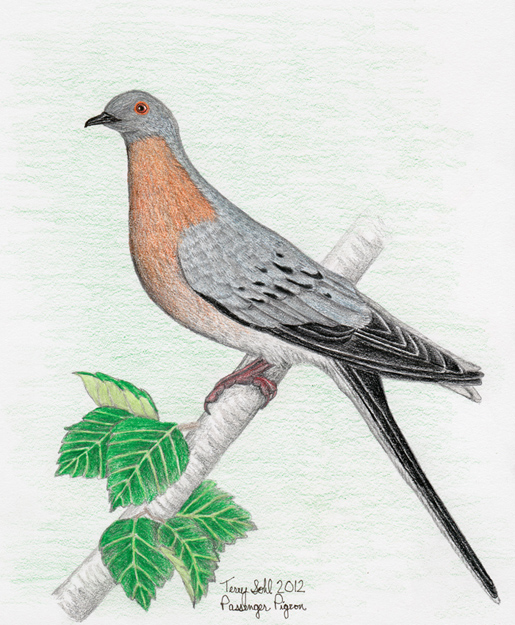
ID Keys: Reddish breast, bluish-gray head, rump, and back
Passenger Pigeon - Drawing by Terry Sohl

The Passenger Pigeon was once one of the most numerous birds in North America. From the 1600s through early 1800s, people wrote of flocks that filled the sky as far as they eye could see, with some individual flocks estimated at over 2 billion birds. However, the Passenger Pigeon was driven to extinction by uncontrolled commercial hunting for their meat. Due to their tendency to both migrate and breed in large dense flocks, they were easy targets for hunters, who often used large mesh nets to catch them by the thousands. By 1880, there were no longer enough birds for hunting to be commercially profitable, and the species was largely left on its own to recover. Although several thousand birds were left at that time, populations continued to plummet. It was thought their strong communal nature made them much less effective breeders when populations were thin and dispersed. The last wild specimens were collected at the beginning of the 20th century, and the last bird of the species died in the Cincinnati Zoo in 1914. Note the photo to the right is of a mounted specimen.

Habitat

Primary nesting sites were mixed hardwood forests around the Great Lakes region. They also used forest areas as roosts in the winter.

Diet

Fed primarily on seeds, acorns, fruits, and berries, and quickly learned to take advantage of planted grain crops. They also were known to feed on insects and worms.

Breeding

Was an occasional breeder in South Dakota.

Migration

The primary breeding areas were the Great Lakes region east through New England, and southeastern Canada. Wintering grounds were primarily from Arkansas east to North Carolina, and southward to the Gulf Coast.

Interactive eBird Map

Click here for an interactive eBird Map of Passenger Pigeon sightings

Similar Species

Mourning Dove

Status

Extinct. The last bird died in the Cincinnati Zoo in 1914.

Image Information

Colored pencil drawing by Terry Sohl - September 2012

Further Information