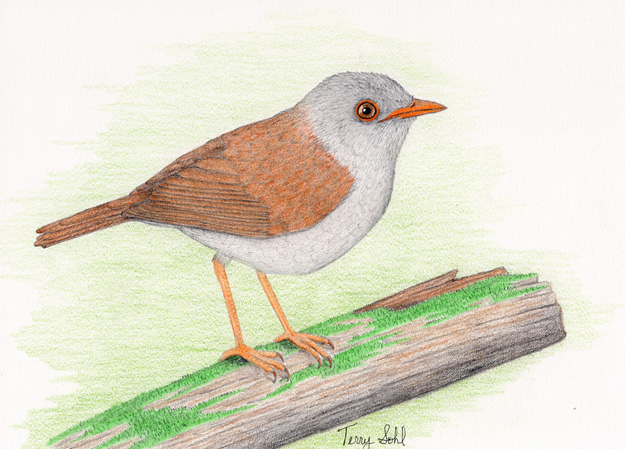
ID Keys: Bright orange bill, orange eye-ring, greyish-white underparts, rich
brown upperparts, light-orange legs
The
Orange-billed Nightingale Thrush is normally a bird of the warm forest regions
in Mexico, Central America, and northern South America. They are related
to Catharus thrushes that can be found in South Dakota (Veery,
Swainson's Thrush,
Gray-cheeked Thrush, and
Hermit Thrush). However, the species is not known to wander
widely from its normal range, and until 2010 had only been seen alive once in
the United States, when one was caught in a mist net (used for bird banding) in
southern Texas. However, in July 2010, a single singing bird was found in
the Black Hills of South Dakota, with many sightings, and photo and sound
recorded verification. Birders from across the country visited the Black
Hills, hoping to get a glimpse of a very rare bird for the United States.
Habitat
Found in a variety of forested habitats, primarily mid- to lower-elevation tropical forests of Mexico and Central America. Can be found in second-growth forest or other heavily disturbed forest, as well as mature forest.
Diet
Diet includes earthworms, arthropods, snails, and some berries and fruit.
Behavior
Usually forages on the ground, although it will also forage in the forest understory and occasionally in the lower canopy. Often flicks and cocks its tail as it forages along the ground.
Nesting
Non-breeder in South Dakota
Song
Short, jumbled non-musical warbles.
Migration
Permanent resident throughout much of its normal range, although there is some short-distance migration in winter to lower-elevations for some populations.
Interactive eBird Map
Click here to access an interactive eBird map of Orange-billed Nightingale Thrush sightings
Similar Species
Veery , Hermit Thrush
Conservation Status
Given the species utilization of second-growth and other disturbed forest areas, the species is not thought to be threatened.
Image Information
Drawing of Orange-billed Nightingale-Thrush - Terry Sohl - March 2012