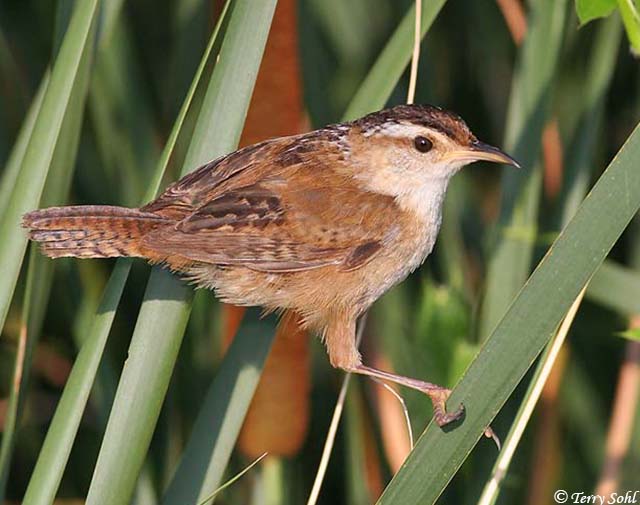
Cattail marshes in South Dakota are usually occupied by Marsh Wrens. Sometimes difficult to see in the dense wetland vegetation, their presence is still unmistakable, with their bubbling songs a common sound in wetland habitats. They are often very curious, responding to a human "pishing" and otherwise checking out (and sometimes scolding) intruders in their domain. They have a complex, chaotic courtship and nesting behavior, with birds mating with multiple partners, and raids on nests of adjacent Marsh Wrens that often result in the destruction of their eggs.
Habitat
During the summer breeding season, they can be found in a variety of fresh- and brackish-water marshes, usually where dense stands of wetland vegetation (cattails, etc.) are present in shallow water or along the water's edges. Uses similar habitat during the winter, but will also use salt marshes.
Diet
The Marsh Wren feeds primarily on insects and spiders found among cattails, reeds, bulrushes, and other marsh vegetation. Its diet includes beetles, flies, dragonflies, caterpillars, aquatic insect larvae, and other small arthropods gathered while climbing through dense wetland plants.
Behavior
Forages in dense low vegetation, hunting for insects both on the vegetation and on the ground. They will often take items from the water's surface, and will also occasionally fly from a perch to take flying insects from mid-air.
Nesting
June and July in South Dakota. The male begins courtship by building a number of incomplete nests, built in cattail marshes and other similar dense wetland vegetation. He allows a female to choose a final nesting site, where he finishes building a dome-shaped structure with the nest opening at the top. The female finishes the nest, lining it with feathers, down, fine grasses, and small roots. She lays between 3 and 10 eggs, and she alone incubates them. The eggs hatch after about 2 weeks, with the young fledging from the nest after about another 2 weeks.
Marsh Wrens are very competitive for nesting sites, with individual birds often destroying the eggs of nearby nesting birds. Individual birds may mate with other Marsh Wrens in the vicinity.
Song
A gurgling, bubbly variable medley.
- 1Click here to hear the bubbling song of a Marsh Wren
- 2Click here to hear the short calls of a Marsh Wren
Migration
Summers throughout much of the northern United States and Canada. Winters throughout the southwestern quarter of the United States, along the Pacific Coast, and in the deep southeastern U.S. Some populations along the Pacific Coast and in the western U.S. are permanent residents.
Interactive eBird Map
Click here to access an interactive eBird map of Marsh Wren sightings
Similar Species
They are often identified by habitat alone, given that other similar-looking wren species aren't found nearly as often around cattails and marshes. However, there are species that are similar in appearance and do sometimes overlap in range:
- Sedge Wren. - Sedge Wrens are found in wet meadows and grassy marshes, habitats that are often directly adjacent to the more dense wetland vegetation nearer water, such as areas of cattails. As such, both species can sometimes be found in the same general vicinity. Marsh Wrens however have a bold white eye stripe lacking on a Sedge Wren. Marsh Wrens have a solid brown shoulder, while a Sedge Wren has a heavily streaked shoulder.
- House Wren - House Wrens aren't normally found in the same habitats as Marsh Wrens, but there are times during migration when both species could conceivably be found in the same area. House Wrens lack the bold white eyebrow of a Marsh Wren, generally have less contrast and marking differences than a Marsh Wren, and lack the streaking found on the upper back of a Marsh Wren.
Conservation Status
Numbers are probably much lower than historical levels due to the vast loss of wetlands throughout its normal range, but they currently appear to have stable populations to increasing populations. Still susceptible to local population loss when wetland habitats are lost. The IUCN currently considers the Marsh Wren to be a species of "Least Concern".
Photo Information
July 26th, 2006 - Minnehaha County - Terry Sohl
Audio File Credits
1Whitney Neufeld-Kaiser, from Washington State in March 2018. Original recording and information found on xeno-canto.
2Paul Marvin, from the Imperial Valley of Southern California on January 18th, 2018. Original recording and information found on xeno-canto.
