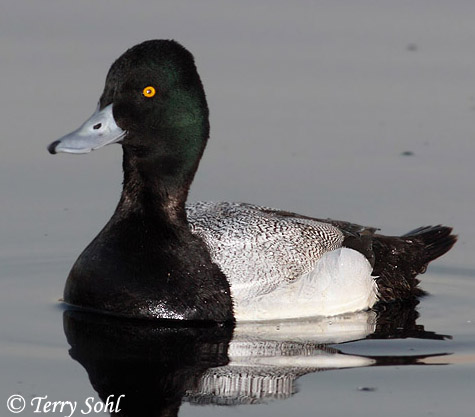
The more common of the two Scaup species to migrate through the state, as the Greater Scaup is generally more common along the coast. Lesser Scaup can be differentiated from the Greater Scaup by differences in the general head shape. Many books say there's a difference in the sheen of the head between the two, with the Greater Scaup supposedly having a greenish sheen, and the Lesser Scaup having a purplish sheen. However, this is generally not a reliable way to differentiate between the two. Head shape and extent of black on the bill tip is more reliable for identification (see below).
Habitat
During the summer breeding season, Lesser Scaup are found in grassland prairies and marshlands of the western US and Canada, up through boreal forest areas in the north. They nest in areas of extensive herbaceous vegetation, including grassland prairies with scattered wetlands and water bodies, as well as herbaceous vegetation along lake shorelines and wetland edges. During migration they can be found in almost any aquatic habitat, fromi lakes, rivers, and reservoirs, to flooded ditches and coastal marshes.
Diet
Omnivorous. Includes large amount of animal matter such as insects, snails, and crustaceans, as well as plant material such as pondweeds and their seeds.
Behavior
Lesser Scaup are a diving duck, primarily foraging by diving below the surface of the water in search of food. They will also sometimes feed at the water's surface, either by grabbing food items from the water's surface or by dipping their head and neck below the water.
Nesting
June through July. Lesser Scaup nest in herbaceous vegetation, either upland grasslands and other vegetation, or in herbaceous vegetation in wetlands and lakeshore edges. The will also occasionally build a floating platform of vegetation in very shallow water along the edge of a water body. The nest itself is a shallow saucer built of grasses and/or wetland vegetation, lined with down. The female lays between 5 and 15 eggs (eggs she may start laying while still constructing the nest) and she alone incubates them. The young leave the nest within a day of hatching, with the female leading them to a nearby water body. The young feed themsleves but are tended to and protected by the female.
Song
Low whistled whew calls from courting and mating males. Female Lesser Scaup have a quacking alarm call and flight call.
- Click here to hear the courting calls of a group of male Lesser Scaup1
- Click here to hear the alarm call of a female Lesser Scaup taking flight2
Migration
Summers in parts of the western United States, and much of western and central Canada. Winters along both U.S. coasts, in the southern U.S., and points south.Interactive eBird Map
Click here to access an interactive eBird map of Lesser Scaup sightingsSimilar Species
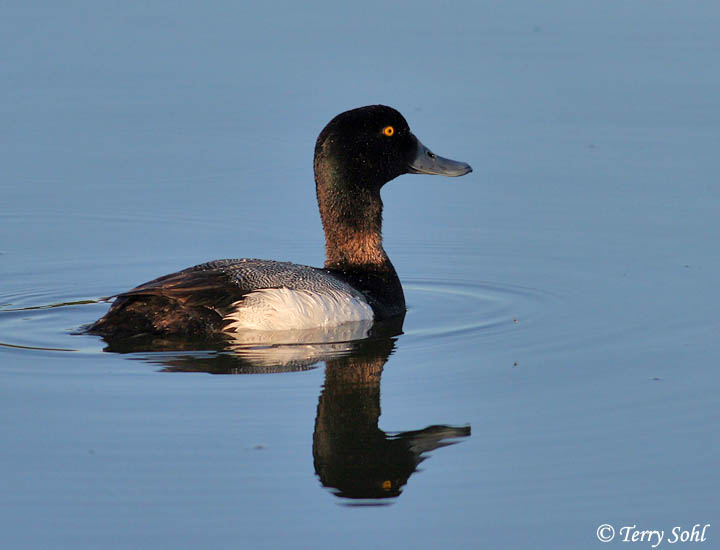
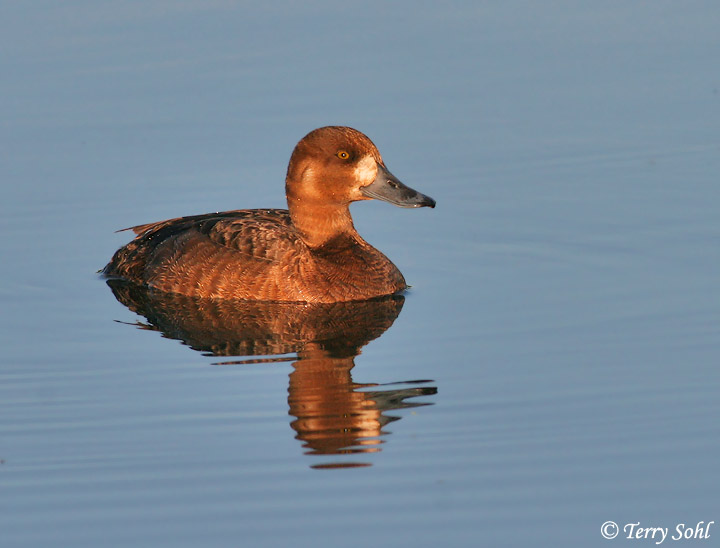
- Greater Scaup - The close relative of a Lesser Scaup, Greater Scaup are less commonly seen in South Dakota, but both species can be seen during migration. Head shape is a clue to differentiating between the two, as a greater Scaup has a more gradual, consistently rounded head, with a bit of a peak towards the front of the head. Lesser Scaup have a noted peak at the top of the head. It can be difficult to see in the field, but the black tip of the bill on a Greater scaup is also more extensive than that of a Lesser Scaup. Females are also very hard to tell apart, but head shape clues are similar to that of the males.
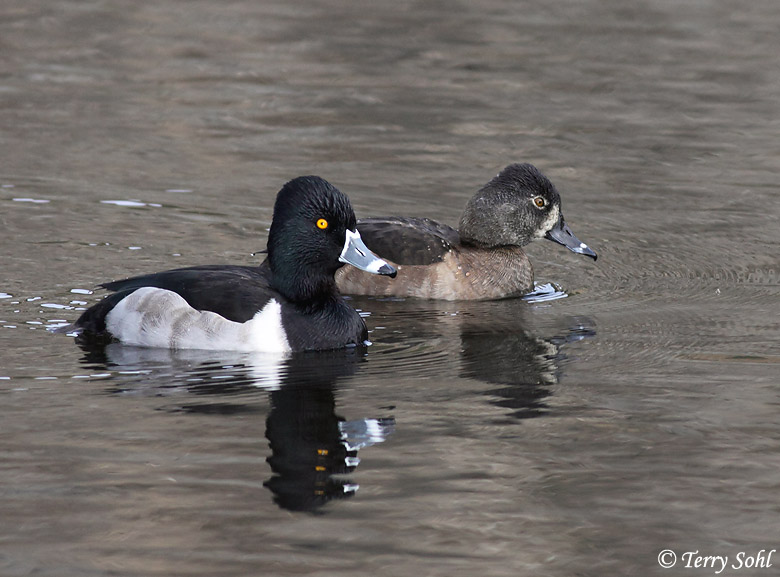
- Ring-Necked Duck - At a distance, both male and female Ring-necked Ducks could be mistaken for their Lesser Scaup counterparts. Male Ring-necked Ducks have a dark back, as opposed to the black-and-white barred back of a Lesser Scaup. The bill of a male Ring-necked Duck has a white ring near the end of the bill, and white where the bill meets the head (both white features lacking on Lesser Scaup). Female Ring-necked Ducks also have a white ring around the end of the bill, and also have white around the eye that's lacking on the female Lesser Scaup.
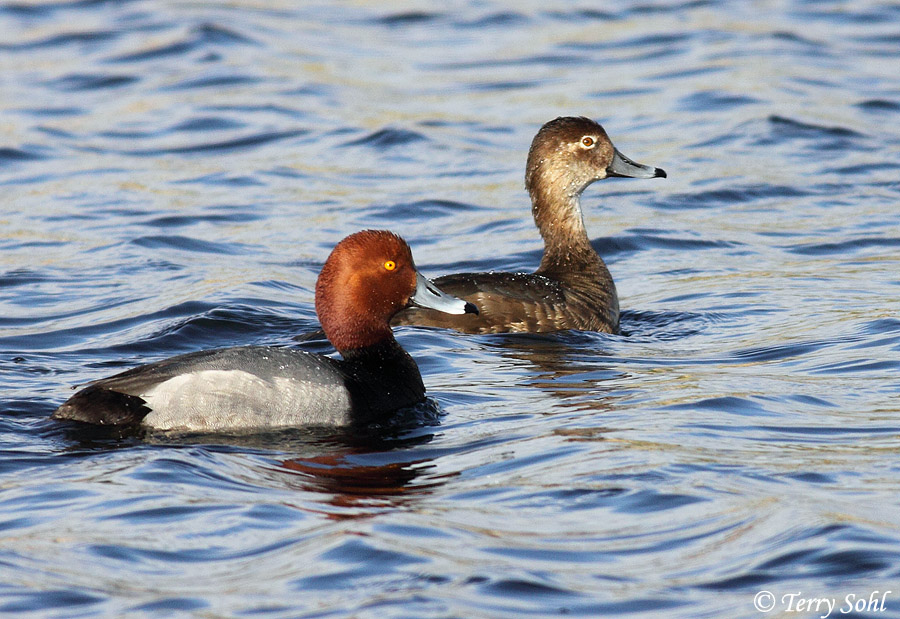
- Redhead - The red head on a Redhead male makes them easy to distinguish from Lesser Scaup, but female Redheads could be confused with female Lesser Scaup. Female Redheads have white around the eye, and an completely black bill tip that are lacking from female Lesser Scaups.
 |
 |
 |
 |
| Greater Scaup (male) | Greater Scaup (female) | Ring-necked Duck (male and female) | Redhead (male and female) |
Conservation Status
Systematic surveys over the last several decades show slight declines in North America. However, Lesser Scaup are still found across a very broad geographic area, they are common in parts of their range, and overall numbers are strong. The IUCN considers the Lesser Scaup to be a species of "Least Concern".
Photo Information
March 26th, 2006 - Lake Vermillion, South Dakota - Terry Sohl
Audio File Credits
- 1Thomas Magarian. Recorded in Pondera County, Montana on April 9th, 2015. Original recording and information available from xeno-canto.
- 2Paul Driver. Recorded in Lostwood National Wildlife Refuge, North Dakota. Original recording and information available from xeno-canto.
