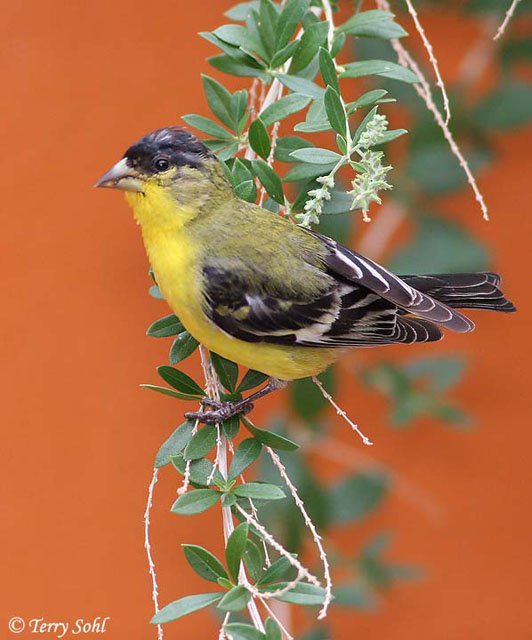
The Lesser Goldfinch is a small finch of the western U.S. Male birds have variable color phases, as birds in the eastern part of their range tend to have dark olive-green backs, while those further west have black backs. The complicated musical warbling of the male often includes snippets of songs from other bird species.
In South Dakota, Lesser Goldfinch were considered an occasional visitor, with sightings in scattered locations in the southwestern part of the state. It wasn't until the 2000s that breeding was confirmed, in Fall River County.
Habitat
Found in a variety of semi-open habitats with brush or trees adjacent to open grassy or weedy areas. They also can be found in and around urban and suburban areas, including parks and residential gardens.
Diet
Seeds make up the majority of the diet in all seasons. Also will feed on small insects on occasion, particularly during the summer breeding season.
Behavior
Gregarious except when nesting, usually foraging in small flocks, sometimes mixed with other species. Will forage at any level of the vegetation and on the ground.
Breeding
For many years Lesser Goldfinch had occasionally been sighted in the far southwestern edge of the state, but it wasn't until the 2000s that breeding was confirmed. The nest of a Lesser Goldfinch is placed in the fork of a tree branch or in a dense shrub, usually protected by dense foliage or other cover. The female builds the nest, a cup consisting of grasses, bark, leaves and other vegetative material, lined with hair, plant down, or feathers. Between 3 and 6 eggs are laid, with the female incubating them for about 12 days. Young fledge from the nest about 2 weeks after hatching.
Song
Fast musical warbling and sweet notes. The call is a soft slurred downscaled note
- Click here to hear the song of a Lesser Goldfinch1
- Click here to hear the call of a male Lesser Goldfinch2
Migration
A permanent resident throughout much of its range. However, birds in more inland locations do tend to move southward or towards the West Coast for the winter.
Interactive eBird Map
Click here to access an interactive eBird map of Lesser Goldfinch sightings
Similar Species
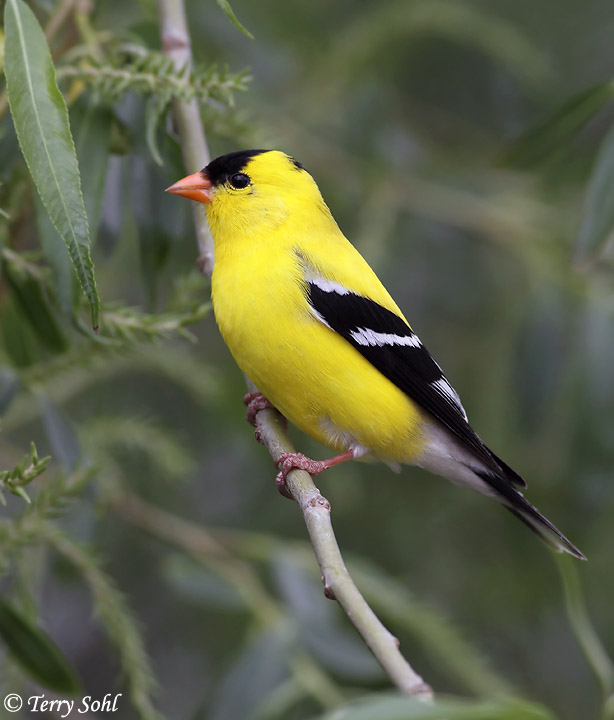
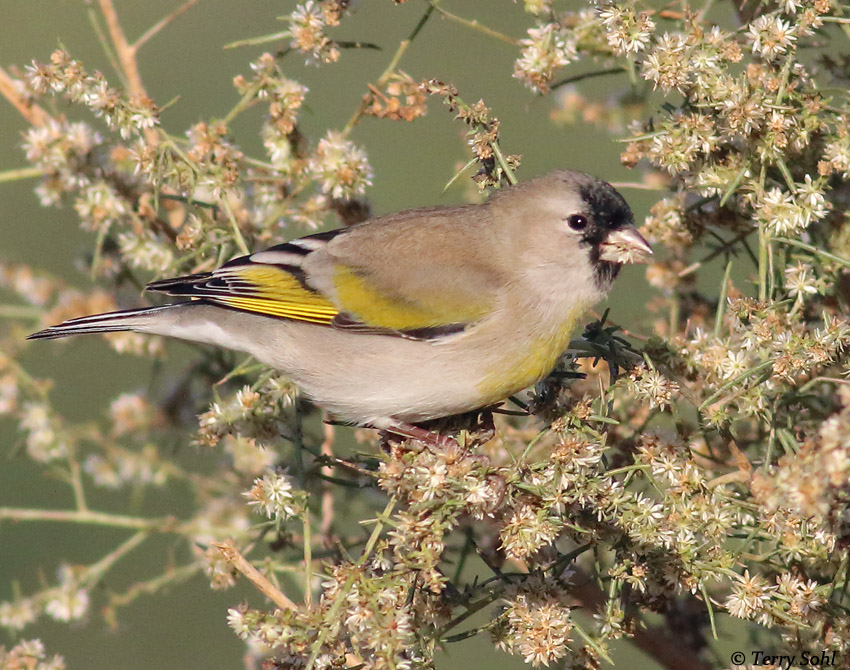
American Goldfinch and Lawrence's Goldfinch could potentially be confused with a Lesser Goldfinch. Click here for a page that describes the differences among Lesser, American, and Lawrence's Goldfinch.
- American Goldfinch - For male birds, American Goldfinch and Lesser's Goldfinch are readily differentiated by the plumage color on their backs. Lesser Goldfinch have either greenish-yellow or black backs (see greenish-yellow phase in photo to the right). American Goldfinch have the same yellow plumage on their backs as they do on their underparts. In breeding plumage, the American Goldfinch has a bright orange bill, while Lesser Goldfinch have a much subtler bill color. Female American Goldfinch have darker wings than a female Lesser Goldfinch. American Goldfinches in any plumage lack the small white wing patch of a Lesser Goldfinch, often visible on females at rest, with white peeking out on their upper wing.
- Lawrence's Goldfinch - Lawrence's Goldfinch are more easily differentiated from either Lesser Goldfinch or American Goldfinch, with a dark chin and more gray tones than found on breeding plumage Lesser or American Goldfinch.
 |
 |
 |
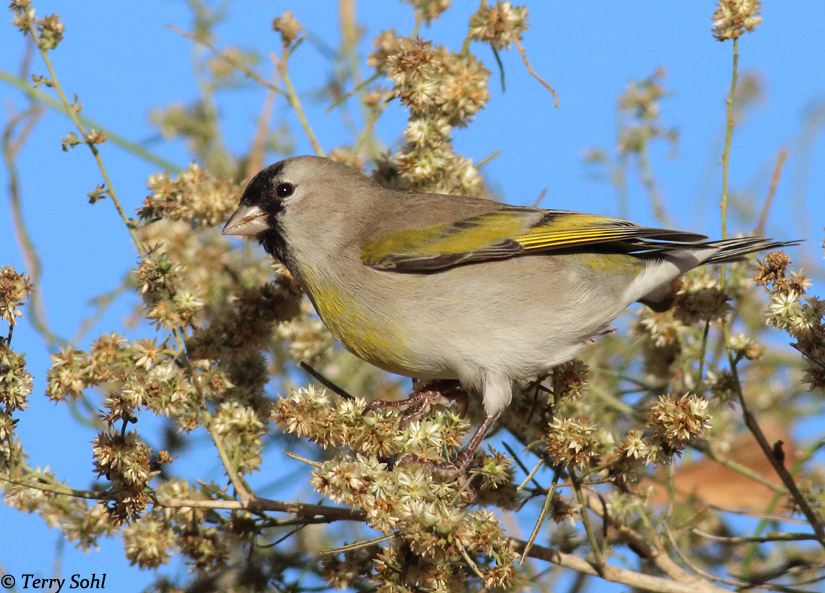 |
| American Goldfinch (male) | American Goldfinch (female) | Lawrence's Goldfinch | Lawrence's Goldfinch |
Conservation Status
Overall numbers appear to be in decline. However, they are still found over a very wide geographic area and are common in parts of their range. The IUCN considers the Lesser Goldfinch to be a species of "Least Concern".
Bird Feeders
Will readily come to feeders for niger ("thistle") seed and sunflower seeds.
South Dakota "Hotspot"
Lesser Goldfinch have been found in scattered locations throughout southwestern South Dakota, particularly in Fall River County. Hot Brook Canyon near Hot Springs is a location where they have often been seen.
Photo Information
September 11th, 2006 -- In Tucson, Arizona -- Terry Sohl
Audio File Credits
- 1Ross Gallardy. Recorded in Santa Cruz County, Arizona on March 21st, 2015. Original recording and information available from xeno-canto.
- 2Manuel Grosselet. Recorded near Mexico City on June 24th, 2018. Original recording and information available from xeno-canto.
