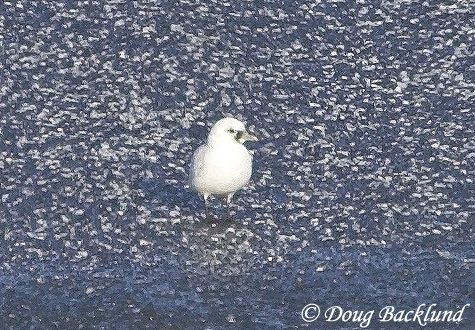
ID Keys: The only gull that is pure white (in adult plumage), with
black legs and eyes, and an orange-tipped yellow bill.
First-year birds may have a dark face and scattered black spots on
their wings.
Ivory
Gulls are true birds of the Arctic, rarely being found away from the
vicinity of pack ice in the northern Arctic. They are the only gull
with a pure white plumage as adults, and even first-year birds only have a
smattering of darker markings on their face and wings. They do move
southward in the winter, following the edge of the expanding winter ice
pack, but only very rarely stray as far south as the Canada/United States
border. Ivory Gulls are unexpected in South Dakota were unknown here
until February 16th, 2008, when Ricky Olson spotted one at Oahe Dam near
Pierre.
Habitat
The Ivory Gull is a true High Arctic species, spending most of its life in remote polar environments closely associated with sea ice. It breeds on isolated rocky cliffs, nunataks, and coastal islands in the Arctic, while outside the breeding season it forages along the edges of pack ice, where it feeds on fish, marine invertebrates, carrion, and the remains left by polar bears. Unlike most gulls, it rarely ventures far from ice-covered waters, making it one of the world's most specialized seabirds.
Diet
Varied, including a wide variety of marine
life (small fish, crustaceans, mollusks, and insects). They are also
willing scavengers, feeding on carcasses and even garbage dumps.
Behavior
Ivory Gulls are highly adapted to life in the Arctic and are often seen following polar bears, seals, or ships to scavenge food. They are graceful, buoyant fliers that frequently forage along the edge of sea ice, picking prey from the water's surface or feeding on carrion. During the breeding season, they nest in small, loose colonies in some of the most remote and inaccessible locations on Earth.
Breeding
Non-breeder in South Dakota. In range, Ivory Gulls nest in small colonies or as isolated pairs on remote Arctic cliffs, rocky outcrops, gravel ridges, and nunataks surrounded by glaciers. The nest is a shallow scrape lined with moss, lichens, seaweed, feathers, and other available vegetation. The female typically lays 1–3 eggs, and both parents share incubation duties and care for the chicks until they fledge.
Song
Ivory Gulls are generally quiet except during the breeding season, when they become more vocal around nesting colonies. Their calls include harsh, gull-like kree, kaah, and chattering notes used in courtship, territorial defense, and communication between mates. Away from breeding sites, they are often silent while foraging over the Arctic pack ice.
Migration
Movements are typically limited to
following the edges of pack ice, as they will move south as the Arctic ice
cap expands in winter. However, they are only an extremely rare
straggler south of northern and central Canada, with occasional records as
far south as New England and the Great Lakes.
Generally distinctive, as they
are the only gull with pure white plumage as adults.
Status
The Ivory Gull is classified as Near Threatened globally by the IUCN, and many populations have experienced significant declines over recent decades. Climate change and the loss of Arctic sea ice pose the greatest long-term threat by reducing critical foraging habitat, while pollutants, oil spills, and disturbance at breeding colonies also contribute to population declines. Because of its dependence on sea ice, the Ivory Gull is considered an important indicator of the health of Arctic ecosystems.
Photo Information
Oahe Dam area near Pierre -
February 16th, 2008 - Doug
Backlund