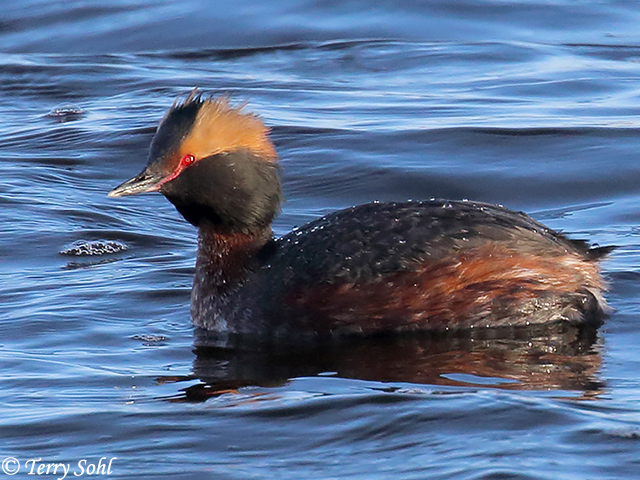
Horned Grebes are a widespread grebe, also found in Europe and Asia. They are often relatively tame, allowing fairly close approach by humans. Horned Grebes are not as gregarious as many of the grebes, and don't breed in the large colonies that other grebes sometimes do. The Horned Grebe is similar to the Eared Grebe, but can best be differentiated in summer plumage by the reddish neck (the Eared Grebe has a blackish neck), and different patterns in the golden tufted plumage behind the eye (see notes below).
Habitat
During the summer breeding season, Horned Grebes prefer areas with open water and extensive wetland vegetation, breeding in areas such as wetlands and ponds in the Prairie Potholes of the Plains of the northern US and southern Canada, or ponds, lakes, and wetlands in the boreal zone further north. During migration and in winter, they can be found in almost any aquatic habitat with adequate open water.
Diet
Mostly insects and crustaceans during summers in South Dakota, but Horned Grebes will also feed on fish, amphibians, leeches, and some plant material.
Behavior
Primarily feeds by diving under the water's surface and propelling itself through the water with its feet. They will also pluck food items from the water's surface, and even will capture passing insects as they fly by.
Nesting
June and July. Courting Horned Grebes have an elaborate set of rituals that include swimming in formation together, posing for each other, and presenting each other with "gifts" of aquatic vegetation. Once a mating pair has been established, both parent stays together through incubation and raising of the young. They build a nest in shallow water, typically a mat of floating vegetation anchored to the surrounding vegetation, or a mound of aquatic vegetation that's been build up from the bottom of the pond or wetland. They form a shallow depression as a nesting site, in which the female lays between 3 and 7 eggs. Both parents help to incubate the young, a time during which each parent may bring food to the other parent when returning to the nest site. The young hatch after about 22 to 25 days, and soon leave the nest to start gathering food on their own. Both parents stay with the young, protecting them from harm until they fledge and are better able to escape danger.
Song
In migration and in winter, Horned Grebes are often silent. However, they are very vocal on their breeding grounds, with breeding pairs courting each other wish a rapid, loud trilling duet. They also have a loud kee-wah often given as a contact call, and a high-pitched, strained honking call that seems to be most often given in alarm.
- Click here to hear the trilling duets of a pair of Horned Grebes on their breeding grounds1
- Click here to hear a kee-wah call of a Horned Grebe2
- Click here to hear a high-pitched honking call of a Horned Grebe3
Migration
Summers in extreme northern U.S. the western 2/3rds of Canada, and Alaska. Generally winters along North American coastlines and large inland water bodies in the south. In South Dakota, Horned Grebes are migrants throughout the state, but are also uncommon breeding birds in the north-central and northeastern part of the state.
Interactive eBird Map
Click here to access an interactive eBird map of Horned Grebe sightings
Similar Species
Horned Grebes could potentially be confused with a couple of other grebe species that are found in South Dakota.
- Eared Grebe
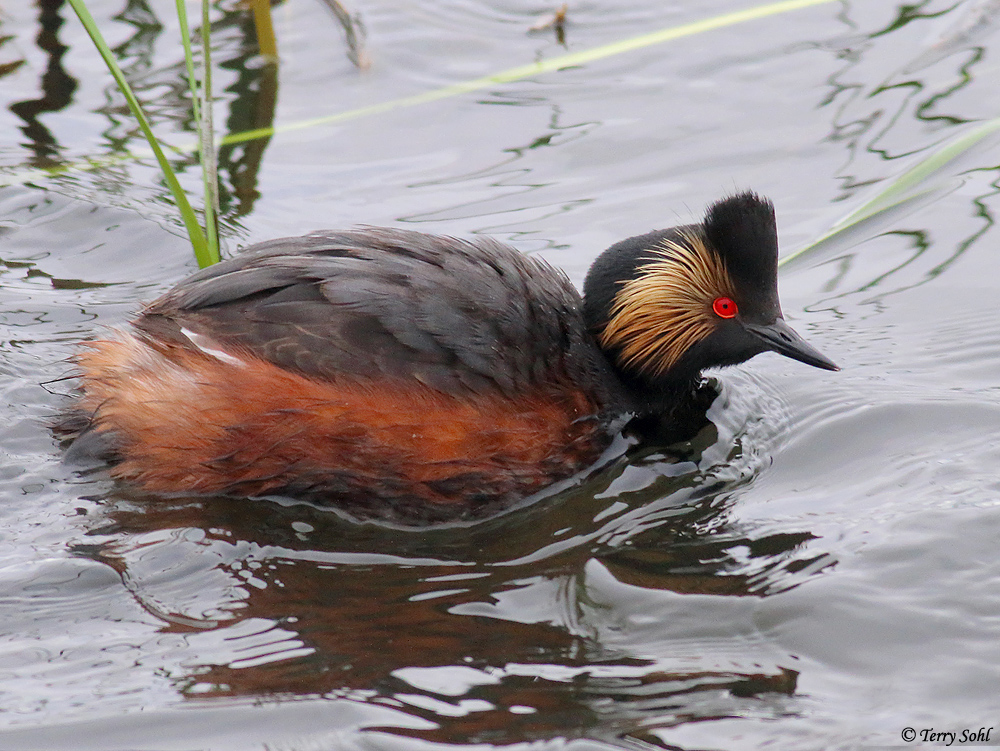
- Eared Grebes are the species closest in appearance to Horned Grebes,
as both species have dark backs, ruddy brownish flanks, and dark heads
with some unique light-colored plumage. On a breeding-plumaged Eared
Grebe, the "ears" are a spray of golden feathers radiating out from
behind the eye in many directions, resulting in a fan-based plume of
feathers that form the "ear". On a breeding-plumaged Horned Grebe, the
plume of feathers also originate from around the eye, but are more
streamlined and oriented in one direction back towards the bird's nape,
giving it more of an appearance of, well...using a hair care product to
keep it's plume manageable, compared to the more "wild" plume of an
Eared Grebe! Eared Grebes also have a black neck, compared to the dark
ruddy brown neck of a Horned Grebe.
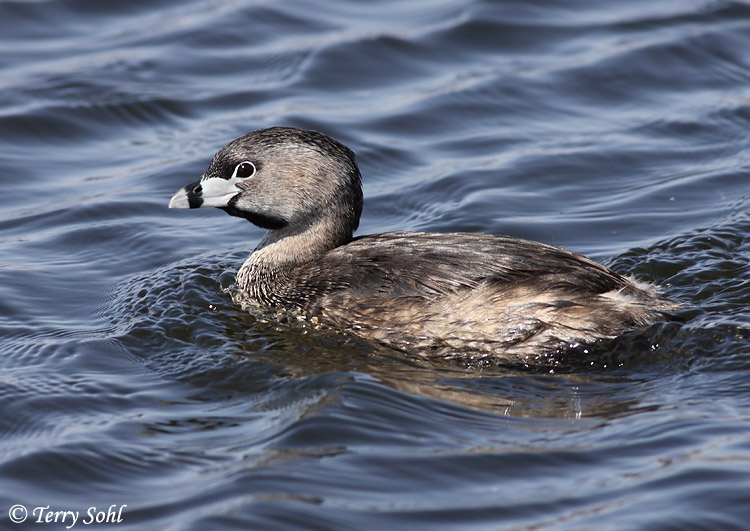
On non-breeding birds, both species have much simpler plumage with white and dark tones. Just as an Eared Grebe has a "messier hairdo" in breeding plumage, the appearance in non-breeding plumage is less "clean" than that of a Horned Grebe. On an Eared Grebe, the dark cap extends below the eye to parts of the cheek and has a rather messy transition to the lighter-colored lower face and chin. On a non-breeding Horned Grebe, there's a clean line between a dark cap, extending down to the eye, and a clean light-colored face and chin with a sharp dividing line between the two colors. - Pied-billed Grebe - Pied-billed Grebes are easier to differentiate from Horned Grebes. For one, they have a much more stout bill, which in breeding plumage has a distinct black band. The combination most likely to be confused is a breeding-plumaged Pied-billed Grebe and a non-breeding plumaged Horned Grebe, as both are tones of white and grayish tones. However, breeding-plumaged Pied-billed Grebe are more uniform in tone on their body, head and neck, while non-breeding plumaged Horned Grebes have darker upperparts and lighter underparts.
 |
 |
 |
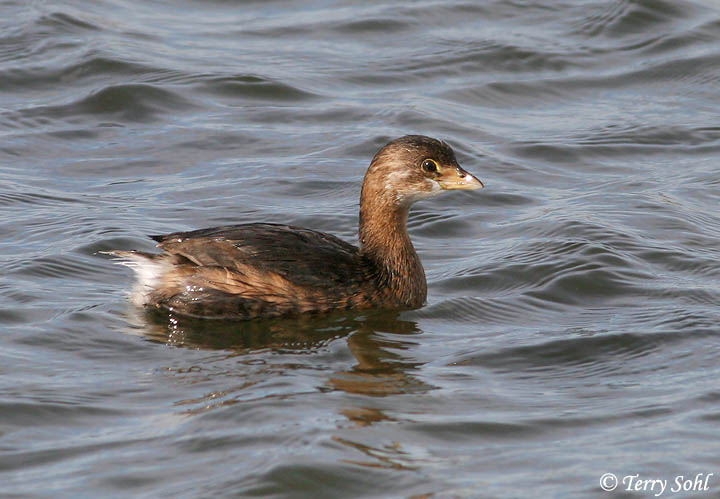 |
| Eared Grebe (breeding plumage) | Eared Grebe (non-breeding plumage) | Pied-billed Grebe (breeding plumage) | Pied-billed Grebe (non-breeding plumage) |
Conservation and Population Status
Systematic surveys in both the North American and European parts of the range of Horned Grebes show very steep declines in populations over the last 40 years, with declines approaching 75% in North America. It's likely there is more than one cause behind the sharp declines. Human land use and land management has undoubtedly contributed to the decline. In the southern part of their range in the Prairie Potholes, many wetlands have been lost in the last 200 years as the land has been drained and converted to agricultural land. In recent decades, runoff from that agricultural land has caused many of the shallow lakes and wetlands preferred by Horned Grebe to undergo eutrophication, with nutrients from ag runoff fueling high-levels of algal and other vegetation growth, disrupting food webs upon which Horned Grebes depend. Forested lands further north in their breeding range have also undergone extensive land use change, with forestry activity and associated human activity disrupting local ecosystems. Horned Grebes also seem uniquely susceptible to entanglement and death from gill nets used in commercial fisheries. Overall, Horned Grebes are still found across a very broad geographic area and there are decent numbers in parts of that range, but the sharp declines in recent decades have led the IUCN to list the Horned Grebe as a "Vulnerable" species.
Further Information
- eBird - Horned Grebe
- Audubon Field Guide - Horned Grebe
- Cornell Lab of Ornithology - All About Birds: Horned Grebe
Photo Information
April 13th, 2019 - Wall Lake, Minnehaha County - Terry Sohl
Audio File Credits
- 1Simon Elliott. Recorded in Highland, Scotland on April 11th, 1993. Original recording and information available from xeno-canto.
- 2Stanislas Wroza. Recorded in the northwestern region of Iceland on July 28th, 2018. Original recording and information available from xeno-canto.
- 3Stanislas Wroza. Recorded in the northeastern region of Iceland on July 27th, 2018. Original recording and information available from xeno-canto.
