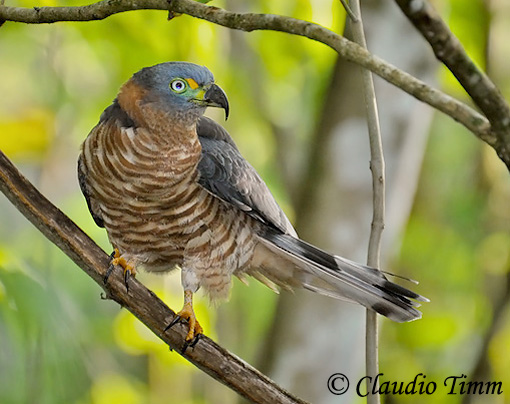
The Hook-billed Kite is a rather odd raptor that just reaches the U.S. in extreme southern Texas. It was unknown in the U.S. until the 1960s, but now seems to be a permanent resident in the forested woodlands along the Rio Grande. The strongly hooked bill is used to extract the "meat" from its main prey, tree snails. The species has a widespread geographic range, and is found in much of Mexico, Central America, and South America. Plumage and bill size are quite variable between geographic locations, with bill size seemingly correlated to the size of snails in their foraging range.
Habitat
The Hook-billed Kite inhabits tropical and subtropical forests, forest edges, gallery forests, wooded river corridors, mangroves, and semi-open woodlands. It prefers areas with mature trees and dense canopy cover but also occurs in second-growth forests and lightly wooded landscapes. Throughout its range, the species is most often associated with humid forests where arboreal snails, its principal prey, are abundant.
Diet
The Hook-billed Kite feeds primarily on tree snails, using its strongly hooked bill to extract the soft-bodied animals from their shells. It also consumes slugs, insects, lizards, frogs, small mammals, nestling birds, and occasionally eggs. Arboreal snails, however, make up the majority of its diet throughout much of its range.
Behavior
The Hook-billed Kite is a quiet, secretive raptor that spends much of its time perched within the forest canopy or soaring slowly above woodlands. It searches methodically for arboreal snails, using its specialized hooked bill to extract them from their shells. The species is usually seen alone or in pairs and is generally unobtrusive, making it one of the more difficult tropical raptors to observe.
Nesting
The Hook-billed Kite builds a small stick nest high in the canopy of a tree, usually concealed among dense foliage. The female typically lays 1–2 white or pale bluish eggs marked with brown or reddish blotches, and both parents participate in incubation and care of the young. Nesting pairs vigorously defend the area around the nest until the chick fledges.
Song
The Hook-billed Kite is generally quiet but gives a series of thin, high-pitched whistles and plaintive, descending calls, especially during the breeding season. These vocalizations are used for communication between mates and territorial defense. Most birds remain silent while hunting or perched within the forest canopy, making the species difficult to detect.
Migration
The Hook-billed Kite is primarily a resident species throughout most of its range from Mexico through Central and South America. Most individuals remain in the same general area year-round, although some populations may make short local or seasonal movements in response to food availability or rainfall. It is not considered a long-distance migratory raptor, and only rare wandering individuals occur outside their normal range.
Interactive eBird Map
Click here to access an interactive eBird map of Hook-billed Kite sightings
Similar Species
Snail Kite. The Hook-billed Kite has a short, strongly hooked bill adapted for extracting tree snails from shells and typically inhabits forests, whereas the Snail Kite has a long, slender, deeply curved bill specialized for feeding on aquatic apple snails in marshes and wetlands. Hook-billed Kites are broader-winged and highly variable in plumage, while Snail Kites are more uniformly dark (adult males) or brown streaked (females and immatures) and are almost always associated with freshwater wetlands.
Conservation Status
The Hook-billed Kite is classified as Least Concern by the International Union for Conservation of Nature because of its extensive range from Mexico through Central and South America and its relatively stable global population. Although localized deforestation and habitat loss may affect some populations, the species remains widespread in suitable forest habitats. It is not currently considered globally threatened.
Further Information
- eBird - Hook-billed Kite
- Audubon Field Guide - Hook-billed Kite
- Cornell Lab of Ornithology - All About Birds: Hook-billed Kite
Photo Information
July 23rd, 2011 - Belem, Brazil - By Claudio Dias Timm - Photo licensed under Creative Commons Attribution-NonCommercial-ShareAlike 2.0 Generic license .
