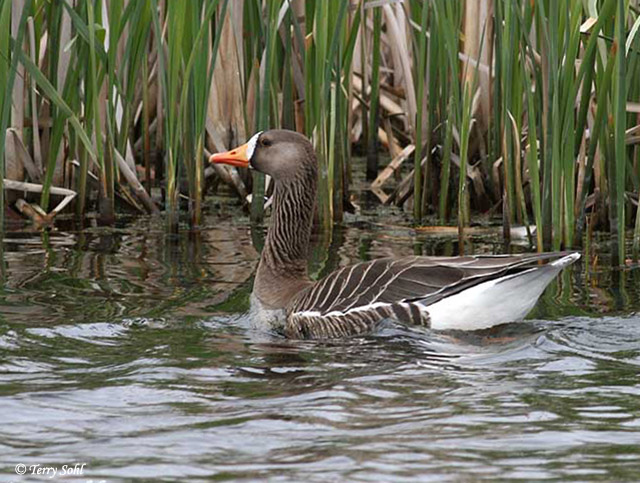
The Greater White-fronted Goose is a medium-sized goose that breeds on Arctic tundra across North America, Europe, and Asia. It is easily recognized by the white patch at the base of its pink bill, dark barring on the belly of adults, and bright orange legs. The species feeds primarily on grasses, sedges, grains, and other plant material, often grazing in agricultural fields during migration and winter. Greater White-fronted Geese are highly social, traveling in noisy flocks and forming large concentrations at important wetlands and staging areas. In North America, they migrate between Arctic breeding grounds and wintering areas in the southern United States and Mexico, following major flyways each spring and fall
Habitat
Breeds on both wet coastal areas and drier inland areas on the Arctic tundra. In migration and in winter, they are generally found in open habitats where they have easy access to both agricultural fields for feeding and shallow waters for roosting at night.
Diet
Primarily feeds on grasses, sedges, other plants, berries, and buds in the summer. Relies heavily on seeds and waste grain in the winter, as well as new growth. They will also occasionally feed on snails and aquatic insects.
Behavior
Often forages on land, walking along and eating food items on the ground. In the water, swims on the surface, reaching its head and neck under the water for food items.
Breeding
Non-breeder in South Dakota. On their breeding grounds, the nest of a Greater White-fronted Goose is a scrape on the ground, placed in either upland tundra or wetter areas near a pond or wetland. The scrape is lined with grasses, and then finished with downy feathers. The female lays between 2 and 7 eggs, and she alone incubates them. The young hatch after 22 to 27 days.
Family bonds are strong with Greater White-fronted Snow Geese, as mating pairs form long-term bonds and stay together even outside of the nesting season. Young Greater White-fronted Snow Geese will also stay with the parents into the next nesting season.
Song
High-pitched laughing honk
- Click here to hear the honking of a White-fronted Goose in flight1
- Click here to hear the honking of a group of White-fronted Geese in flight2
- Click here to hear the "nocturnal flight call" of a White-fronted Geese3
Migration
Summers on the Arctic tundra. Winters locally in California, Washington, Oregon, New Mexico, and Arizona, as well as near the U.S. Gulf Coast and Mexico. They tend to follow established routes and use the same stopover points each season. They are generally only found west of the Mississippi River.
Interactive eBird map
Click here to access an interactive eBird map of Greater White-fronted Goose sightings
Similar Species
Greater White-fronted Geese have a unique plumage if seen well, but they could potentially be confused with the following species in poor viewing conditions.
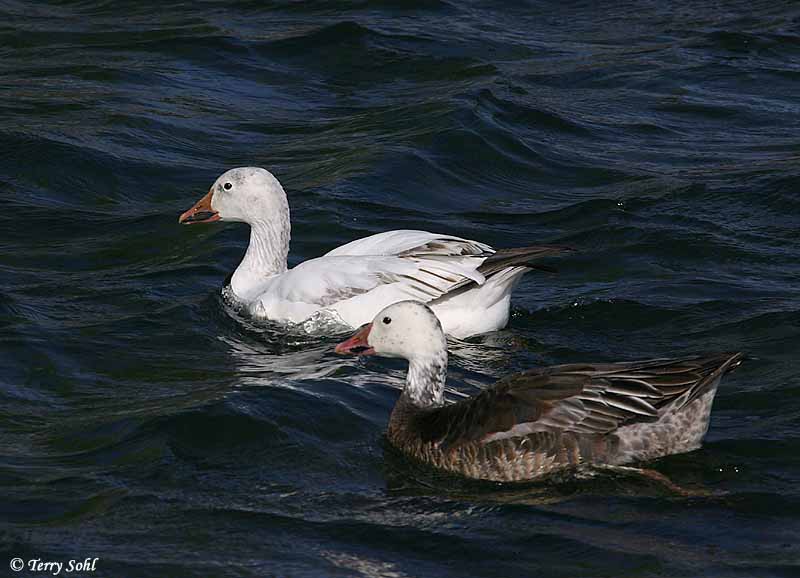
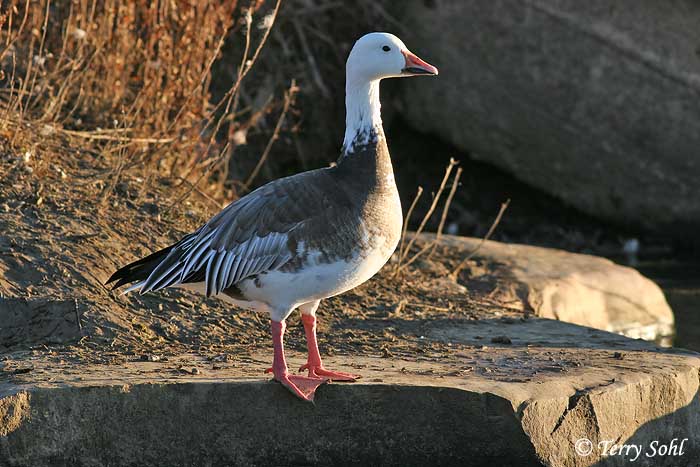
- Snow Goose - With their all-white plumage, the white phase Snow Goose is unlikely to be confused with a Greater White-fronted Goose. However, the dark-phase of a Snow Goose could be confused with a Greater White-fronted Goose. The dark back of the two looks very similar, but a dark-phase Snow Goose has a white head, and more white on its underparts than a Greater White-fronted Goose.
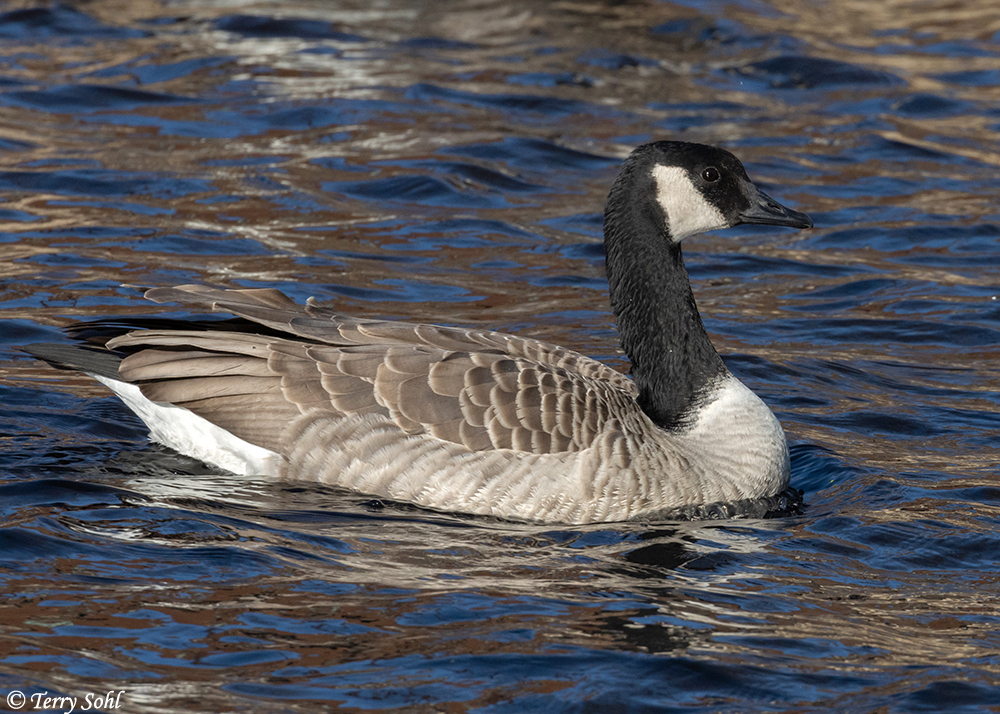
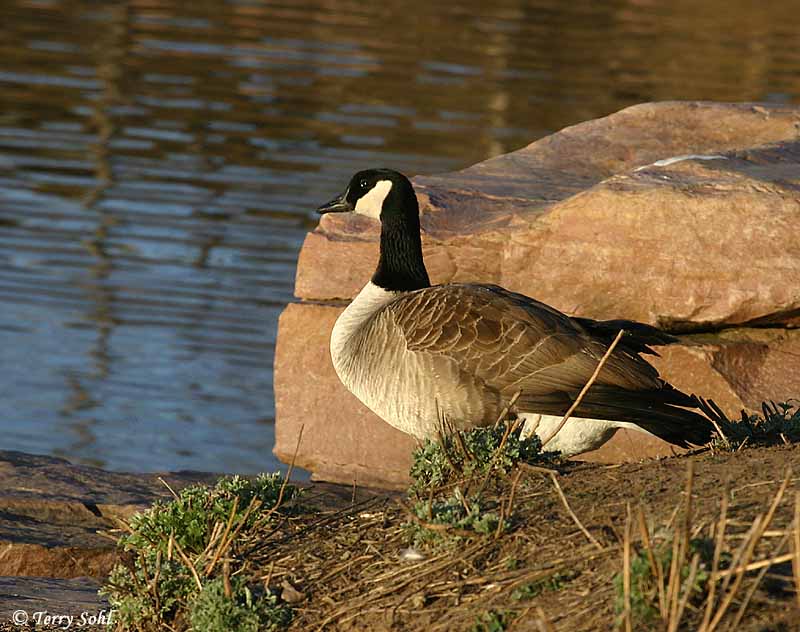
- Canada Goose - The bodies of both geese can look surprisingly similar. The rest of the body is quite different! Canada Goose has a black head and neck with a white chin-strap, while a Greater White-fronted Goose has brownish neck and head, with a white patch in front of the eye. The legs of the two species are also different, with black legs on the Canada Goose, and orange legs on a Greater White-fronted Goose.
 |
 |
 |
 |
| Snow Goose | Snow Goose | Canada Goose | Canada Goose |
Conservation Status
In the North American part of their range, populations of Greater White-fronted Geese have substantially grown in the last 40 years, in part, rebounding from sharp declines during the first half of the 20th century. They are found across a very broad geographic area, and they are common in many parts of that range. The IUCN considers the Greater White-fronted Goose to be a species of "Least Concern".
Further Information
- eBird - Greater White-fronted Goose
- Audubon Field Guide - Greater White-fronted Goose
- Cornell Lab of Ornithology - All About Birds: Greater White-fronted Goose
Photo Information
March 20th, 2005 -- Western Minnehaha County -- Terry Sohl
Audio File Credits
- 1Alain Malengreau. Recorded in Belgium on December 19th, 2019. Original recording and information available on xeno-canto.
- 2Bram Vogels. Recorded in Belgium on December 8th, 2020. Original recording and information available on xeno-canto.
- 3Juha Saari. Recorded in Finland on October 4th, 2020. Original recording and information available on xeno-canto.
