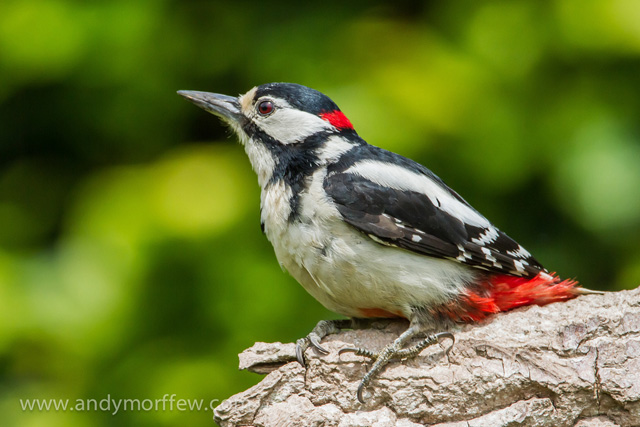
The Great Spotted Woodpecker is a widespread woodpecker found across Europe and much of Asia, where it inhabits deciduous, coniferous, and mixed forests, parks, orchards, and wooded suburban areas. It is easily recognized by its bold black-and-white plumage, white shoulder patches, bright red undertail, and, in males, a red patch on the back of the head. The species feeds on insects, seeds, and nuts, using its strong bill to excavate wood and open pine cones. It also readily visits bird feeders, especially during winter, to eat suet, peanuts, and sunflower seeds. In North America, the Great Spotted Woodpecker is an extremely rare vagrant, with only a handful of records, primarily from islands in western Alaska.
Habitat
Found in forested habitats, usually in deciduous forests, but also utilizing conifer forests in some areas. Has adapted well to a human presence, and can be found in parks, gardens, and other vegetated urban areas.
Diet
Feeds on insects, feeding heavily on ants when available. They will also take nuts, fruits, and berries, as well as occasionally taking other items such as eggs or young nestlings. Diet often varies by season, with more insects in the summer months, and more vegetative material in the winter.
Behavior
Often forages by flying to the trunk of a tree and working its way up, searching for insects. Has also increasingly learned to obtain food from feeders.
Nesting
The nest of a Great Spotted Woodpecker is a cavity in a tree, excavated by both the male and female. The female lays between 4 and 7 eggs, with both parents helping to incubate the eggs, and feed the nestlings after they hatch.
Song
The drumming of a Great Spotted Woodpecker is 8 to 12 taps, tapering off at the end. The call note is a stout tshik sound.
Migration
The Great Spotted Woodpecker is primarily a resident species, with most individuals remaining in the same area throughout the year. However, birds from northern and eastern parts of its range may make short-distance movements or occasional irruptions southward during years when cone and seed crops are poor. These movements are irregular and driven mainly by food availability rather than true long-distance migration.
Interactive eBird map
Click here to access an interactive eBird map of Great Spotted Woodpecker sightings
Similar Species
Distinct from other woodpeckers that have been seen in North America.
Feeders
Will attend feeders for suet, nuts, and fruits.
Conservation Status
The Great Spotted Woodpecker is classified as Least Concern by the International Union for Conservation of Nature because of its extensive range across Europe and Asia, large global population, and stable overall trend. The species readily adapts to a variety of wooded habitats, including forests, parks, and suburban areas. Although local populations may be affected by habitat changes, it is not currently considered globally threatened.
Further Information
Photo Information
Photo taken by Andy Morffew - June 25th, 2012 - Itchen Abbas, Hampshire, England - Photo licensed under Creative Commons Attribution NoDerivs 2.0 Generic License
