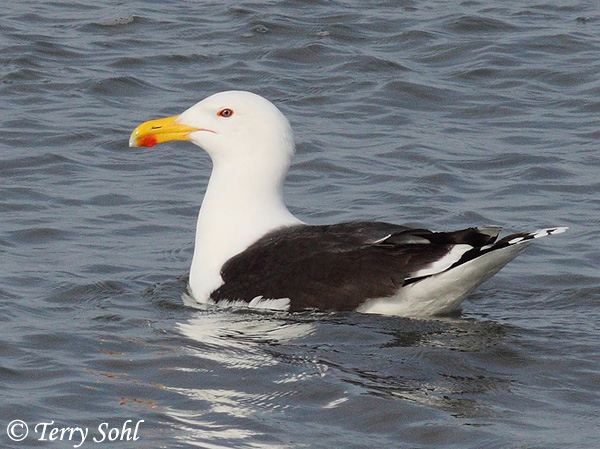
The Great Black-backed Gull is the largest gull in the world. It is primarily found in the North Atlantic, along the northeastern and Canadian coastlines in North America. it is rarely found inland except along the Great Lakes. It's range has been expanding in recent decades, as it has been appearing inland more often (still nearly always near the Great Lakes), and further south along the Atlantic coast. The species was unknown in South Dakota until a single specimen was documented along the Missouri River near Pierre in 2006.
Habitat
The vast majority of Great Black-backed Gulls are found in coastal waters of the North Atlantic. Small numbers are found around the Great Lakes. While primarily a coastal bird, some will spend much of the winter far offshore over the continental shelf.
Diet
Omnivorous. Food items may include fish, mollusks, crustaceans, large insects, carrion, eggs, birds, rodents, and occasionally vegetable matter such as fruits and berries. Its large size allow it to feed on birds and rodents that are too large for most gulls.
Behavior
Its omnivorous nature make it an opportunistic feeder. Great Black-backed Gulls will forage while on foot, while swimming, or in flight. They have adapted well to a human presence, and can often be found scavenging around garbage dumps, docks, and sea-going vessels.
Nesting
Non-breeder in South Dakota. In range, the Great Black-backed Gull nests in loose colonies or as isolated pairs on coastal islands, rocky cliffs, beaches, dunes, salt marshes, and occasionally on rooftops. The nest is a shallow scrape or mound made of grasses, seaweed, moss, and other vegetation. The female typically lays 2–3 olive or brownish eggs marked with dark spots, and both parents share incubation and vigorously defend the nest and chicks from intruders.
Song
The Great Black-backed Gull gives a variety of deep, harsh calls, including loud, laughing kow-kow-kow and grating keoh notes. Like other large gulls, it performs a characteristic long call with its head thrown back during territorial and courtship displays. Adults also use a range of alarm calls, begging calls, and softer contact notes when interacting with mates and chicks.
Migration
Great Black-backed Gulls are permanent residents in much of their range, but many move southward along the Atlantic coastline in winter, with the species much more common along the Southeastern U.S. coast in winter than in summer.
Interactive eBird Map
Click here to access an interactive eBird map of Great Black-backed Gull sightings
Similar Species
Lesser Black-backed Gull , Herring Gull . See Identification Tips page for "typical gulls" for information on distinguishing between similar species.
Status
The Great Black-backed Gull is classified as Least Concern by the International Union for Conservation of Nature because of its broad North Atlantic distribution and large global population. Although some regional populations have experienced declines due to changes in fisheries, pollution, and habitat conditions, the species remains widespread and is not currently considered globally threatened.
Further Information
- eBird - Great Black-backed Gull
- Audubon Field Guide - Great Black-backed Gull
- Cornell Lab of Ornithology - All About Birds: Great Black-backed Gull
Photo Information
April 13th, 2012 - Sachuest National Wildlife Refuge, Rhode Island - Terry Sohl
