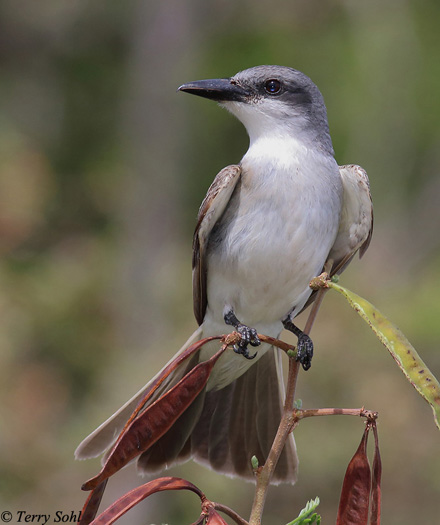
The Gray Kingbird is a widespread flycatcher species in the Caribbean. In the United States, they are summer breeding residents in Florida. In the United States, they are most likely to be confused with the Eastern Kingbird, but the much longer bill differentiates the Gray Kingbird. They are a species that has adapted well to a human presence, as they can often be found on farmland and around cities.
Habitat
In the United States portion of their range, Gray Kingbirds will utilize a variety of habitats, including both natural landscapes such as brushland and open woodland, as well as man-made landscapes such as agricultural land and suburban settings.
Diet
Primarily feeds on insects. They will also sometimes take small vertebrates such as baby birds and small lizards. They will also feed on fruits and berries in some locations.
Behavior
Forages by observing from a perch and flying out to capture insects in mid-air. They will also sometimes hover and glean insects from foliage and branches.
Nesting
The nest of a Gray Kingbird is a cup of sticks, grasses, weed stems, and roots, lined with softer material such as fine grasses. The female usually lays 3 or 4 eggs, with female doing most of the incubation. Upon hatching, both parents help to feed the young.
Song
The Gray Kingbird is a noisy species that gives loud, harsh, rolling calls often described as repeated kip-kip-kip or chattering notes. Males vocalize frequently during the breeding season to defend territories and communicate with mates. The species also produces sharp scolding calls when chasing predators or other birds away from its nest.
Migration
Gray Kingbirds are considered permanent residents in parts of their Caribbean range, but those found in the southeastern United States are just summer residents.
Interactive eBird Map
Click here to access an interactive eBird map of Gray Kingbird sightings
Similar Species
In range, most likely to be confused with the Eastern Kingbird , but the much larger bill and lack of a white band on the tail tip make the Gray Kingbird easy to differentiate from the Eastern Kingbird, if seen well.
Conservation Status
The Gray Kingbird is classified as Least Concern by the International Union for Conservation of Nature because of its wide distribution throughout the Caribbean, southern Florida, Central America, and northern South America and its large overall population. The species remains common in coastal habitats, urban areas, and open woodlands. Although localized habitat loss and severe storms may affect some populations, it is not currently considered globally threatened.
Further Information
- eBird - Gray Kingbird
- Audubon Field Guide - Gray Kingbird
- Cornell Lab of Ornithology - All About Birds: Gray Kingbird
Photo Information
Photo taken in June 2015 - St. John's Island, U.S. Virgin Islands - Terry Sohl
