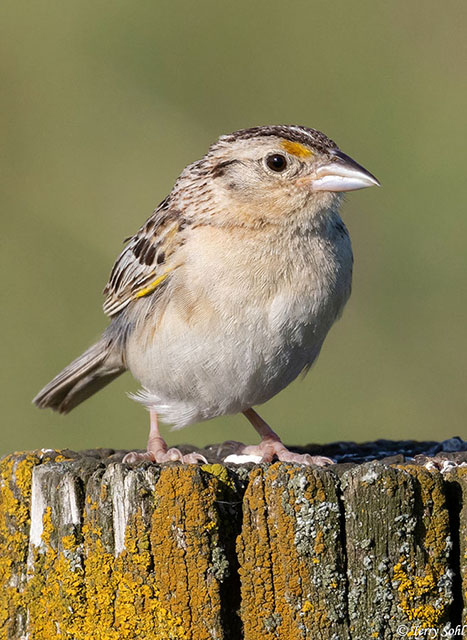
Named after its buzzy song which is very similar to a grasshopper, the Grasshopper Sparrow can sometimes be difficult to observe. Unless singing during the mating season, they prefer to stay out of sight near the ground in grassy areas, and will often run along the ground when moving about rather than flying. However, singing males can often be easily observed, as they sing from a taller perch in their grassland domain, such as a fence line or fence post, or the tallest clump of grass or other vegetation in their territory..
The Florida sub-species of the Grasshopper Sparrow is considered a Federally endangered bird. Habitat loss has been the primary cause of the decline, as vast swaths of land are converted to urbanized or agricultural land uses. Strong declines has also been noted elsewhere in their range as habitat is lost to human land uses.
Habitat
Grasslands and prairies, prefer ably with tall grasses and scattered shrubs. Will also use hayfields, and occasionally agricultural fields with other crops.
Diet
Primarily feeds on insects and spiders in the summer, while seeds and waste grain make up most of the diet in the winter (and a portion of the summer diet). Appropriately, grasshoppers are a preferred prey item in parts of its range. They also will feed on earthworms and snails.
Behavior
Nearly always forages along the ground. During the summer breeding season, they sometimes are found in loose breeding colonies, with individual males defending small patches of turf by singing from low perches.
Nesting
June and July in South Dakota. The nest of a Grasshopper Sparrow is placed on the ground, next to a grassy clump. The nest is a cup of grasses lined with fine roots, hair, and/or fine grasses. The nest is usually covered by a dome of grasses woven into the surrounding vegetation, with an entrance to the nest from the side. The female lays between 3 and 6 eggs, with the female incubating them. The young hatch after about 11 days, fledging from the nest about 8-10 days after hatching.
Song
The typical song of a Grasshopper Sparrow is an insect-like buzzing, typically preceded by a couple of tik notes (tik-tik-buzzzzzzzzzzzzz). Occasionally the song may also include a series of jumbled notes, typically when the song is given in flight. Calls of a Grasshopper Sparrow are typically a thin tseet, although they have other calls that may be used when alarmed or defending a nest.
- Click here to hear a singing Grasshopper Sparrow1
- Click here to hear the quiet call notes of a Grasshopper Sparrow2
- Click here to hear an alternative Grasshopper Sparrow song3
Migration
Summers throughout much of the U.S. Winters in the southern U.S., Mexico, Central America, and parts of the Caribbean. The are summer residents and migrants in South Dakota.
Interactive eBird Map
Click here to access an interactive eBird map of Grasshopper Sparrow sightings
Similar Species
Grasshopper Sparrows could potentially be confused with a few other small sparrow species. Note that each of the species noted below are not that common in South Dakota.
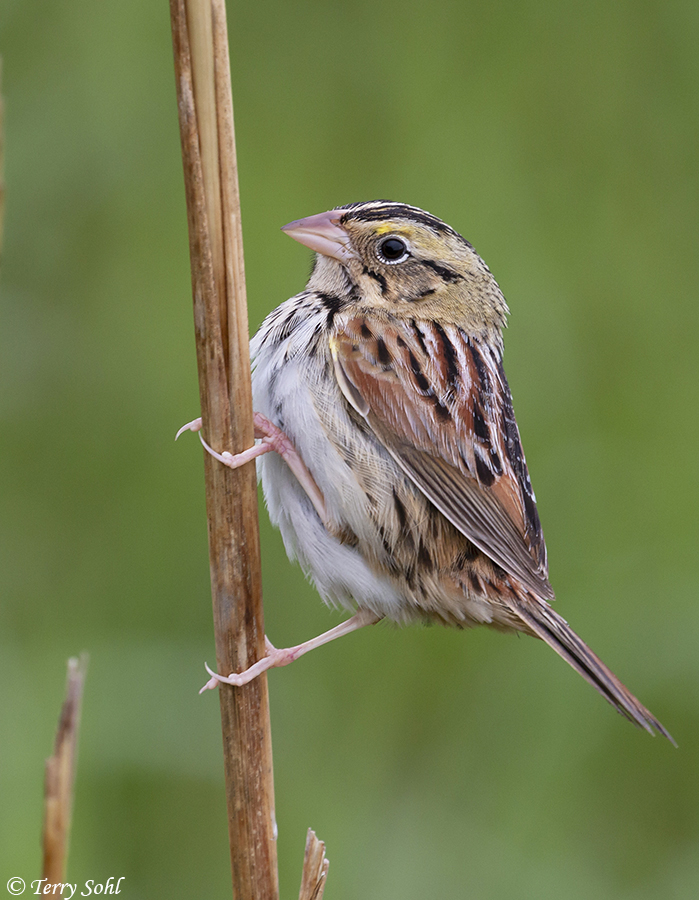
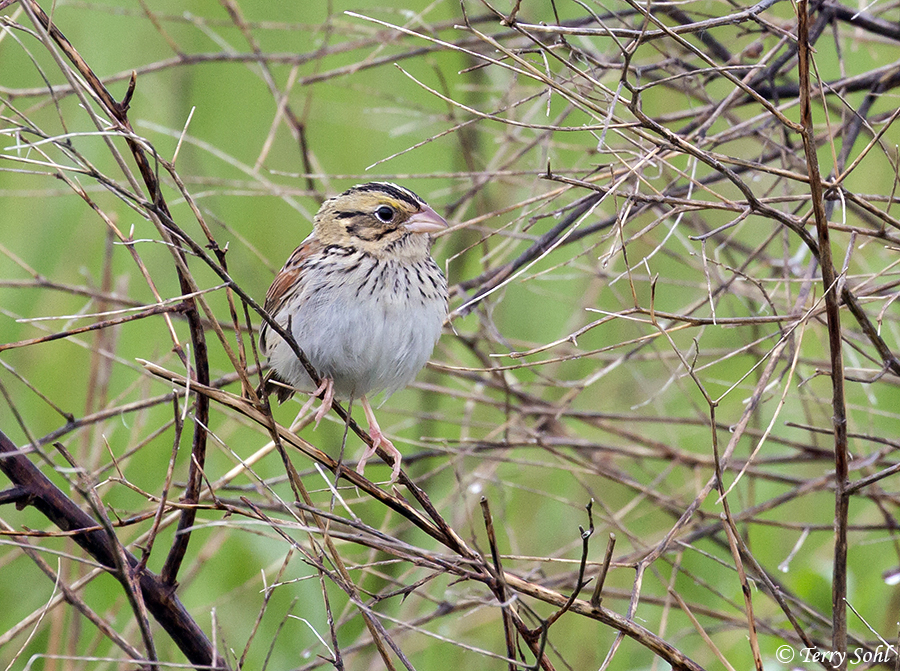
- Henslow's Sparrow - Henslow's Sparrows are but rare visitors in South Dakota, although in recent years there have been more and more sightings, primarily in the southeastern part of the state. They are about the same size and structure as a Grasshopper Sparrow. However, Henslow's Sparrows have obvious dark streaks on their flanks and upper breast. The head pattern on a Henslow's Sparrow is also stronger and more "contrasty", while the head of a Henslow's Sparrow tends to have a very subtle greenish tinge that gives it an appearance of a different colored head than the rest of the body.
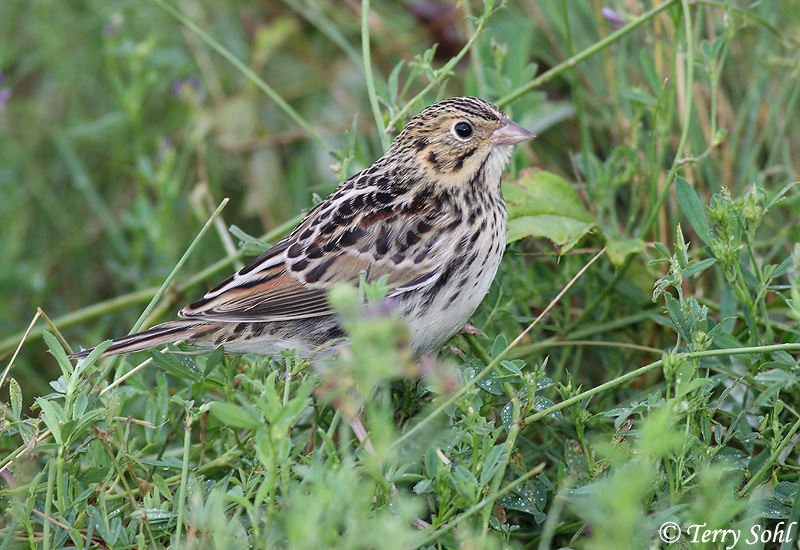
- Baird's Sparrow - Baird's Sparrows are another species that's quite rare in South Dakota, but they are found in the opposite corner of the state, in the far northwest. Baird's Sparrows have streaks on the flanks and upper breast that are lacking on a Grasshopper Sparrow. Baird's Sparrows also have a stronger facial pattern, including a dark "mustache stripe" lacking on the Grasshopper Sparrow.
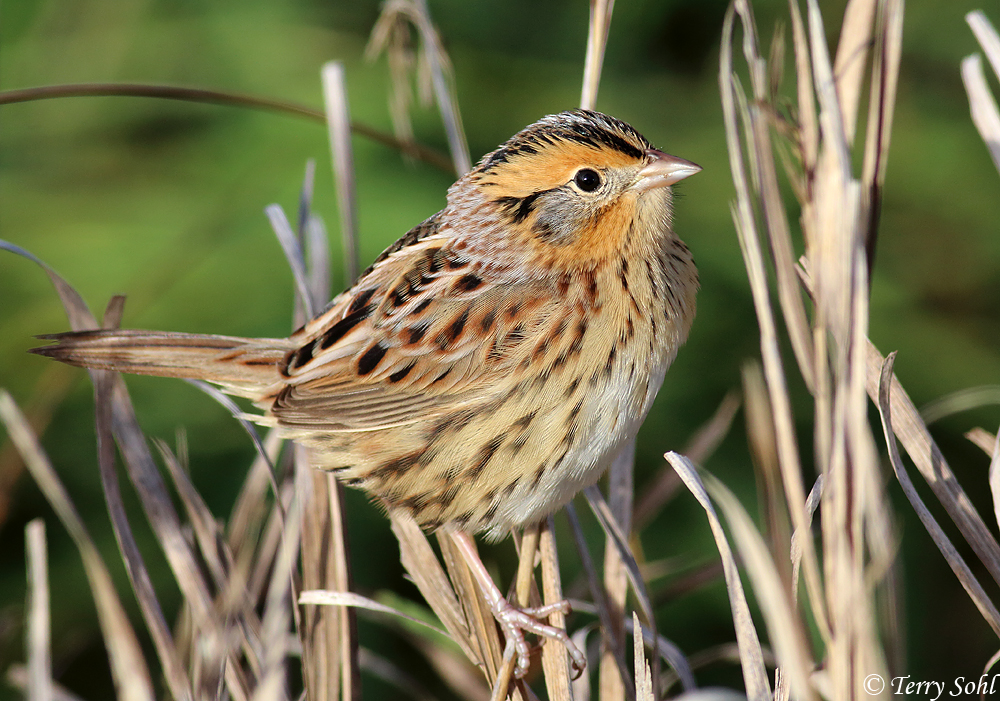
- LeConte's Sparrow - LeConte's Sparrows are found in yet a different corner of the state than the above two species, with summer breeding populations scattered and scarce in the northeastern edge of the state. They have streaks on the upper breast and flanks that are lacking on a Grasshopper Sparrow, and have a warmer, buffier look overall, particularly on the head.
 |
 |
 |
 |
| Henslow's Sparrow | Henslow's Sparrow | Baird's Sparrow | LeConte's Sparrow |
Conservation Status
Grasshopper Sparrows have shown severe declines locally. The
Florida sub-species is seriously endangered, as are local populations in the
Appalachians. Standard count surveys have indicated overall population
declines of over 50% in the last several decades. However, they are
still found across a very broad geographic area, and are common in parts of
that range. Thus,
the IUCN
considers the global Grasshopper Sparrow population to be of "Least Concern".
In South Dakota, they often show a strong preference for Conservation Reserve Program (CRP) land. Since about 2005, many farmers are giving up their CRP contracts and planting crops on former CRP land, which has the potential to seriously affect Grasshopper Sparrow populations in many areas. Overall cropland expansion that has occurred since 2005 in the Great Plains undoubtedly has had a negative impact.
Further Information
- eBird - Grasshopper Sparrow
- Audubon Field Guide - Grasshopper Sparrow
- Cornell Lab of Ornithology - All About Birds: Grasshopper Sparrow
Photo Information
July 11th, 2020 - McCook County, South Dakota -- Terry Sohl
Audio File Credits
- 1Joshua Stevenson. Recorded in Gibson County, Tennessee on July 12th, 2014. Original recording and information from xeno-canto.
- 2Paul Marvin. Recorded in Santa Cruz County, Arizona on February 11th, 2012. Original recording and information from xeno-canto.
- 3Jonathon Jongsma. Recorded in Custer State Park, South Dakota on June 21st, 2012. Original recording and information from xeno-canto.
