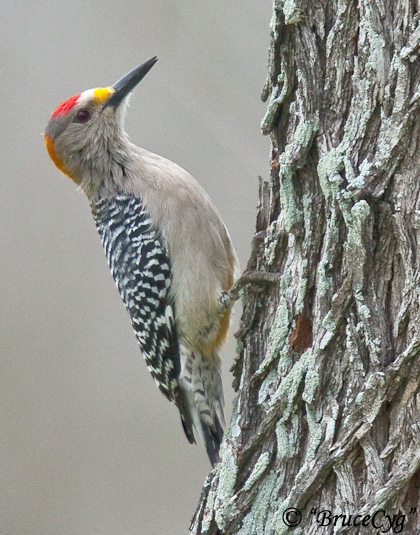
The Golden-fronted Woodpecker is a close relative of the Red-bellied Woodpecker, with a range that extends from Texas, southward into Mexico and Central America. Golden-fronted Woodpeckers do occasionally interbreed with Red-bellied Woodpeckers where their ranges meet in Texas. They are distinguished in appearance by the golden color on their nape and above the bill. Males and females are similar in appearance, except the male has a red crown, while the female has a plain gray crown.
Habitat
The Golden-fronted Woodpecker inhabits open woodlands, thorn forests, riparian woodlands, mesquite groves, parks, orchards, suburban neighborhoods, and lightly wooded agricultural areas. It prefers habitats with scattered mature trees that provide nesting cavities and abundant foraging opportunities. The species readily adapts to human-modified landscapes and is a common visitor to backyard feeders within its range.
Diet
The Golden-fronted Woodpecker has an omnivorous diet that includes insects, spiders, fruits, berries, nuts, and seeds. It gleans insects from bark, branches, and foliage, catches flying insects in midair, and readily visits feeders for suet, peanuts, and sunflower seeds. The species also consumes cactus fruits and other seasonal plant foods when available.
Behavior
Uses a variety of foraging techniques. They will climb through the branches of trees looking for insects. They will also forage on the ground, and sometimes fly out to capture insects in mid-air.
Nesting
The nest of a Golden-fronted Woodpecker is a cavity in a tree, or sometimes in a man-made object like a utility pole or fence post. The female usually lays 4 or 5 eggs, with both parents helping to incubate them. When the eggs hatch, both parents help to feed the young. They often raise more than one brood per breeding season.
Song
The drumming of a Golden-fronted Woodpecker is short and of a moderate speed. The contact call is a grating Krrrr . Also has a series of other harsh calls.
Migration
Considered a permanent resident throughout its range. There are some short distance movements on occasion, with birds concentrating in areas with good foraging opportunities.
Interactive eBird Map
Click here to access an interactive eBird map of Golden-fronted Woodpecker sightings
Similar Species
In range most likely to be confused with Red-bellied Woodpecker. The Golden-fronted Woodpecker has a distinctive golden-yellow forehead and nape, along with a gray face, whereas the Red-bellied Woodpecker lacks the yellow forehead and instead has an extensive red crown and nape. Golden-fronted Woodpeckers also have a yellow nasal tuft and are primarily found in Texas, Mexico, and Central America, while Red-bellied Woodpeckers are widespread across the eastern United States.
Feeders
Will attend feeders for suet, nuts, and fruits.
Conservation Status
The Golden-fronted Woodpecker is classified as Least Concern by the International Union for Conservation of Nature because of its large range and stable population. It remains common throughout much of Texas, Mexico, and parts of Central America, where it readily adapts to both natural woodlands and human-modified habitats. Although localized habitat loss may affect some populations, the species is not currently considered globally threatened.
Further Information
- eBird - Golden-fronted Woodpecker
- Audubon Field Guide - Golden-fronted Woodpecker
- Cornell Lab of Ornithology - All About Birds: Golden-fronted Woodpecker
Photo Information
Photo taken by "BruceCyg" - Choke Canyon State Park, Texas - Photo licensed under Creative Commons Attribution NonCommercial NoDerivs 2.0 Generic License.
