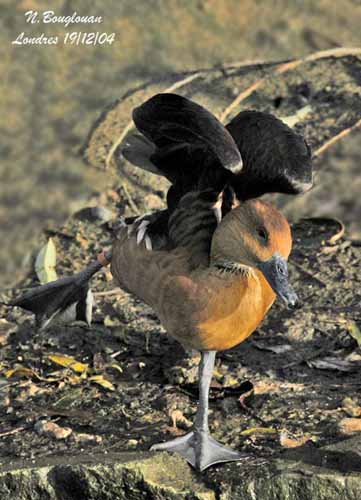
ID Keys: Fulvous-brown overall, dark back with brown splotches,
white stripe on flanks.
The
Fulvous Whistling-Duck is a widespread duck of
Africa, Asia, and much of the tropical Americas. Normally found in the
extreme southern U.S., wandering individuals or small groups may occasionally be
seen in nearly any location in the United States.
Habitat
The Fulvous Whistling-Duck inhabits shallow freshwater wetlands, including marshes, ponds, flooded grasslands, rice fields, and lakes with abundant emergent vegetation. It prefers areas with dense reeds, cattails, or other aquatic plants that provide cover for nesting and roosting, and it often feeds in nearby flooded agricultural fields and wet meadows.
Diet
The Fulvous Whistling-Duck feeds primarily on seeds and grains of aquatic plants, grasses, sedges, and agricultural crops such as rice. It also consumes small aquatic invertebrates, insects, and mollusks, particularly during the breeding season. Most feeding occurs by dabbling in shallow water or grazing in flooded fields and wet meadows.
Behavior
Forages both on land and in water. In the water, swims on the surface and acts like a dabbling duck, grabbing food near the surface, or sometimes tipping downward and sticking its head underwater. On land, they most often forage in wet fields.
Breeding
Non-breeder in South Dakota. The Fulvous Whistling-Duck usually nests in dense marsh vegetation, where the female builds a well-concealed nest of grasses and reeds above shallow water or on floating vegetation. The typical clutch contains 8–14 creamy white eggs, and both parents share incubation and care of the ducklings. In some populations, the species may also nest in tree cavities or use abandoned nests of other birds when suitable marsh sites are unavailable.
Song
The Fulvous Whistling-Duck is named for its distinctive, high-pitched whistling calls, often heard in flight or among flocks. These clear, repeated whistles serve to maintain contact between mates and flock members and are especially common at dawn, dusk, and during nocturnal activity. Compared with most ducks, the species is notably vocal throughout the year.
Migration
Populations along the Gulf Coast often migrate south to Mexico in the fall. Groups often stray from usual breeding areas, resulting breeding area expansion. Erratic wandering may bring small groups to nearly any location in the U.S., and even into southern Canada.
Fairly distinctive. Same structurally as Black-bellied Whistling Duck. The Fulvous Whistling-Duck has a rich cinnamon-buff body with a darker back, fine pale striping on the flanks, and lacks the bright red bill of the Black-bellied Whistling-Duck. Black-bellied Whistling-Ducks are more boldly patterned, with a black belly, gray face, chestnut body, bright pinkish-red bill, and conspicuous white wing patches visible in flight.