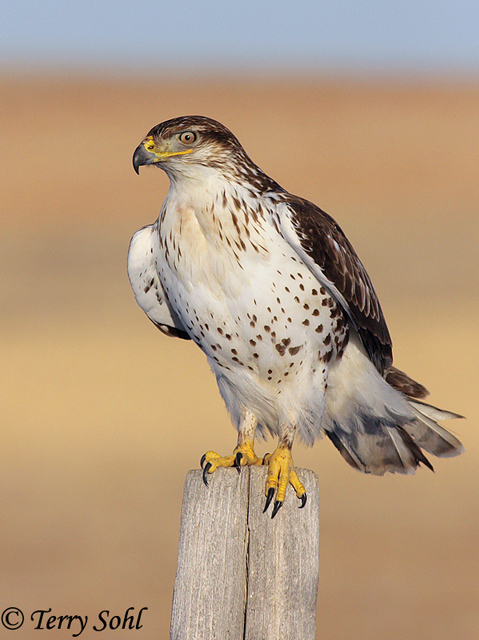
The Ferruginous Hawk is a large regal (the well-named Buteo regalis!) hawk of open western prairies. They are the largest of the "Buteo" Hawks. In historic times, the nest of the Ferruginous Hawk often used both bison bones in the structure and bison dung as part of a lining. They are a species that seems less shy of human beings than some other Buteo hawks. Unlike many raptor species, they will often allow for a surprisingly close view without flushing.
In South Dakota, Ferruginous Hawks are found in all seasons. Most range maps show them over-wintering southward from South Dakota, but they can be consistently found in parts of South Dakota during the winter months. Prairie Dogs seem to be a favored prey item in winter, and they are often found hanging around the edges of prairie dog towns.
Habitat
The Ferruginous Hawk inhabits open grasslands, prairies, shrub-steppe, and arid rangelands with scattered nesting sites and abundant prey. It favors large, treeless landscapes where ground squirrels, prairie dogs, rabbits, and other small mammals are common. Nests are often placed on isolated trees, cliffs, rock outcrops, utility structures, or even on the ground in open prairie.
Diet
The Ferruginous Hawk feeds primarily on small to medium-sized mammals, especially prairie dogs, ground squirrels, pocket gophers, jackrabbits, and cottontails. It also takes birds, reptiles, and occasionally large insects when opportunities arise.
Behavior
The Ferruginous Hawk is a powerful raptor of open country that spends much of its time soaring over grasslands or perched on elevated vantage points while searching for prey. It often hunts by hovering briefly into the wind before dropping onto small mammals below. During the breeding season, pairs maintain large territories and perform impressive aerial courtship displays that include soaring, dives, and talon presentations. Ferruginous Hawks can also often be seen sitting on the ground, where sometimes it will wait by a gopher or prairie dog hole for prey to surface.
Nesting
April through June in South Dakota. Most nests are built in trees, but they will also sometimes nest on cliffs or on the ground. The nest is a large structure of built of sticks, lined with softer material. Ferruginous Hawks often start with the nest of another species and build upon it. They will use cow dung (or traditionally, bison dung) to line the nest. The female lays 2 to 5 eggs, and both parents help to incubate them. Upon hatching, the female initially stays with the young while the male hunts for food and brings it back to the nest. As the chicks get older, both parents will hunt for food.
Song
The most commonly heard vocalization is a harsh, screaming key-ahh, or kaah-kaah.
Migration
Ferruiginous Hawks are generally a short-distance migrant, with some birds at the northern end of it's normal range migrating southward in the winter. Many range maps show Ferruginous Hawks over-wintering in areas southward from South Dakota (including the data used for the map below), but you can typically find them here during the winter months.
Interactive eBird Map
Click here to access an interactive eBird map of Ferruginous Hawk sightings
Similar Species
Depending on morph and age, in South Dakota, Ferruginous Hawks are most likely to be confused with the Red-Tailed Hawk, Rough-Legged Hawk, or Swainson's Hawk. Click here for a page that describes differences between the "Buteo" hawk species, and identification keys for each. With a number of color morphs, and plumages differing between immature and adult birds, the variety of plumage patterns makes it difficult to list all identification keys here. Here are specific tips for differentiating Ferruginous from Red-tailed, Swainson's, and Rough-legged Hawks, with a focus on structural and other elements that are more consistent regardless of color morph.
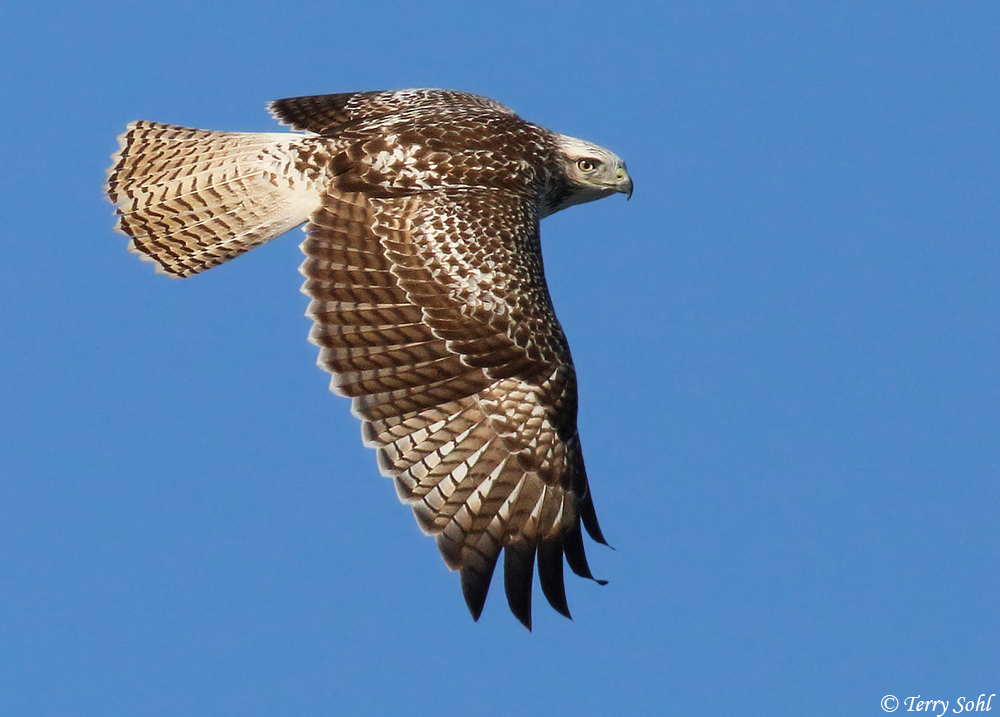
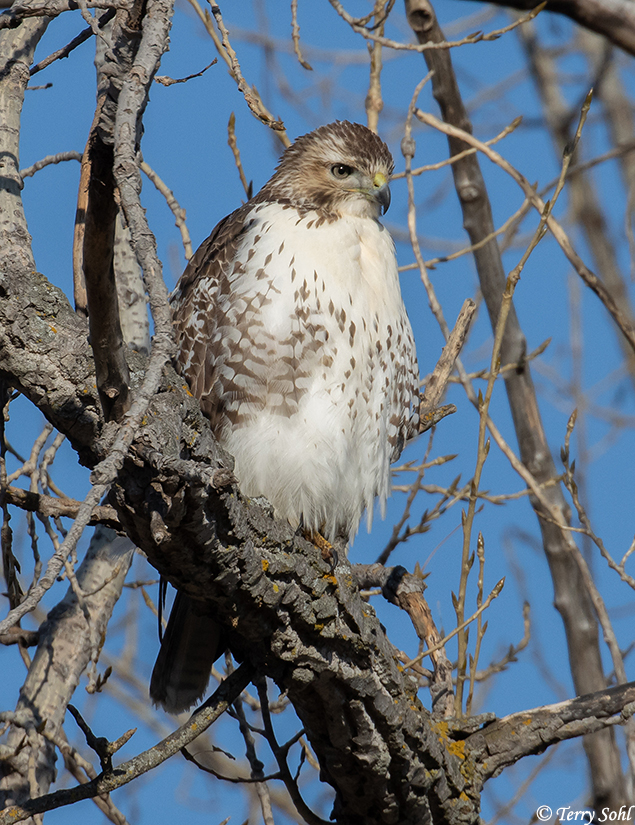
- Red-Tailed Hawk - The trademark red tail of a Red-tailed Hawk is one clue to differentiating them, although how obvious that is depends on viewing angle, color morph of the hawk, and age (see immature Red-tailed Hawk in first photo below, with barring on reddish tail). In flight, Red-tailed Hawks have broader wings, while those on a Ferruginous Hawk appear to be longer and more tapered. The legs on a Red-tailed Hawk are bare, while those on a Ferrugionous Hawk are feathered down towards the feet. Red-tailed Hawks have a smaller bill and shorter gape, while that of a Ferruginous Hawk extends backwards under the eye.
- Rough-Legged Hawk - Rough-legged Hawks have a much smaller bill than a Ferruginous Hawk. In flight, light morph Rough-legged Hawks (by far the most common) have an obvious dark "wrist" spot not seen on a Ferruginous Hawk.Of light morph birds, Rough-legged Hawks are much more heavily marked on their underside, with a dark belly, while Ferruginous Hawks can appear to be almost completely white. Dark morph birds are more difficult to differentiate, so bill characteristics play a key role. Seasonality is also a clue, as Rough-legged Hawks are only present in South Dakota during the winter months.
- Swainson's Hawk - Seasonality is a clue, as Swainson's Hawks are only around South Dakota in the summer and adjacent migration periods. Swainson's Hawks have a variety of color morphs, but the most common light morph birds have a rusty or brownish chest, compared to the clean white breast of a Ferruginous Hawk. Dark morph birds of the two species are more difficult to differentiate, but Swainson's Hawks often show a dark chestnut tone on portion of their underparts and have a white undertail covert, compared to the more consistently dark plumage on the underside of a Ferruginous Hawk, with light primary flight feathers and tail.
 |
 |
 |
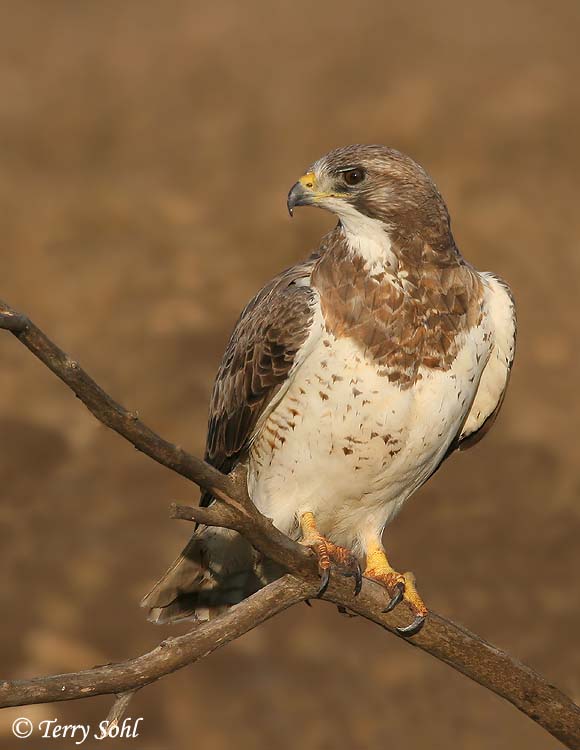 |
| Red-tailed Hawk (immature) | Red-tailed Hawk | Rough-legged Hawk | Swainson's Hawk (light morph) |
Conservation Status
Ferruginous Hawks have disappeared or plummeted in number in much of their former range, primarily due to habitat loss. However, overall populations remain relatively strong, and they are found over a wide geographic region. The IUCN lists them as a species of "Least Concern".
South Dakota "Hotspot"
My favorite location to find them are around prairie dog towns on the Fort Pierre National Grasslands during the winter months. However, the key isn't necessarily the geography and area of the grasslands themselves, but the presence of the prairie dog towns. They seem to hang out around most of the prairie dog towns in the western half of South Dakota in the winter.
Photo Information
January 1st, 2013 - Near Kennebec, South Dakota - Terry Sohl
Audio File Credits
1Andrew Spencer, XC77780. Accessible at www.xeno-canto.org/77780
