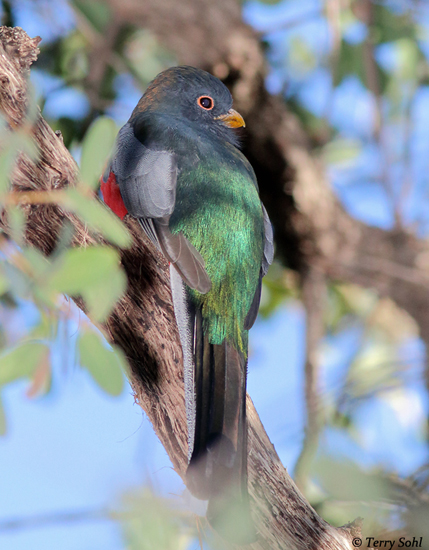
ID Keys: Obvious in range. Bright red belly, green head and
upperparts, white band on chest
The
Elegant Trogon is indeed an elegant and exotic-looking resident of the
tropics, with a range that just extends into the U.S. in southern Arizona.
There it is most often found in wooded canyons with names now famous to
birders (Ramsey Canyon, Madera Canyon, more), where it nests in the summer
in the tall sycamores and other trees that line the canyon streams.
Males are brilliantly colored, with bright red underparts and deep emerald
green upperparts. Females are less colorful, with the only strong
color found on the red undertail coverts.
Habitat
In the U.S. part of its range, Elegant Trogons are found in pine-oak forests in the canyons of Arizona, nearly always in areas where tall sycamores line canyon streams. In the rest of its range in Mexico and Central America, it can be found in relatively dry forests and canyons.
Diet
Omnivorous, feeding on a variety of fruits, berries, and insects. Insects often make up the majority of the diet when available, especially if large insects such as cicadas or katydids are available. They will also occasionally eat small vertebrates such as small lizards.
Behavior
Typically very sluggish in behavior. When perched, the bird moves little, often loitering in one location for signifcant amounts of time. Nesting birds are often strongly territorial, defending a territory that may extend up to a mile from the nest site.
Nesting
Males court females by following them, calling, and puffing out their chest. Nesting usually occurs in an old woodpecker or owl nest. Upon the eggs hatching, both the female and male will contribute to feeding the young. Elegant Trogons are evidently monogomous, and even sometimes show up on Arizona nesting grounds already paired.
Song
Song of the Elegant Trogon is a series of harsh croaking sounds, repeated 4 to 10 times.
Migration
Most birds within their range are non-migratory. The exception are birds in Arizona and in the rest of the northern Sonoran area. Elegant Trogons which summer in these areas do move southward in the fall, although occasionally one can be found overwintering in Arizona.
Interactive eBird Map
Click here to access an interactive eBird map of Elegant Trogan sightings
Similar Species
In the U.S. part of its range, Elegant Trogons are similar in structure to the Eared Quetzel , but plumage difference are obvious. In the rest of its range, it may be confused with other Trogon species. The female has a white mark behind her eye which is generally diagnostic. The male may be confused with the Collared Trogon or the Mexican Trogon.
Conservation Status
Elegant Trogons have no current serious conservation concerns. Populations in the Arizona portion of its range may actually be increasing in recent decades.
Image Information
November 9th, 2015 - Florida Canyon, south of Tucson, Arizona - Terry Sohl