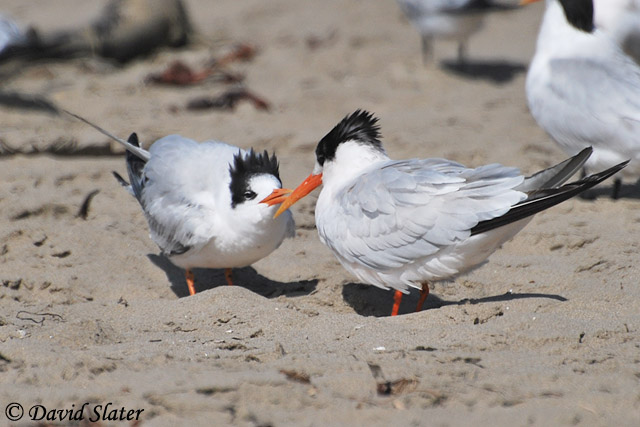
The Elegant Tern is a large tern species found on the west coast of North America. They have an extremely small breeding range, as most breeding occurs on a few islands off the west coast of Mexico. Over 90% of all breeding for the species occurs on Isla Rosa alone. In recent decades, Elegant Terns have expanded their breeding range northward, with small numbers nesting around southern California. Despite the increase in nesting range, the high proportion of breeding birds on Isla Rosa makes Elegant Tern populations susceptible to disturbance or introduction of predators on Isla Rosa and other nesting locations.
Habitat
The Elegant Tern inhabits coastal marine environments, including beaches, sandy islands, estuaries, bays, lagoons, harbors, mudflats, and nearshore ocean waters. It nests colonially on sandy islands and coastal beaches, primarily along the Pacific coast of Mexico and southern California. Outside the breeding season, it remains closely associated with productive coastal waters where small fish are abundant.Diet
The Elegant Tern feeds primarily on small fish such as anchovies, sardines, smelt, and other schooling species. It captures prey by flying over the water and plunge-diving to seize fish near the surface. Squid, crustaceans, and other small marine organisms may also be taken when available.Behavior
The Elegant Tern is a highly social seabird that nests in dense colonies and often forages in flocks over coastal waters. It spends much of the day flying over the ocean searching for schools of small fish, making graceful plunge-dives to capture prey. Birds frequently rest on beaches, sandbars, jetties, and islands, often mixed with other terns and gulls. During the breeding season, courtship involves aerial displays and the presentation of fish by males to females.Nesting
The nest of an Elegant Tern is a depression on the ground, without any lining or nest material. The female usually lays a single egg, and both parents help to incubate it. After the egg hatches, both parents help to feed the young. Young at breeding colonies typically leave the nest just a few days after hatching, joining communal groups of young (a 'creche').Song
The Elegant Tern gives loud, harsh, gull-like calls often described as raspy ker-rick or grating kraah notes. Colonies are typically noisy, with birds producing a constant chorus of calls used for mate recognition, territorial defense, and communication between parents and chicks. Its voice is generally deeper and harsher than that of many smaller tern species.Migration
Most breeding occurs on a handful of islands off the west coast of Mexico, but they also breed in smaller numbers in Southern California. After breeding, birds disperse northward, and they can be found up the west coast of the United States to Washington state. Birds winter off the west coast of southern Mexico, Central America, and South America.Interactive eBird Map
Click here to access an interactive eBird map of Elegant Tern sightingsSimilar Species
A number of tern species are light in overall appearance with dark caps. The most similar tern species to the Elegant Tern in size and plumage are the Royal Tern and Caspian Tern .
Royal Tern: The Elegant Tern is slimmer, with a longer, thinner, more strongly downcurved bill and a more graceful appearance. Royal Terns are bulkier, paler-backed birds with a heavier orange bill and a thicker-necked profile.
Caspian Tern: Caspian Terns are much larger and more robust, with a massive bright red bill and broader wings. Elegant Terns are noticeably smaller, slimmer, and show a longer, more delicate bill with a shaggier crest and more buoyant flight style.
