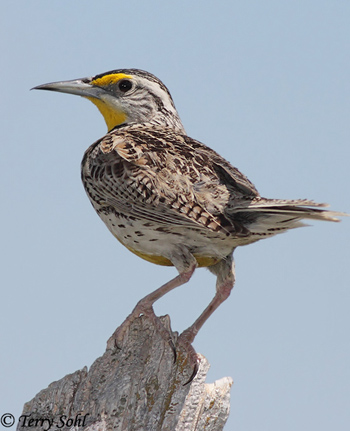
The Eastern Meadowlark is nearly identical in appearance to the Western Meadowlark. The two species are best differentiated by range and by voice. The Western Meadowlark is by far the more common of the two species in South Dakota, with the Eastern Meadowlark only normally found in the extreme south-central part of the state. LaCreek National Wildlife Refuge is another area where they can most reliably be seen in the state. Hybrids between the two species can occur where their ranges overlap.
Habitat
The Eastern Meadowlark inhabits open grasslands, native prairies, hayfields, pastures, CRP lands, weedy fields, and agricultural landscapes with extensive grassy cover. It favors broad, open areas with tall grasses for nesting and foraging while generally avoiding heavily wooded habitats. In South Dakota, it is most common in the eastern and southeastern portions of the state, where suitable grassland habitats are widespread.Diet
Primarily feeds on insects, especially during the summer months when insects may make up nearly the entire diet. They will also feed on seeds and waste grain, especially during winter months.Behavior
The Eastern Meadowlark spends much of its time walking through grasslands while searching for insects, seeds, and other food. Males are highly territorial during the breeding season and often sing from fence posts, shrubs, hay bales, or other elevated perches overlooking open fields. Despite their bright yellow underparts, meadowlarks can be surprisingly difficult to see when hidden among tall grasses. During fall and winter, they frequently gather in loose flocks and forage together in open fields and pastures.Nesting
May and June. The Eastern Meadowlark nests on the ground in a shallow depression concealed within dense grasses or other low vegetation. The female constructs a well-hidden nest of grasses and often arches surrounding vegetation over it to create a protective canopy. Typical clutches contain 3–7 eggs, and the female performs most of the incubation while both parents help feed the young after hatching.Song
The Eastern Meadowlark is famous for its clear, rich, flute-like song, a series of sweet, whistled notes that carry across open grasslands. Males frequently sing from fence posts, shrubs, and other elevated perches while defending territories during the breeding season. Calls include sharp zert and chatter notes that are quite different from the species' melodious song.Migration
The Eastern Meadowlark is a short- to medium-distance migrant. Northern populations, including many birds from South Dakota, move south in fall to winter in the southern United States and parts of Mexico, while populations in milder regions may remain year-round. Spring migrants return to breeding areas in March and April, with most South Dakota birds present from spring through fall.Interactive eBird Map
Click here to access an interactive eBird map of Eastern Meadowlark sightingsSimilar Species
Western Meadowlark. The Eastern Meadowlark and Western Meadowlark are very similar in appearance, but their songs are the most reliable field mark. Eastern Meadowlarks give a clear, simple, flute-like whistle, while Western Meadowlarks produce a richer, more complex, and more musical series of bubbling, flutelike notes.
In appearance, Eastern Meadowlarks tend to show a brighter yellow face, a slightly paler overall coloration, and less white in the tail, but visual differences are subtle and often difficult to use in the field. Both species have yellow underparts and a bold black "V" on the chest.
Range can also be helpful. Eastern Meadowlarks are most common in the eastern United States and southeastern portions of the Great Plains, while Western Meadowlarks dominate much of the western United States and Great Plains. In South Dakota, both species occur, but Western Meadowlarks are generally more widespread and abundant across much of the state.
