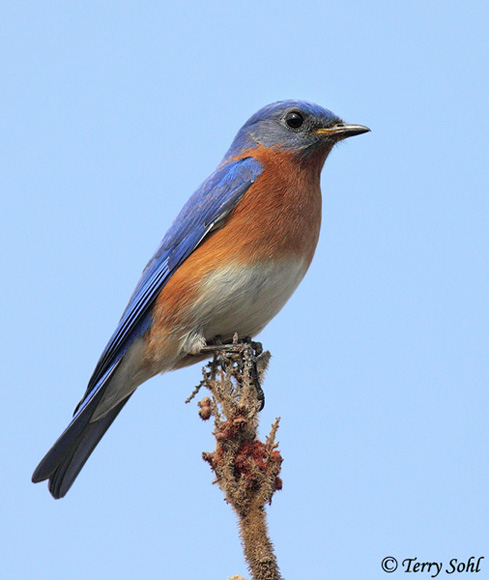
The Eastern Bluebird is a colorful thrush known for its brilliant blue upperparts and warm rusty-orange breast. It inhabits open woodlands, orchards, pastures, parks, golf courses, and grasslands with scattered trees and nest cavities. The species feeds primarily on insects during the breeding season and shifts to berries and fruits during fall and winter. In South Dakota, Eastern Bluebirds are common summer residents and breeders, especially in the eastern and southeastern portions of the state, with some birds lingering into winter during mild years. Their gentle warbling songs and bright colors make them one of the most beloved backyard birds.
They historically have used old woodpecker holes and other cavities in trees for nesting. They readily use nest boxes, and conservation efforts involving bluebird trails have contributed to population recovery across much of North America, especially as European Starlings have become aggressive competitors for natural tree cavities for nesting.
Habitat
The Eastern Bluebird inhabits open woodlands, forest edges, orchards, pastures, parks, golf courses, cemeteries, and agricultural areas with scattered trees and open grassy ground. It favors habitats that provide both perching sites for hunting insects and natural cavities or nest boxes for nesting. In South Dakota, it is most common in the eastern part of the state, especially where open grasslands are interspersed with shelterbelts, groves, and other scattered trees.
Diet
Mostly insects during the summer months, as well as other small invertebrates such as worms, snails, and spiders. They also eat many berries, particularly during the winter months where berries may be the primary food source. More rarely they will eat small vertebrates such as small frogs, snakes, lizards, or small rodents.
Behavior
Often feeds by observing from a relatively low perch and flying down to pluck insects from the ground or foliage, often hovering instead of landing while taking the food item. They will also sometimes fly out and catch insects in mid-air. Breeding pairs may perch next to and preen each other.
Nesting
Late April through July. Eastern Bluebirds are cavity nesters, traditionally using natural cavities (particularly old woodpecker nesting sites), but also now accepting nest boxes specifically built for the species. Male Bluebirds entice the female by selecting a nesting site and moving in and out of the cavity, carrying nesting material and calling to the female. The female herself builds the nest, lining the cavity with grasses and sometimes other vegetative material. The female lays between 3 and 7 eggs, and she alone incubates them. The young hatch after about 14 days, and fledge from the nest about 2 to 3 weeks after hatching.
Song
The Eastern Bluebird gives a soft, musical song composed of short warbling phrases and mellow whistles. Its most familiar call is a gentle, slurred tur-a-lee that is often heard as birds fly overhead or communicate with mates and family members. Compared with many other songbirds, its voice is sweet, subtle, and pleasantly musical. They also have various harsher calls and short chip notes.
- Click here to hear the song of an Eastern Bluebird1
- Click here to hear the call of an Eastern Bluebird2
- Click here to hear the chattering alarm call of an Eastern Bluebird3
Migration
Winters in the southeastern United States and Mexico, although small numbers may winter in the state in selected spots. Summers throughout most of the eastern half of the United States and southeastern Canada. Many populations in the southeastern quarter of the United States are permanent residents, as are birds in Mexico and Central America.
Interactive eBird Map
Click here to access an interactive map of Eastern Bluebird sightings
Similar Species
Similar to other Bluebird species
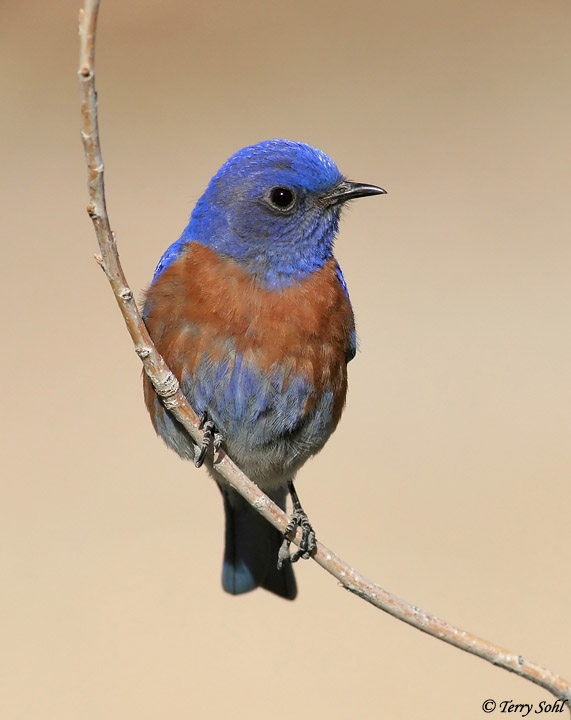
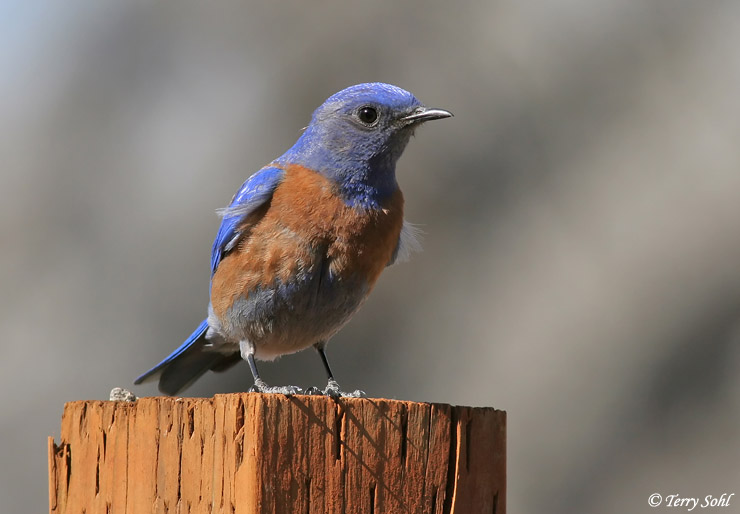
- Western Bluebird - There's no real range overlap between Western Bluebirds and Eastern Bluebirds (Western Bluebirds are but extremely rare visitors to South Dakota), but occasionally stray birds may cause some confusion. Western Bluebird males have a completely blue head and throat, while Eastern Bluebird males have chestnut-colored throats. Western Bluebirds have bluish bellies, while Eastern Bluebirds have a white belly. Females are perhaps more difficult to distinguish, but Western Bluebird females have grayish underparts and a grayish throat, while those same features are white on a female Eastern Bluebird.
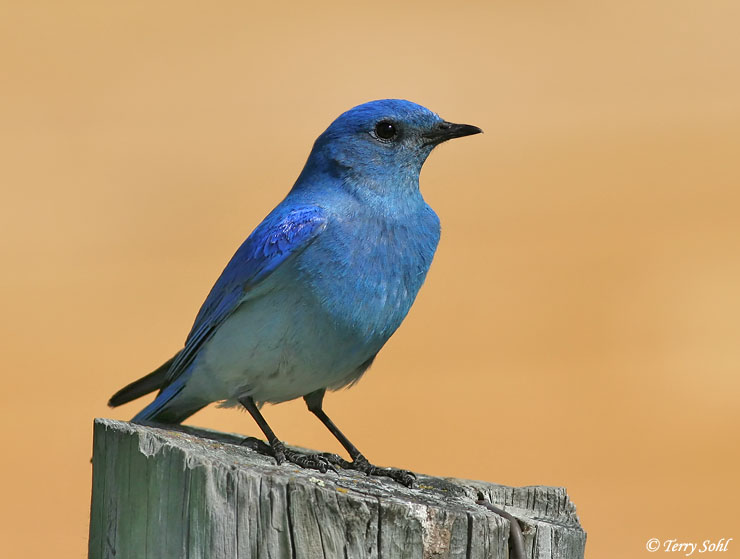
- Mountain Bluebird - Mountain Bluebirds and Eastern Bluebirds may occasionally be found together in South Dakota. Mountain Bluebirds males are more completely blue, with lighter blue below and a sky blue on their breast and flanks, while an Eastern Bluebird has an orangish breast. Female Mountain Bluebirds have a lighty buffy color on the belly and throat, while those features are white on an Eastern Bluebird.
 |
 |
 |
 |
| Western Bluebird | Western Bluebird | Mountain Bluebird | Mountain Bluebird |
Bird Feeders
Will sometimes attend feeders for mealworms (yes, you can buy mealworms to feed to bluebirds!)
Conservation Status
Eastern Bluebirds experienced sharp declines in the first half of the 20th century due to competition for nesting sites with non-native species (European Starling, House Sparrow). Eastern Bluebirds have been recovering in recent decades, thanks in large part to the large numbers of nest boxes erected for their benefit. The IUCN currently lists Eastern Bluebirds as a species of "Least Concern".
Photo Information
March 30th, 2012 - Beaver Creek Nature Area near Brandon, South Dakota - Terry Sohl
Audio File Credits
- 1Jacob Saucier. Recorded in Avoyelles Parish, Louisiana on December 21st, 2017. Original recording and information from xeno-canto.
- 2Richard E. Webster. Recorded in Sonora, Mexico on July 29th, 2019. Original recording and information from xeno-canto.
- 3Richard E. Webster. Recorded in Sonora, Mexico on August 16th, 2013. Original recording and information from xeno-canto.
