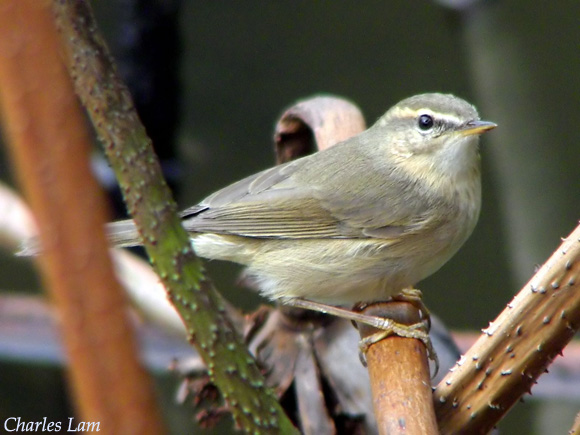
The Dusky Warbler is one of the Old World "leaf warblers". They are found in eastern Asia, ranging from Siberia southward into China in summer, and overwintering in southeastern Asia. Like several of the leaf warbler species, they are occasionally prone to wander far from their normal range. Vagrants occur with relative frequency as far as western Europe, with instances of individuals even overwintering in Great Britain. In North America, they are primarily known from multiple sightings on the islands and coastline of Alaska. However, in 1980, a Dusky Warbler was found on Farallon Island off the coast of California. Since then, multiple other sightings have also occurred in California.
Habitat
The Dusky Warbler breeds in dense shrubby habitats of northern Asia, including willow thickets, riparian scrub, forest edges, young conifer stands, taiga clearings, and brushy wetlands. During migration and winter, it occupies dense vegetation such as reedbeds, hedgerows, scrublands, brushy fields, woodland edges, gardens, and riverine thickets. It typically favors thick low cover where it forages close to the ground and often remains concealed.Diet
The Dusky Warbler feeds primarily on insects and other small arthropods. Its diet includes flies, beetles, caterpillars, aphids, spiders, and various insect larvae that it gleans from leaves, twigs, shrubs, and low vegetation. During migration and winter, it may occasionally consume small berries, but insects remain its principal food source.Behavior
Actively forages by hopping and flitting in vegetation, primarily relatively close to the ground. They may glean insects directly from vegetation, or capture insects while in flight.Nesting
The nest of a Dusky Warbler is a dome of grasses, moss, leaves, and other vegetative material, with an entrance built on the side. It is placed on the ground, typically in a somewhat protected location such as up against the base of a clump of grasses or other vegetation. The female lays 5 to 7 eggs, and she alone incubates them. The eggs hatch after about 12 days, with both parents helping to feed and raise the young. The young fledge about 2 weeks after hatching.Song
The Dusky Warbler is often identified by its call, a sharp, hard tack note that resembles the sound of two pebbles being tapped together. Its song is a simple, repetitive series of dry, scratchy notes and short trills.Migration
The Dusky Warbler breeds across Siberia and northeastern Asia and is a long-distance migrant. After breeding, it migrates south to winter primarily in southern China, India, Southeast Asia, and neighboring regions. During migration it frequents dense scrub, hedgerows, reedbeds, woodland edges, and other brushy habitats. In North America, the species is an exceptionally rare vagrant, recorded only occasionally in Alaska and along the Pacific Coast.Interactive eBird map
Click here to access an interactive eBird map of Dusky Warbler sightingsSimilar Species
In their Old World range, may be confused with other leaf warbler species. The Dusky Warbler is more plain in appearance overall, lacking the yellow tones or greenish upperparts of several other leaf warbler species.
For vagrants found in North America, they are most likely to be confused with the Arctic Warbler. The Dusky Warbler is a small, brown warbler with a noticeable pale eyebrow, dark legs, and a generally drab appearance. The Arctic Warbler is larger, greener above, paler below, and shows a stronger facial pattern with a longer, more prominent supercilium. Arctic Warblers typically have pale legs and a heavier bill, while Dusky Warblers have dark legs and a finer, more delicate appearance. Vocalizations are also very different, with the Dusky Warbler's sharp “tack” call contrasting with the distinctive buzzing and trilling calls of the Arctic Warbler.
