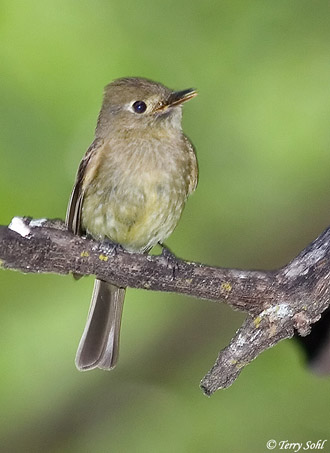
The Cordilleran Flycatcher is a small olive-green flycatcher that breeds in coniferous forests, mountain woodlands, and shaded canyons of western North America. It forages by perching quietly and then making short flights to capture insects in midair, often returning to the same perch. The species was once grouped with the Pacific-slope Flycatcher as the Western Flycatcher before being recognized as a separate species. In South Dakota, it is an uncommon and localized breeder in the Black Hills and a rare migrant elsewhere. Because of its similarity to other Empidonax flycatchers, vocalizations are often the most reliable means of identification.
Habitat
The Cordilleran Flycatcher inhabits moist coniferous forests, mixed mountain woodlands, shaded canyons, riparian corridors, and forested stream valleys. It is especially associated with areas containing dense understory vegetation, mossy banks, rocky ravines, and running water. In South Dakota, it occurs primarily in the cooler, forested habitats of the Black Hills.
Diet
The Cordilleran Flycatcher feeds primarily on insects and other small arthropods. Its diet includes flies, mosquitoes, moths, beetles, ants, wasps, spiders, and other small invertebrates captured in short aerial sallies from perches or gleaned from foliage and branches. During late summer and migration, it may occasionally consume small berries and other fruits.
Behavior
Often feeds in typical flycatcher manner, watching from a perch and flying out to capture insects in mid-air. They will feed at nearly any height in the forest canopy. They also may glean food items from foliage, or capture insects from vegetation while hovering.
Nesting
June and July. The Cordilleran Flycatcher typically places its nest in sheltered sites such as mossy banks, rock crevices, cliff ledges, root tangles, cavities, or protected niches near streams and forested ravines. The female builds a cup-shaped nest from moss, grasses, bark fibers, rootlets, and other plant materials, often incorporating large amounts of moss. Typical clutches contain 3–4 eggs, and the female performs most of the incubation while both parents help feed the nestlings after hatching.
Song
The Cordilleran Flycatcher is best identified by its distinctive song, often rendered as a rising pit-PEET with emphasis on the second syllable. This vocalization differs from that of many other Empidonax flycatchers and is one of the most reliable field marks for identification. Calls include sharp whit, and other short contact notes given while foraging or defending territory.
Migration
The Cordilleran Flycatcher breeds in the mountains of western North America, from the Rocky Mountains south through the Southwest and into Mexico, including localized breeding populations in the Black Hills. After breeding, it migrates south to winter primarily in Mexico and northern Central America. Migration occurs mainly through mountain corridors and western interior regions, with birds moving north in spring and returning south in late summer and fall. The Black Hills of South Dakota represent the eastern-most extent of it's breeding range.
Similar Species
Pacific-slope Flycatcher , as well as other Empidonax flycatchers. Range and voice are the best means of telling these confusing species apart.
Conservation Status
The Cordilleran Flycatcher is generally considered a species of low conservation concern, with populations remaining relatively stable across much of its western North American range. It occupies a broad variety of montane forest and canyon habitats and continues to be fairly common in suitable breeding areas. Local populations may be affected by forest management practices, wildfire, drought, and habitat alteration along riparian corridors, but the species remains widespread and secure overall. The IUCN considers the Cordilleran Flycatcher to be a species of "least concern".
Photo Information
July 6th, 2008 - Along Grace Coolidge Creek in the Black Hills - Terry Sohl
Interactive eBird Map
Click to access the interactive eBird species sightings page for Cordilleran Flycatcher
