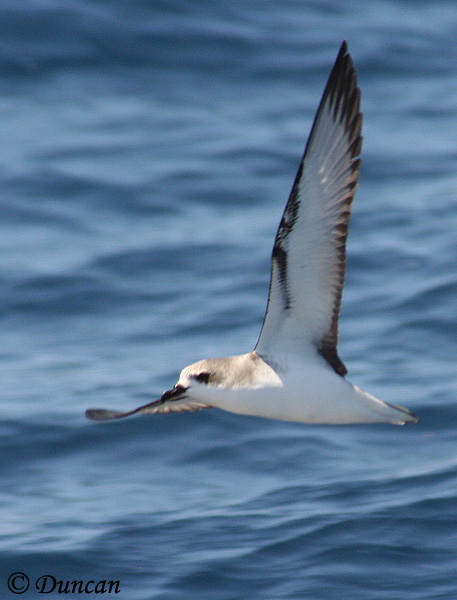
The Cook's Petrel is one of the smallest Petrel species in the world. They likely used to breed across many parts of New Zealand, but now have an extremely small breeding range, nesting on just three islands near New Zealand. However, they disperse widely across the Pacific basin outside of the breeding season, and are regular visitors well offshore of the West Coast of North America. The accidental introduction of rats and cats to nesting islands decimated breeding populations in the 20th century, leading the bird to be considered endangered. However, active efforts to eliminate predators on their breeding grounds has led to increased breeding success, and numbers of Cook's Petrels are now increasing again.
Habitat
Found on a few forested islands near New Zealand when breeding. Outside of the breeding season, they are pelagic, and are typically found well offshore, only very rarely being seen close to shore.
Diet
Feeds mostly on small fish, squid, and crustaceans.
Behavior
Forages by flying low over the water's surface, dipping down to grab prey items when spotted. They will also sometimes grab food items with their bill while swimming on the ocean's surface.
Nesting
The nest of a Cook's Petrel is a burrow with a nesting chamber, typically built on steep forested slopes on their nesting islands near New Zealand. The female lays a single egg, and both parents help to incubate it. Upon hatching, both parents help feed the nestling.
Song
Usually silent away from breeding colonies. Has a series of high-pitched calls made on breeding grounds.
Migration
Breeds in a very limited range, on three islands near New Zealand. Outside of the breeding season, they disperse widely across the Pacific, ranging as far north as the Aleutian Islands, with most birds found well offshore in the eastern side of the Pacific, from North America to South America.
Similar Species
In range, most likely to be confused with the Mottled Petrel or Stejneger's Petrel
Conservation Status
Until recently, the IUCN listed this bird as "Endangered", as populations were in a very sharp decline. The primary reason was that introduced predators such as rats and cats had infested their nesting islands, and greatly decreased nesting success. However, with the successful eradication of rats and cats from their main breeding island, the IUCN has recently upgraded the Cook's Petrel status to "Vulnerable".
Photo Information
Photo taken by " Duncan" - Photo licensed under Creative Commons Attribution ShareAlike 2.0 Generic License .
Interactive eBird Map
Click to access the eBird species page for Cook's Petrel
