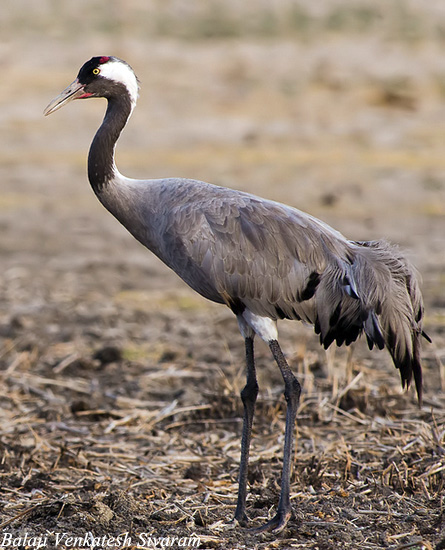
The Common Crane is a bird of Eurasia and Africa, but in North America, single birds have occasionally been found within flocks of Sandhill Cranes. In North America the most frequent sightings have been within the great congregations of migrating Sandhill Cranes along the Platte River in Nebraska in March and April, or in the large number of overwintering cranes in Bosque del Apache in New Mexico. The black head and neck and broad white stripe starting behind the eye make it readily distinguishable from Sandhill Cranes.
Habitat
In its normal breeding range, Common Cranes are found in wet meadows, forest clearings, wetlands, bogs, and grassy fields. In migration they are also often found in agricultural land.
Diet
The Common Crane has a highly varied omnivorous diet that includes seeds, grains, roots, tubers, shoots, berries, and other plant material. It also feeds on insects, earthworms, snails, frogs, small reptiles, rodents, and other small animals, especially during the breeding season when protein-rich foods are important for raising young. Common Cranes frequently forage in agricultural fields, wetlands, grasslands, and marshes.
Behavior
The Common Crane is a highly social bird that often occurs in pairs during the breeding season and in large flocks during migration and winter. It is famous for its elaborate courtship displays, which include dancing, bowing, wing-flapping, jumping, and tossing vegetation into the air. Common Cranes forage by walking slowly through wetlands, grasslands, and agricultural fields while probing for food. During migration and winter, thousands of birds may gather at traditional staging and roosting sites, creating spectacular concentrations.
Nesting
The nest is a mound of grassy vegetation built in an inaccessible areas, such as in very shallow water, in a thicket, or in a bog or wetland vegetation. Nests may be reused for many years. The female lays two eggs, with the male usually incubating during the day, and the female incubating at night. Incubation takes about 30 days. Once the eggs hatch, both parents tend to the young and feed them.
Song
The Common Crane is known for its loud, far-carrying trumpeting calls, often rendered as a rolling krrroo. Pairs frequently perform synchronized duets, with the male and female calling together while stretching their necks upward in a behavior known as unison calling. These resonant vocalizations can be heard for miles and are a characteristic sound of migration stopovers, breeding territories, and wintering flocks.
Migration
The Common Crane breeds across northern and eastern Europe and large portions of northern Asia, primarily in wetlands, bogs, marshes, and forested peatlands. After breeding, it migrates south along several major flyways to wintering areas in southern Europe, North Africa, the Middle East, India, and eastern Asia. During migration, large flocks gather at traditional staging areas where thousands of cranes may feed in agricultural fields and roost in wetlands before continuing their journey.
Similar Species
In North America, they are most likely to be confused with Sandhill Cranes . The Common Crane and Sandhill Crane are similar in size and shape, but several field marks separate them. Common Cranes have a striking black-and-white head and neck pattern with a white stripe extending from behind the eye down the side of the neck, whereas Sandhill Cranes are more uniformly gray with a red crown and lack the bold white neck stripe.
In flight, Common Cranes often appear slightly darker and more contrasting because of their black neck, black wing feathers, and white facial markings. Sandhill Cranes appear plainer overall and show less contrast across the head and neck.
Vocalizations are also distinctive. Common Crane gives a deep, rolling, trumpeting kruu call, while Sandhill Crane produces a louder, harsher, more rattling bugling call. In North America, a Common Crane would be an exceptional rarity, while Sandhill Cranes are widespread and regularly encountered.
Conservation Status
The Common Crane is generally considered a species of low conservation concern and has experienced significant population increases across much of Europe in recent decades. Wetland protection, legal protections, and habitat management have allowed many populations to recover and expand into parts of their former range. Although threats such as wetland drainage, power-line collisions, disturbance, and habitat degradation still occur, the overall global population is stable to increasing and the species is considered secure throughout much of its range. The IUCN lists the Common Crane as a species of "Least Concern" .
Photo Information
Photo by Balaji Venkatesh Sivaram - December 15th, 2012 - Little Rann of Kutch, Gujarat, India - Photo licensed under Creative Commons Attribution NonCommercial ShareAlike 2.0 Generic license
Interactive eBird Map
Click to access the interactive eBird species sightings page for Common Crane
