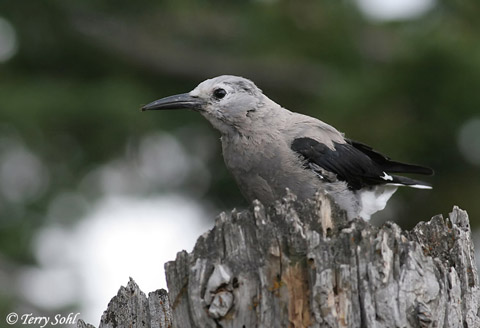
The Clark's Nutcracker is a bold, pale gray member of the crow family closely tied to the high mountains of western North America, especially pine forests near timberline. Famous for its intelligence and excellent memory, it harvests and buries thousands of pine seeds each year, recovering them through winter and inadvertently planting countless trees in the process. Loud, curious, and often surprisingly tame around people, Clark’s Nutcracker is one of the most important seed dispersers and ecological partners of western alpine forests.
Habitat
The Clark's Nutcracker inhabits high-elevation conifer forests, subalpine ridges, and open mountain slopes across western North America, especially where whitebark, limber, ponderosa, or pinyon pines produce abundant seeds. Outside the breeding season it may wander downslope into foothill woodlands, campgrounds, and even sagebrush valleys in search of food.
Diet
Omnivorous. Feeds heavily on pine seeds when available, also other seeds and nuts, fruits, berries, insects, birds, eggs, amphibians, reptiles, and carrion and garbage.
Behavior
Often forages by clambering along the ground or through the branches of a tree. They use their strong bill to pry open pine cones for seeds, also using it to dig insects out of wood. A single bird may store thousands of seeds, for later retrieval during scarce winter months.
Nesting
March through May in South Dakota. Overall, The Clark's Nutcracker nests quite early in the year, often while snow still covers the mountains, building a bulky stick nest in conifers such as pine, fir, or spruce. The female lays 2 to 4 eggs, and both parents feed the young largely on cached pine seeds and insects, allowing this hardy species to raise its brood in cold, high-elevation forests long before many other western birds begin nesting.
Song
The Clark's Nutcracker is a loud and conspicuous bird whose most familiar sound is a harsh, rolling kraaaah or rattling krrr-krrr that carries far across mountain slopes. It also gives a variety of chatters, nasal calls, and scolding notes, especially when flying or defending food caches and territory.
Migration
Complex, poorly understood migrations. Clark's Nutcracker is normally a bird of the Rocky Mountains. However, they sometimes move outward from that core in large numbers during the fall.
Similar Species
Canada Jay in range, but generally distinctive if seen well. The Clark's Nutcracker is larger, longer-winged, and much paler gray-white than the softer, fluffier-looking Canada Jay, with bold black wings and a long pointed bill. Canada Jays are darker slate-gray with a shorter bill, shorter tail, and more rounded, gentle appearance, usually moving quietly through boreal forest rather than the open alpine habitats favored by Clark’s Nutcracker.
Bird Feeders
Will come to feeders for sunflower seeds and nuts.
Conservation Status
Numbers are generally stable. Has adapted well to a human presence in some areas. The IUCN considers the Clark's Nutcracker to be a species of "least concern".
Photo Information
August 9th, 2007 - Yellowstone National Park, Wyoming - Terry Sohl
Interactive eBird Map
Click to access an interactive eBird species sightings page for Clark's Nutcracker
