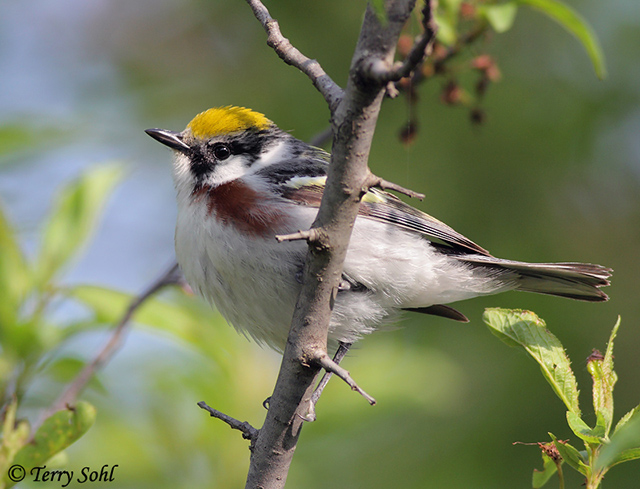
The Chestnut-sided Warbler is a very active warbler that is often seen foraging quite low in the foliage compared to many warbler species. Their "down-to-earth" behavior is a trait learned from their breeding grounds, where they prefer dense shrubby second-growth forest that occurs after a disturbance event. They are one species that has likely benefited from man's alteration of the North American landscape, as they prefer the type of second-growth shrubby forest that is often found after forest clear-cuts regenerate.
Habitat
Chestnut-sided Warblers are birds of dense thickets and shrubs, particularly areas of second-growth forest following a disturbance such as a fire, storm event, or clear-cutting. They can also be found in low forest undergrowth along the edges of denser forested areas. They prefer similar habitats when migrating through South Dakota.
Diet
The Chestnut-sided Warbler feeds primarily on insects and spiders gleaned from leaves, twigs, and shrubs. Its diet includes caterpillars, beetles, flies, leafhoppers, ants, and other small arthropods, which it actively searches for in dense vegetation. During migration and on the wintering grounds, it also consumes berries and other small fruits.
Behavior
The Chestnut-sided Warbler is an active and energetic forager that moves quickly through shrubs, saplings, forest edges, and second-growth woodlands while searching for insects. It often gleans prey from leaves and twigs but will also make short aerial sallies to capture flying insects. During the breeding season, males are strongly territorial and frequently sing from exposed perches in shrubby habitats. The species is especially associated with young forests, regenerating clear-cuts, and brushy woodland openings.
Breeding
Non-breeder in South Dakota. On their breeding grounds, Chestnut-sided Warblers nest in bushes and low trees, usually amongst dense foliage in the crook of a branch, within 5 feet from the ground. The female builds the nest, building an outer main layer of bark, grasses, and roots, and lined with finer grasses, hair, and spider webs. The female lays between 3 and 5 eggs, and she alone incubates them. The young hatch after about 12 days, and fledge from the nest about 12 to 14 days after hatching.
Song
The song of a Chestnut-sided Warbler is a cheery musical wheet-wheet-wheet-wheet-you. The typical call is a sweet cheep.
- Click here to hear the song of a Chestnut-sided Warbler1
- Click here to hear an alternative song of a Chestnut-sided Warbler2
- Click here to hear the call of a Chestnut-sided Warbler3
Migration
Neotropical migrant, summering in southern Canada and in the northern and southern U.S. Winters in Central and South America. In South Dakota they're an uncommon migrant in the eastern part of the state, and are a much rarer migrant in the west.
Similar Species
Chestnut-sided Warbler males have a rather unique plumage pattern, so there's not too many species they're likely to be confused with. Female Chestnut-sided Warblers are somewhat plainer in breeding plumage, and quite a bit plainer in non-breeding plumage, and could potentially cause more identification challenges. Here are the species most likely to be confused with a Chestnut-sided Warbler:
- Bay-breasted Warbler - In breeding plumage both male Bay-breasted and Chestnut-sided Warblers have a chestnut-color patch on their flanks. However, on a Bay-breasted Warbler male, the chestnut color continues upward across the throat, and there's also a chestnut-colored patch on the top of their head. In contrast, Chestnut-sided Warbler males have a white throat and a yellowish crown. Female Chestnut-sided Warblers share the chestnut-flanks and yellow crown of the male, but it's less extensive and bright. Non-breeding female Bay-breasted and Chestnut-sided Warblers each have a yellowish wash on the crown and upper back, but it's brighter on a Chestnut-sided, and the Chestnut-sided female has a light eye-ring that's lacking from the female Bay-breasted.
- Pine Warbler - Pine Warblers aren't going to cause any identification issues with a male Chestnut-sided Warblers, but females in non-breeding plumage could potentially be confused with them. Both have some yellow on the head and a light eye-ring. However, female Chestnut-sided Warblers are a light gray to white on their underparts, while both male and female Pine Warlbers have some yellow on the throat, flanks, and breast.
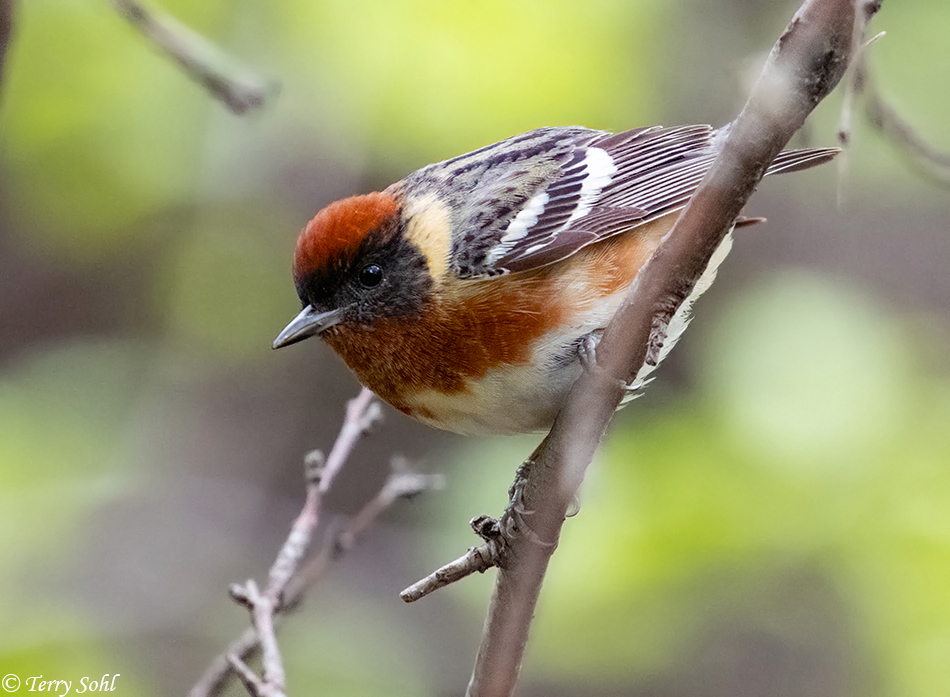 | 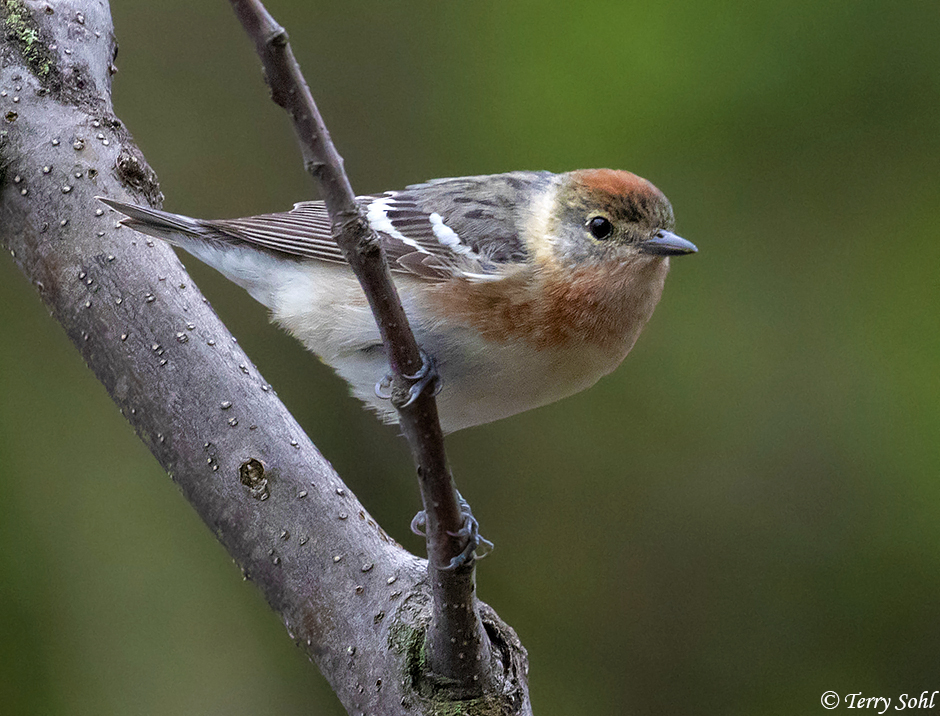 | 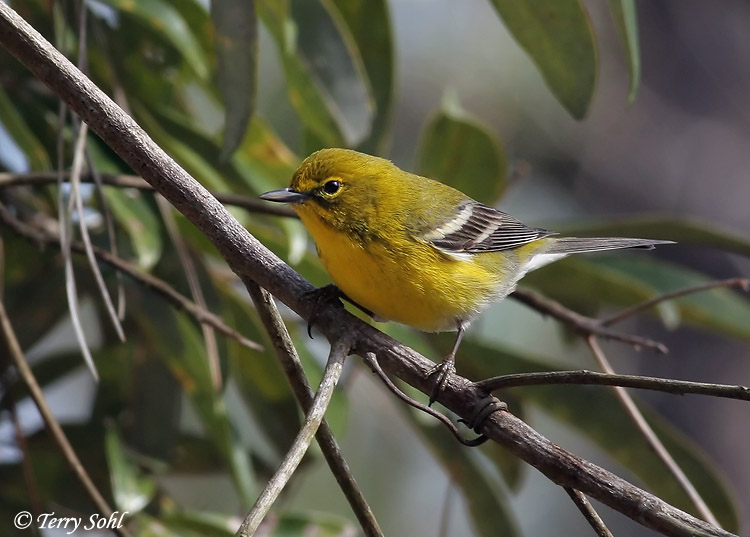 | 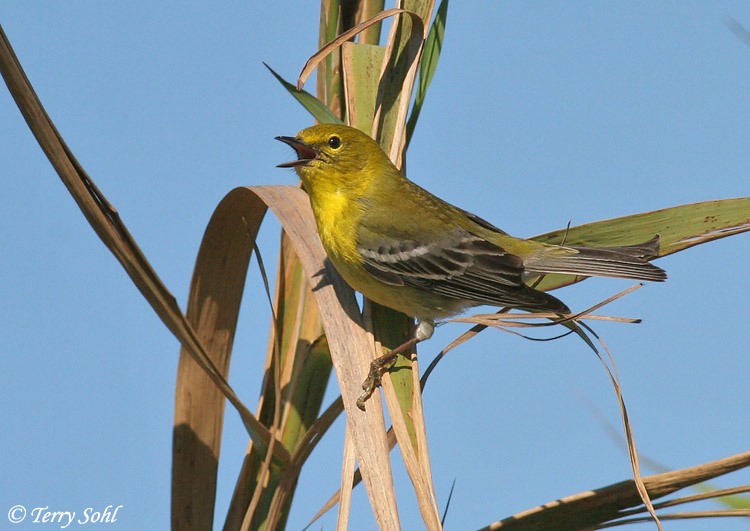 |
| Bay-breasted Warbler | Bay-breasted Warbler | Pine Warbler | Pine Warbler |
Conservation Status
Chestnut-sided Warblers may be more common now than before settlement of the continent, because of the increased second-growth forest that results from clear-cutting. They don't do as well in mature or undisturbed forest land. There's some evidence of decline in recent decades, but they are still found across a very broad geographic area, are common in parts of that range, and have overall healthy populations. The IUCN considers the Chestnut-sided Warbler to be a species of "Least Concern".
Photo Information
May 22nd, 2011 - Beaver Creek Nature Area in Minnehaha County, South Dakota - Terry Sohl
Audio File Credits
- 1Christopher McPherson. Recorded in Hillsborough County, New Hampshire on June 8th, 2019. Original recording and information available from xeno-canto.
- 2Christopher McPherson. Recorded in Hillsborough County, New Hampshire on June 3rd, 2020. Original recording and information available from xeno-canto.
- 3Jerome Fischer. Recorded in Gamboa, Colon Province of Panama on January 29th, 2019. Original recording and information available from xeno-canto.
Interactive eBird Map
Click to access the interactive eBird species sightings page for Chestnut-sided Warbler
