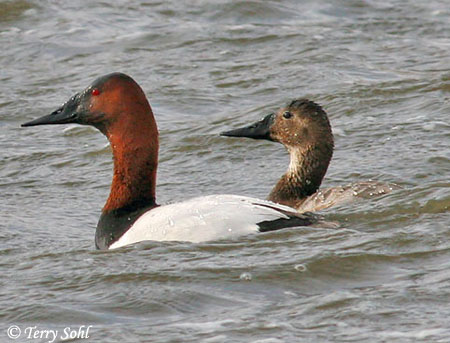
Canvasbacks are the biggest of the diving ducks found in the state. They are generally more wary and less tolerant of human presence than some of the other ducks. Numbers are far below historical levels, probably due to losses of wetland habitat essential for breeding success.
Habitat
The Canvasback inhabits large prairie marshes, shallow lakes, wetlands, and pothole regions during the breeding season, especially areas with dense emergent vegetation for nesting. During migration and winter it favors large lakes, reservoirs, coastal bays, estuaries, and open water habitats rich in submerged aquatic vegetation.
Diet
The Canvasback feeds mainly on submerged aquatic plants such as wild celery, pondweeds, grasses, and seeds gathered by diving in open water. It also eats snails, insects, mollusks, and other aquatic invertebrates, especially during the breeding season.
Behavior
Primarily forages in water a few feet deep, diving underwater for food. They also sometimes feed at the surface, either grabbing food items from the water's surface, or tipping down and submerging their head underwater.
Nesting
May through July. The nest of a Canvasback is a basket of reeds and other dead vegetations, placed in dense wetland vegetation or on nearby shoreline. The female usually lays between 8 and 11 eggs, and she alone incubates them. The young leave the nest within a few hours of hatching, and find their own food. The female stays with the young and protects them. The young fledge after about 9 weeks.
Song
The Canvasback is generally quiet, but males give low nasal whistles and soft cooing sounds during courtship displays. Females produce harsher quacks and growling calls, especially when alarmed or defending young.
Migration
Summers in the western U.S., northern Great Plains, Alaska, and western Canada. Winters in the southern U.S., near the U.S. coasts, and Mexico.
Similar Species
Redhead. The Canvasback differs from the Redhead by its long sloping forehead and wedge-shaped bill profile, which create a distinctive straight-line appearance from forehead to bill tip. Redheads have a rounder head, shorter bill, and softer facial profile, while Canvasbacks also tend to show a paler back and a darker chest with stronger contrast overall.
Conservation Status
Has been in general decline the last several decades. However, they are still found over a wide geographic area, and overall populations are not currently felt to be threatened. The IUCN lists the Canvasback as a species of "Least Concern".
Photo Information
March 30th, 2003 -- Western Minnehaha County -- Terry L. Sohl
Interactive eBird Map
Click to access the interactive eBird species sightings page for Canvasback
