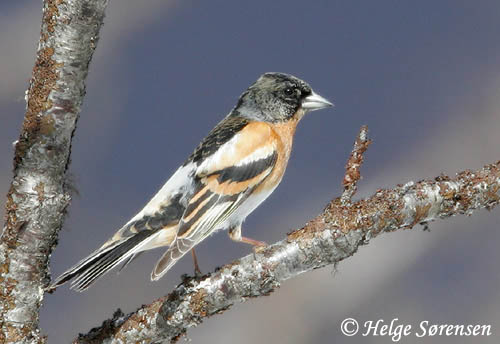
The Brambling is common finch in Europe and Asia. However, every year, small numbers are found in Alaska during migration, apparently after crossing the Bering strait from nearby Russia. Even smaller numbers will occasionally migrate further south through North America. They have reached several U.S. states. They can sometimes surprise a birder by popping up unexpectedly at a feeder. However, there have only been two documented cases of a Brambling in South Dakota (see SDOU's "Birds of South Dakota).
Habitat
Can be found in a variety of semi-open and brushy habitats or open woodlands during their unusual North American appearances. In their native range, they breed in northern forests and winter in woodlands and brushy fields.
Diet
Feeds on insects and seeds during the summer months. Feeds primarily on seeds during the winter.
Breeding
Non-breeder in South Dakota. In their breeding range, Bramblings typically nest in northern birch or coniferous forests, building a cup-shaped structure made of moss, lichen, and grass reinforced with wool or hair. These nests are usually placed in the fork of a tree branch, often at a significant height, to provide protection during their brief subarctic breeding season.
Song
A bold harsh dshweeee song. They also have a chek-chek-chek flight call.
Migration
Small numbers are found every year in Alaska during migration, just a short distance across the Bering Sea from their normal migration routes. Much smaller numbers have continued their southward migration on the North American side of the Pacific Ocean, and have reached many States in the continental U.S.
Interactive eBird Map
Click to access an interactive eBird map of Brambling sightings
Similar Species
Generally distinctive compared to native North American species. Some similarities in colors with the Common Chaffinch , another visitor from Europe.
Conservation Status
Common in its normal range. The IUCN considers the Brambling to be a species of "Least Concern". While they do not face major immediate threats, they can be affected by habitat fragmentation and extreme weather in their northern breeding grounds.
Further Information
Photo Information
Taken in Norway, May 2005 by Helge Sørensen
