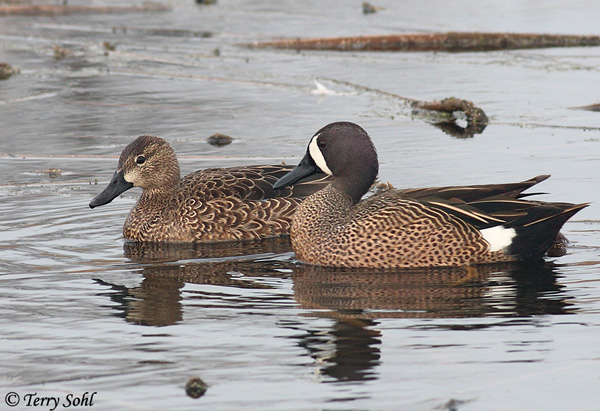
Blue-winged Teals are generally warm-season ducks, usually avoiding cold weather more than many other North American ducks. They are one of the latest arriving ducks in South Dakota, and one of the first migrants to leave in the fall. Large numbers may fly non-stop over open ocean to wintering grounds in South America. Despite the extremely different plumages of the males, Blue-winged Teals have been found to be almost genetically identical to the Cinnamon Teal. Females of the two species are extremely difficult to tell apart.
Habitat
During the summer breeding season, they are found in and around shallow freshwater ponds and marshes, where water is adjacent to upland grasses and herbaceous vegetation that they use for nesting. In migration they can be found on almost any fresh water habitat, from larger lakes to temporary watered areas like flooded fields and ditches.
Diet
Blue-winged Teal primarily eat plant material, including aquatic plants, seeds, and waste grain. They also eats crustaceans and insects, particularly females during summer breeding season.
Behavior
Forages in very shallow water, swimming with head submerged or picking items off the surface of the water. They are often found in small flocks along the water's edge.
Nesting
Late April through July. The nest of a Blue-winged Teal is a depression on the ground, lined with grasses and weeds, with a final layer of feathers and down. The female usually lays 8 to 13 eggs, and the female alone incubates them. The young leave the nest soon after hatching and find their own food, but the female will tend to them for about 3 weeks. The young fledge after about 6 weeks.
Song
Quack from females, with squeaky whistles or a louder chyerk from males.
- Click here to hear the assortment of calls from 2 males and 1 female interacting1
- Click here to hear the quacking call of a female2
Migration
Winters along southern U.S. coasts and down through Mexico, Central America, and South America.
Interactive eBird Map
Click to access an interactive eBird map of Blue-winged Teal sightings
South Dakota "Hotspot"
When you're out birding, look around. Is there water? Then you're likely in a Blue-winged Teal hotspot! They can be found in pretty much any location where shallow water is found, including the shallow margins of large lakes, wetlands and marshes, flooded fields, and wet ditches.
Similar Species
Male rather distinctive with face markings, but females are similar in appearance to many duck species. Some identification clues for females are subtle and difficult to see in field conditions. Identification by a nearby male mate is sometimes the safest way to distinguish them.
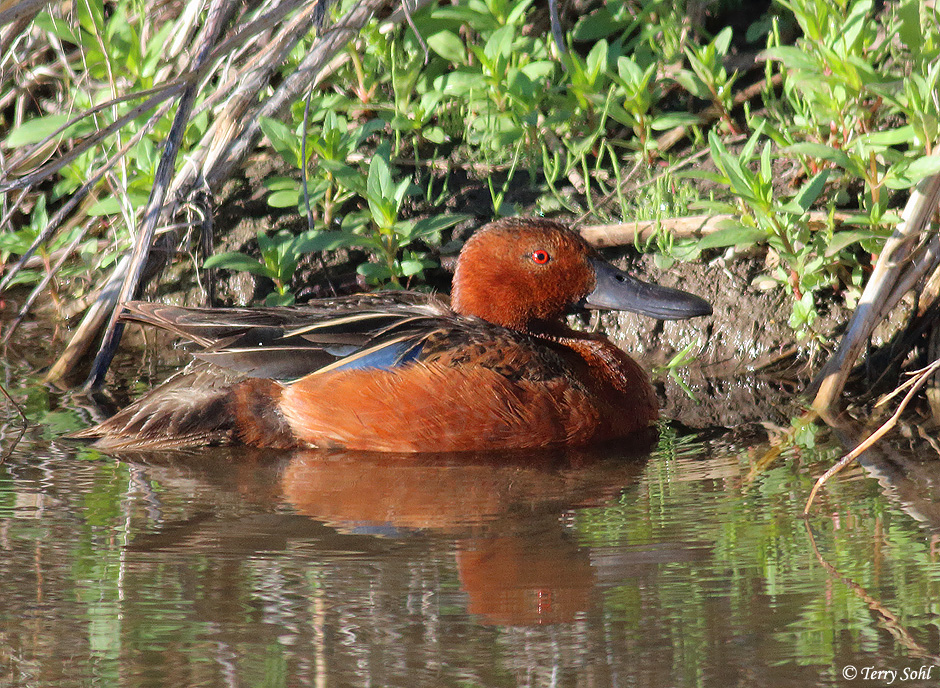
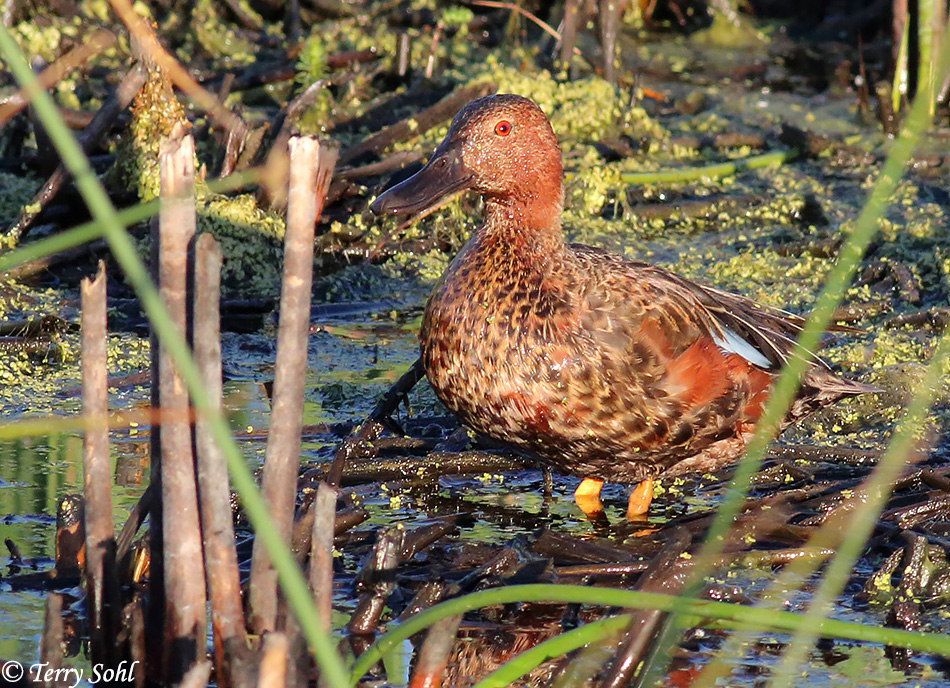
- Cinnamon Teal. - Females of both species are extremely similar and present a difficult identification challenge. Female Cinnamon Teal are "warmer" in color overall, and have a less strongly marked head, with less of a dark eyeline. Female Cinnamon Teal also display a less obvious white patch at the base of the bill of a female Blue-winged Teal. (Unfortunately I don't have any photos of female Cinnamon Teal, so the photos right below are of the male!)
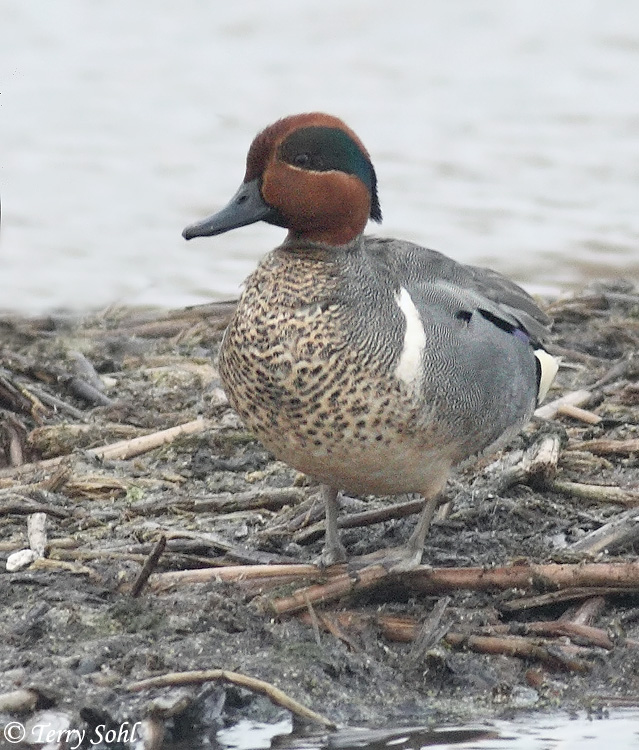
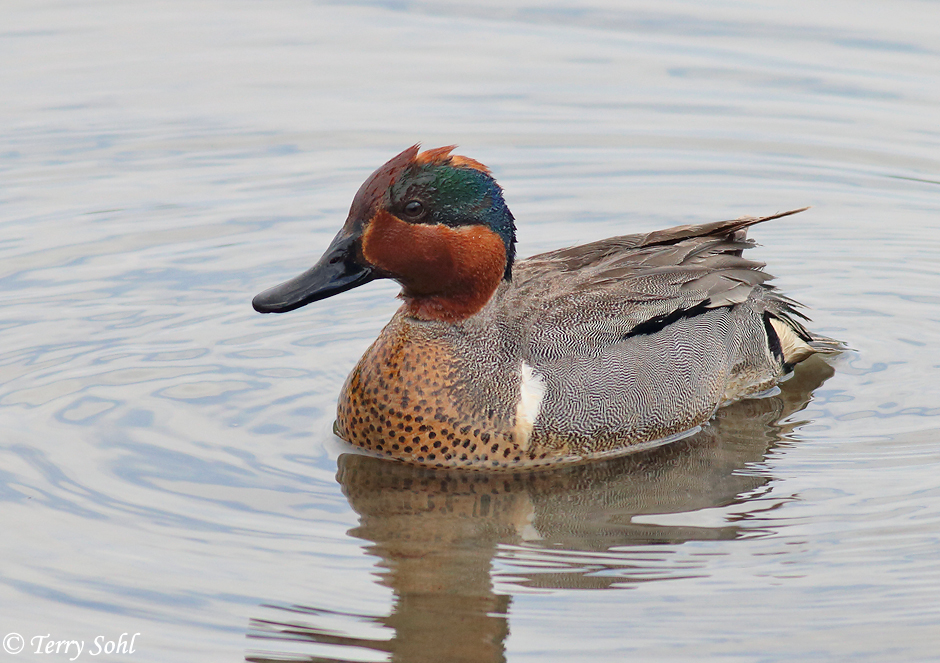
- Green-winged Teal - Again, females are similar in appearance. Green-winged Teal females are a bit smaller, but that's difficult to judge in the field. Green-winged Teal females look more "compact", with a shorter bill and smaller head, and they lack a lighter spot at the base of the bill that's found on female Blue-winged Teal. Female Green-winged Teal also have a creamy patch under their tail that can also be apparent as a "rump patch" while the bird is at rest and floating in the water. (again, unfortunately I only have photos of male Green-winged Teal below!)
 |
 |
 |
 |
| Cinnamon Teal | Cinnamon Teal | Green-winged Teal | Green-winged Teal |
Conservation Status
Blue-winged Teal have a very broad geographic distribution and are common within parts of that range. Overall populations are generally stable, although some surveys indicate . The IUCN lists the Blue-winged Teal as a species of "Least Concern".
Further Information
- eBird - Blue-winged Teal
- Audubon Field Guide - Blue-winged Teal
- Cornell Lab of Ornithology - All About Birds: Blue-winged Teal
Photo Information
March 31st, 2012 -- Minnehaha County near Sioux Falls -- Terry L. Sohl
Audio File Credits
- 1Andrew Spencer. Recorded in Burke County, North Dakota on June 8th, 2012. Original recording and information from xeno-canto.
- 2Paul Marvin. Recorded in Orange County, Florida on March 23rd, 2014. Original recording and information from xeno-canto.
