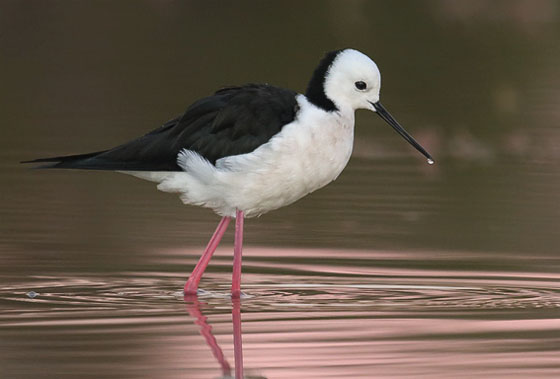
Depending on the source, the Black-winged Stilt may be a separate species from North America's Black-necked Stilt, or most stilt populations are simply different races of the same species. For those groups that consider all stilts to be one species, the usual name is this one, the Black-winged Stilt. Plumage is distinct from the Black-necked Stilt, and Black-winged Stilts are only extremely rare visitors to North America. The first bird was found on Nizki Island in the far western Aleutian Islands in 1983. Another single bird was found on St. George Island in 2003.
Habitat:
Found in a variety of shallow-water habitats, from wetlands, ponds and lakes, flooded farm fields, and coastal areas.
Diet:
Feeds heavily on aquatic insects, but will also take small crustaceans, mollusks, or other small invertebrates.
Behavior:
Forages by wading in shallow water, grabbing food items near the surface with their bill. They may also occasionally dip their head below the water in search of prey further below the water's surface.
Nesting:
The nest is variable, and can be a shallow scrape on the ground with a sparse lining of grasses or other materials, a more substantial nest of sticks, mud, shells, or other materials, or a floating mass of grasses, reeds, and other vegetation. The nest is placed near a water source. The female usually lays 3 or 4 eggs, and both parents help to incubate them. The young are fully capable of wading, walking, and swimming within 24 hours after hatching
Song:
Click here to access vocalizations of the Black-winged Stilt .
Migration:
Migratory status depends upon the local population. Many Black-winged Stilts found in warmer climates are full-time residents. Others that breed in more temperate or colder areas are strongly migratory, moving to lower latitudes or towards the coast for the winter months.
Interactive eBird map:
Click here to access an interactive eBird map of Black-winged Stilt sightings
Similar Species:
Conservation Status:
Populations are strong and generally stable. Particularly for those groups who classify all stilts as one species, they are found over an extremely large geographic range and are unlikely to face threats to their overall global population. The IUCN lists the Black-winged Stilt as a species of "Least Concern" .
Photo Information:
Photo taken by "Leo" - Photo licensed under Creative Commons Attribution NonCommercial ShareAlike 2.0 Generic license .
