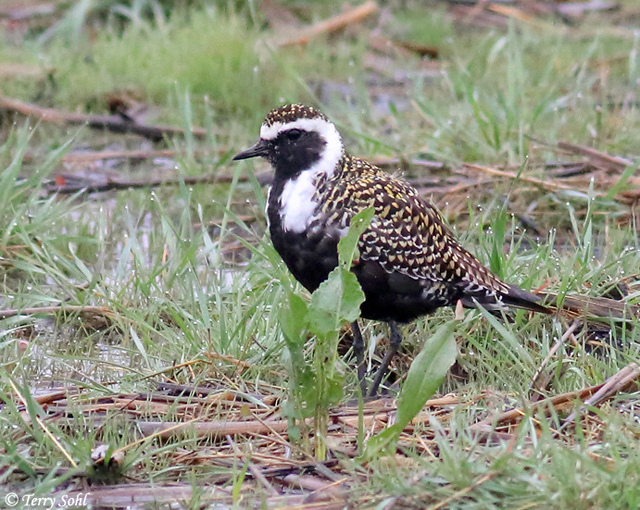
The American Golden Plover is one of the longest-distance migrants, summering on the Arctic Tundra, and wintering in southern South America. They are most commonly found in South Dakota during the spring migration, as most fall birds fly directly from eastern Canada to South America. However, small numbers are sometimes found during the fall migration in the state.
While large flocks can sometimes be seen during the spring migration, American Golden Plover were once much more common than it is presently. Hunting pressure in the 19th century and habitat loss since then have presented challenges for the species. Recent trends have again started to show a decline in overall numbers, although there are no serious conservation concerns yet.
Habitat
The American Golden-Plover breeds on the Arctic tundra, where it favors dry, open landscapes with low vegetation, mosses, lichens, and scattered wetlands. During migration, it frequents grasslands, agricultural fields, mudflats, prairies, shorelines, and other open habitats. On its wintering grounds in South America, it is commonly found in pampas, pastures, wetlands, and short-grass areas.
Diet
The American Golden-Plover feeds primarily on insects and other invertebrates, including beetles, grasshoppers, flies, spiders, worms, and crustaceans. During migration and winter, it also consumes berries, seeds, and other plant material. It typically forages by running across open ground and picking prey from the surface or probing shallowly into soil and mud.
Behavior
The American Golden-Plover is an active, alert shorebird that forages by running across open ground and stopping abruptly to pick up prey. During migration, it often occurs in flocks, especially in agricultural fields, grasslands, and coastal habitats. It is a strong long-distance migrant, undertaking some of the longest nonstop flights of any shorebird between Arctic breeding grounds and South American wintering areas.
Nesting
The nest of an American Golden Plover is a shallow scrape on the ground in the tundra, lined with mosses and other bits of vegetation. Three or four eggs are laid, tightly placed in a circle in the nest to aid retention of warmth. Males incubate the eggs during the day, while females incubate them at night. The young hatch after about 4 weeks.
Interactive eBird Map
Click to access an interactive eBird map of American Golden Plover sightings.
Song
The primary call is a loud, rich whistling quee-dol.
- Click here to hear the song an American Golden Plover
- Click here to hear the alarm call of an American Golden Plover
Migration
A long-distance migrant, summering in the Arctic Tundra, and wintering in South America. American Golden Plovers could be seen in either spring or fall migration in South Dakota, but they are generally more common in the spring.
Similar Species
American Golden Plovers are potentially confused with other plover species, including at least one that may also be found as a migrant in South Dakota.
- Black-bellied Plover - Both American Golden Plovers and Black-bellied Plovers may be found as migrants in South Dakota, although Black-bellied Plovers are less common. They are similar structurally and in size, and both have black underparts, a black face and throat, and heavily spotted upperparts. However a Black-bellied Plover lacks the golden color on the back of a breeding-plumaged American Golden Plover. Black-bellied Plovers also have white undertail coverts, compared to black undertail coverts on an American Golden Plover. In breeding plumage, the white pattern on the head and upper body is also different, with more extensive white on the head of a Black-bellied Plover.
- Pacific Golden-Plover - Pacific Golden Plovers are the most difficult species to differentiate from American Golden Plovers, but they are not found in South Dakota. Where the two species do overlap, both species in breeding plumage have black, white, and gold spotting on the back. The white on a Pacific Golden Plover's head, however, extends downward along the side of the body below the wing, while it stops at the top of the wing on an American Golden Plover. The undertail coverts of a Pacific Golden Plover are more spotted and multicolor with black and lighter colors, while those on an American Golden Plover are completely black.
South Dakota "Hotspot"
Numbers migrating through South Dakota seem to vary substantially from year to year. There's no reliable location to always find them, but they often are found in wet or flooded farm fields during the spring migration. They can also be found near shallow water with nearby mudflats.
Conservation Status
Populations were decimated due to 19th-century hunting pressures. Numbers have never recovered to historical levels, and diminishing habitat in their South American wintering grounds is possibly causing further declines, as systematic surveys record a declining trend in recent years. Despite the declines, populations still are relatively strong, they are found across a broad geographic area, and they are relatively common in parts of their range. The IUCN considers the American Golden Plover to be a species of "Least Concern".
Further Information
- eBird - American Golden Plover
- Audubon Field Guide - American Golden Plover
- Cornell All About Birds - American Golden Plover
Photo Information
Photo taken on May 12th, 2018 - Lincoln County, South Dakota - Terry Sohl
Audio File Credits
- Patrik Aberg. Recorded near Nome, Alaska on June 6th, 2017. Original recording and information available from xeno-canto.
- Frank Lambert. Recorded in Valdez-Cordova County, Alaska on June 8th, 2015. Original recording and information available from xeno-canto.
