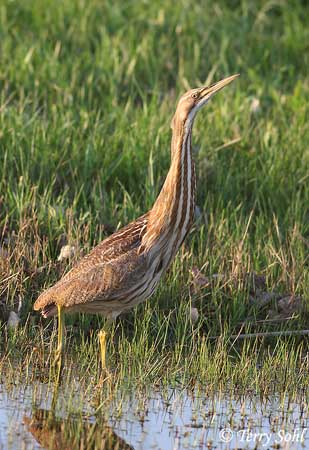
The American Bittern is more often heard than seen, with its loud booming cry heard for long distances late in the evening and at night. They inhabit large, vegetated wetland areas, usually slipping through the vegetation unseen. If startled on its summer breeding grounds, it will stand motionless with its head pointed upward, using its striped underparts to blend into the vegetation.
The plumage lends itself well to such a strategy during the spring months as they forage amongst the dead standing cattails from the prior growing season, but despite the color differences, the striping can also be surprisingly effective as camouflage amongst the green shoots of a new summer. During the winter months, they move to different habitats and generally abandon the "freeze" behavior.
Habitat
During the summer breeding season, American Bitterns use marshes and sloughs, lakes with emergent wetland vegetation around its shoreline. During the winter months, they can be found in areas where the waters don't freeze, and are often found in brackish wetlands near the coast.
Diet
Fish, aquatic insects, frogs, tadpoles, salamanders, crustaceans, small rodents, and small snakes and lizards.
Behavior
Will feed at any time of day or night. When feeding, they often stand motionless, blending in the vegetation and waiting for prey to approach, and then spearing it with a quick jab of their bill.
Nesting
June and July in South Dakota. Nesting is primarily done amongst the thick vegetation along a shallow water shoreline, such as in cattails or rushes. The nest is a mound of dead cattails and grasses, lined with finer grasses, elevated 6-12 inches above the water's surface. Two to seven eggs are laid, and are incubated by the female. Incubation takes 3 1/2 to 4 weeks.
Interactive eBird Map
Click to access an interactive eBird map of American Bittern sightings.
Song
Very unusual, booming oonka-oonka-oonka-oonka that carries for long distances.
- Click here to hear the booming "unka-lunka" song of an American Bittern, recorded in British Columbia.
- Click here to hear the calls of a flushed and disturbed bird in flight, recorded in Florida.
Migration
Summers throughout much of the U.S. and southern Canada. Winters near U.S. coasts, the extreme southern U.S., Mexico, and Central America.
Similar Species
Several species have a similar overall shape. However, plumage patterns and size generally make the American Bittern distinctive if it is seen well. If not seen well, they could potentially be confused with the following:
- Least Bittern - The most similar in overall appearance and plumage to American Bittern, Least Bittern are easily differentiated due to their much smaller size. They also have much less extensive and prominent vertical striping on their underparts compared to an American Bittern. Behavior is also an identification clue: American Bitterns tend to stand in shallow water or on adjacent shorelines. Least Bitterns often clamber amongst wetland vegetation by clinging to reeds and cattails with their feet.
- Black-crowned Night-Heron - Both can be found in South Dakota, both are often in the same habitat, and both have a somewhat similar size and shape. Adult Black-crowned Night-Herons are easily differentiated from American Bitterns, as they have a very clean plumage pattern with white underparts, compared to the heavily streaked American Bittern. Juvenile Black-crowned Night-Herons, however, are streaky underneath and could potentially be confused with an American Bittern. However, the streaks are generally finer on a Black-crowned Night-Heron, and the bill is noticeably shorter and thicker than that of an American Bittern.
South Dakota Hotspot
I've had a lot of luck finding American Bitterns in the expansive wetland areas in and around Lake Thompson. However, they could potentially be found in almost any wetland habitat with extensive wetland vegetation, as I've found them in flooded ditches with cattails, small ponds with wetland vegetation around the margins, or very extensive habitats like those near Lake Thompson.
Western Minnehaha County and the wetland complexes in the region are another area where I've seen them (or heard them) relatively often.
Status
Has declined in parts of its range due to habitat loss, especially in the southern end of its breeding range. However, American Bitterns are still found across a broad geographic area, and are common in many parts of their range. The IUCN considers the American Bittern a species of "Least Concern".
Further Information
- eBird - American Bittern
- Audubon Field Guide - American Bittern
- Cornell All About Birds - American Bittern
Photo Information
May 2nd, 2006 -- Near Tea in Lincoln County -- Terry Sohl
Audio File Credits
- Ian Cruickshank, XC160036. Accessible at www.xeno-canto.org/160036.
- Paul Marvin, XC172859. Accessible at www.xeno-canto.org/172859.
